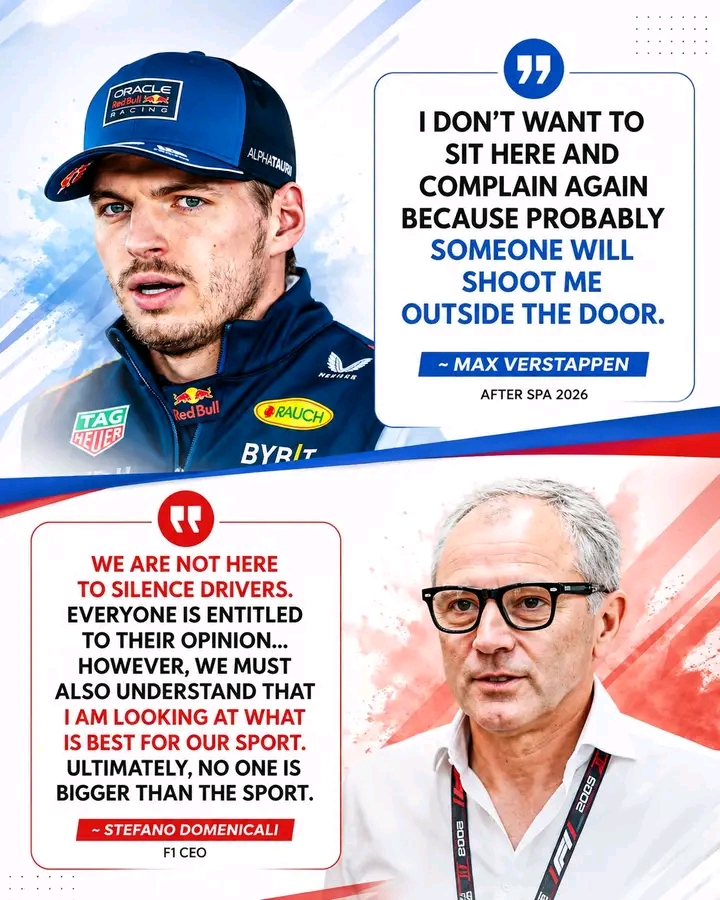
Formula 1 CEO Stefano Domenicali has responded to criticism from reigning world champion Max Verstappen, emphasizing that every driver has the right to express an opinion while making it clear that the sport itself must remain bigger than any individual competitor.
Domenicali’s comments add another layer to an increasingly important conversation surrounding Formula 1’s direction, particularly as the championship continues to grow globally and faces the challenge of balancing the interests of its biggest stars with the long-term vision of the sport.
Verstappen has never been known for holding back his opinions. Whether discussing racing regulations, stewarding decisions, sprint weekends, or the wider direction of Formula 1, the Red Bull driver has frequently spoken his mind. His willingness to challenge decisions has helped make him one of the most outspoken figures in the paddock.
But Domenicali’s latest response appears to underline an important message: while Formula 1’s drivers are central to the championship’s popularity, the sport cannot be built around one person.
DOMENICALI MAKES FORMULA 1’S POSITION CLEAR
Domenicali’s response can be interpreted as a reminder that Formula 1 is ultimately a collective sport involving 10 teams, 20 drivers, the FIA, promoters, fans, broadcasters and commercial partners.
The F1 CEO acknowledged that Verstappen, like every other driver, has the right to criticize aspects of the championship. However, the broader message was that individual opinions should be viewed within the context of Formula 1’s long-term development.
That distinction is particularly relevant because Verstappen’s influence extends far beyond his own team. As one of the biggest stars in modern motorsport, his comments can quickly become major headlines and influence how fans perceive the sport.
When a driver of Verstappen’s stature questions Formula 1’s direction, the reaction is naturally much greater than it would be if the same criticism came from a less prominent figure.
WHY MAX VERSTAPPEN’S CRITICISM CARRIES SO MUCH WEIGHT
Max Verstappen is not simply another driver on the grid.
The Dutchman has established himself as one of the defining personalities of the current Formula 1 era. His intense racing style, multiple championship victories and enormous global fan base give his opinions considerable weight.
Verstappen has also been vocal about changes to the sport that he believes could affect the quality of racing. In the past, he has expressed concerns about the increasing number of sprint events, the entertainment-driven direction of F1 and certain regulatory decisions.
From Verstappen’s perspective, criticism is often about protecting what he believes makes Formula 1 special. The driver has repeatedly made it clear that he values the competitive and technical side of the sport and wants the championship to maintain its identity as the pinnacle of motorsport.
That is why Domenicali’s response is significant. It represents a philosophical difference that Formula 1 may have to manage carefully in the coming years.
FORMULA 1 IS BIGGER THAN ANY SINGLE DRIVER
The central message behind Domenicali’s comments is simple: Formula 1 must continue to evolve even when individual drivers disagree with certain decisions.
That does not mean the opinions of drivers should be ignored. In fact, experienced competitors can provide valuable insight because they directly experience the effects of technical regulations, sporting rules and changes to the race weekend format.
However, Formula 1 also has to consider the wider picture.
The championship must attract new fans, keep existing supporters engaged, maintain commercial growth and ensure that teams remain financially competitive. It must also adapt to changing media habits and expand its presence in emerging markets.
This creates a difficult balancing act.
What is good for a driver may not always be good for the championship as a whole. Similarly, what increases the sport’s global popularity may not always be popular with traditional fans or the drivers themselves.
Domenicali’s position suggests that Formula 1 intends to listen to its stars without allowing any one individual to dictate the future of the championship.
THE VERSTAPPEN EFFECT COULD STILL SHAPE F1’S FUTURE
Even if Formula 1 insists that no driver is bigger than the sport, Verstappen’s influence cannot be underestimated.
The Red Bull star is one of the biggest attractions in the championship, and his presence has been central to the sport’s popularity during his era of dominance. His rivalry with other leading drivers has generated enormous attention, while his aggressive personality has helped create a strong connection with both supporters and critics.
That means F1 officials will always have to take his opinions seriously.
The key will be finding a balance between listening to drivers and maintaining a long-term strategy. If Formula 1 changes direction every time a major driver complains, the championship could lose consistency. But if officials completely dismiss concerns from the drivers, they risk creating unnecessary tension inside the paddock.
The best approach is likely to involve greater communication between the sport’s leadership, teams and drivers.
WHAT THIS MEANS FOR RED BULL AND MAX VERSTAPPEN
The comments also carry significance for Red Bull Racing.
Verstappen’s future and relationship with the team remain among the biggest storylines in Formula 1, particularly as the competitive landscape continues to change. If the Dutchman feels that the championship is moving in a direction he does not enjoy, his dissatisfaction could become a factor in future career decisions.
For Red Bull, keeping Verstappen motivated will be essential.
The team needs to provide him with a competitive car, but it must also understand what Verstappen wants from the sport itself. If his concerns are purely about performance, technical development can address some of them. If his concerns involve the fundamental direction of Formula 1, however, the conversation becomes much more complicated.
This is where Domenicali’s comments could become particularly relevant.
Formula 1 may be willing to listen to Verstappen, but it is unlikely to give any single driver complete control over its future.
THE CHAMPIONSHIP BATTLE COULD ADD EVEN MORE PRESSURE
The timing of any disagreement between Verstappen and Formula 1 leadership can also matter.
When a driver is fighting for a championship, frustrations are naturally amplified. Decisions involving penalties, regulations, race formats and stewarding can feel more significant when every point could determine the title outcome.
As competition becomes closer, the pressure on drivers and teams increases. A controversial decision that might otherwise be forgotten can suddenly become part of a championship narrative.
For Verstappen, maintaining focus will be crucial. His ability to convert criticism into performance has been one of his defining characteristics, but the Red Bull driver will also need to ensure that disagreements outside the cockpit do not distract from his primary objective: winning races and championships.
WHY THIS DEBATE MATTERS FOR F1 FANS
At its heart, this is not simply a disagreement between a Formula 1 CEO and a world champion.
It represents a much larger debate about what Formula 1 should become.
Should the championship prioritize traditional racing values above everything else? Should it continue expanding its entertainment offering? Should drivers have a greater influence over sporting decisions? Or should F1 leadership focus on growing the sport while preserving its competitive integrity?
There are reasonable arguments on both sides.
Traditional fans may agree with Verstappen when he questions certain changes, while newer audiences may welcome innovations designed to make race weekends more accessible and entertaining.
Formula 1’s challenge is finding a middle ground.
The sport cannot remain frozen in time, but it also cannot change so dramatically that it loses the characteristics that made it successful in the first place.
MY PREDICTION FOR THE VERSTAPPEN AND F1 RELATIONSHIP
The most likely outcome is that this disagreement will remain a war of words rather than become a serious conflict.
Verstappen will probably continue to speak openly whenever he disagrees with a decision, while Domenicali and Formula 1 will continue pursuing the championship’s broader commercial and sporting strategy.
That may actually be healthy for the sport.
Formula 1 benefits from strong personalities, and Verstappen’s willingness to challenge the establishment adds another layer to the championship. The key is ensuring that criticism remains constructive and that disagreements do not damage the relationship between the sport’s leadership and its most important competitors.
Ultimately, Domenicali’s message is unlikely to silence Verstappen. If anything, it reinforces the idea that Formula 1 is entering a period where its biggest stars will increasingly debate the direction of the championship.
And that conversation is likely to continue for years.
FINAL THOUGHTS
Stefano Domenicali’s response to Max Verstappen highlights a fundamental reality of modern Formula 1: drivers can be the face of the sport, but no individual can represent the entire championship.
Verstappen has every right to criticize decisions he disagrees with, and Formula 1 should take those opinions seriously. At the same time, the sport must consider the interests of teams, fans, promoters and its global audience when making decisions about its future.
The real challenge for Domenicali and F1 leadership will be finding the right balance between evolution and tradition.
As Formula 1 continues to grow, the voices of its biggest stars will remain powerful. But the long-term success of the championship will depend on whether those voices can coexist with a broader vision for the sport.
What do you think? Should Formula 1 listen more closely to Max Verstappen’s criticism, or is Stefano Domenicali right that the sport must always be bigger than any one driver? Share your opinion in the comments below.