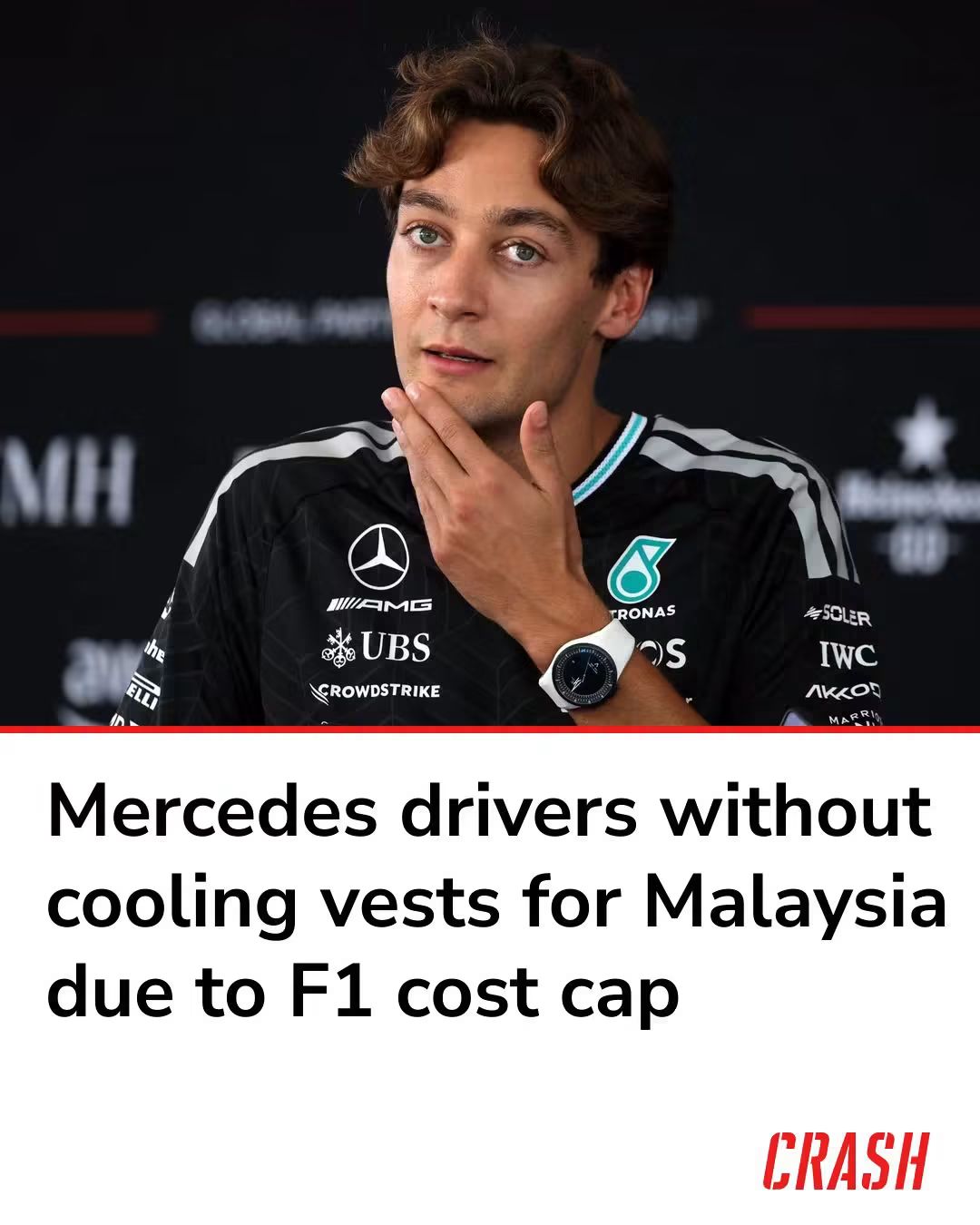
Formula 1’s return to Sepang this weekend has turned into a brutal test of human endurance for Mercedes, and not just because of the scorching Malaysian climate. George Russell and Kimi Antonelli will line up for the relocated Bahrain Grand Prix without the cooling vests that many of their rivals will rely on to survive cockpit temperatures that can climb toward 60°C. The reason is not a technical failure or a personal preference. It is the sport’s cost cap.
Mercedes has chosen to put limited development resources into the car rather than into making the driver cooling system reliable enough for race conditions. That decision places the Silver Arrows drivers at a clear physical disadvantage in one of the hottest events of the 2026 season.
WHY SEPANG HAS BECOME A HEAT HAZARD THIS WEEKEND
The Bahrain Grand Prix was moved to Malaysia’s Sepang International Circuit because of ongoing conflict in the Middle East. The FIA has officially classified the event as a heat hazard. Track temperatures already hit around 61°C in practice, and ambient conditions remain high and humid. Inside the closed cockpit of a modern Formula 1 car, the combination of engine heat, solar load, and restricted airflow routinely pushes the environment to extreme levels.
Cooling vests were introduced as a response to earlier heat crises, most notably the 2023 Qatar Grand Prix that left several drivers in medical distress. Under current rules, teams must install the necessary hardware when a heat hazard is declared. Drivers can then choose to wear the liquid-cooled vest or carry five kilograms of ballast instead so that no one gains a weight advantage by skipping the system. The vest is designed to extract heat from the driver’s body and has proven effective when properly engineered.
Mercedes, however, has not invested enough to make its version robust. Russell has been open about the situation. The team told him the resources required to develop a reliable system would come at the direct expense of car performance under the $215 million cost cap. Faced with that trade-off, Mercedes prioritized upgrades to the W17.
THE REAL IMPACT OF THE COST CAP ON DRIVER SAFETY
The cost cap was introduced to level the financial playing field and stop the wealthiest teams from spending their way to dominance. In many ways it has worked. The gap between the front and midfield has narrowed, and smaller teams have become more competitive. Yet this weekend exposes an unintended consequence: safety and driver welfare equipment that requires meaningful engineering effort still sits inside the same restricted budget as aerodynamic development.
Russell has argued that cooling systems should sit outside the cost cap, either through an FIA-funded allowance or a standardized external supplier that every team can access without dipping into its own development pot. “We should all be wearing the vest. When it works, it works great,” he said. His call is practical rather than radical. Driver salaries are already exempt from the cap. Making a piece of equipment that protects drivers from medical risk similarly exempt would remove the perverse incentive to choose performance over physiology.
The physical toll is not theoretical for Russell. After the 2024 Singapore Grand Prix he hyperventilated in an ice bath and had lost roughly four kilograms during the race. Singapore follows Malaysia on the calendar, meaning the same decision will likely affect him again next weekend. For a driver chasing every point in a tight championship fight, the cumulative fatigue of racing without cooling support could become decisive.
HOW THIS AFFECTS THE TITLE FIGHT AND THE WIDER SPORT
Mercedes arrives in Malaysia with a significant upgrade package aimed at keeping its championship challenge alive. Kimi Antonelli currently leads the drivers’ standings, with Russell not far behind. Every tenth of a second and every ounce of driver concentration matters. By carrying ballast instead of a working cooling system, the Mercedes drivers start the race heavier and less comfortable than many of their rivals. In a high-humidity, high-temperature environment, that disadvantage compounds over a full race distance.
The broader industry implication is more important than one weekend’s result. Formula 1 markets itself as a technological pinnacle that also prioritizes safety. When teams are forced to choose between making the car faster and keeping the driver from overheating, the message is mixed. Rival teams that have already invested in reliable cooling systems gain both a physical and a psychological edge. Drivers who have previously suffered in extreme heat may approach these races with extra caution, altering strategy and risk-taking.
There is also a fairness question. Midfield teams with tighter budgets face the same dilemma but with less margin for error. If the cost of a properly engineered cooling system becomes a competitive differentiator, the original goal of the cost cap is partially undermined. Safety equipment should not be a luxury item that only well-resourced development programs can afford to perfect.
WHAT NEEDS TO CHANGE BEFORE THE NEXT HEAT HAZARD
The solution does not require reinventing the cost-cap framework. The FIA could designate driver cooling systems as an exempt category for the remainder of the season or mandate a single standardized supplier whose costs are shared or subsidized. Either approach would remove the zero-sum calculation teams currently face. It would also align the regulations more closely with the spirit of the heat-hazard protocol, which exists precisely to protect drivers when conditions become dangerous.
Until that happens, Mercedes will continue to race its drivers in conditions Russell has compared to sitting in an oven. The team’s decision is understandable within the current rules. It is also a clear signal that the rules need adjustment. Performance and safety should not be forced into direct competition under a single spending limit.
This weekend in Malaysia will test more than car setup and strategy. It will test how far the sport is willing to push its drivers when the budget sheet and the thermometer pull in opposite directions. The answer will shape not only the championship battle but the credibility of Formula 1’s commitment to driver welfare in an era of extreme climate and extreme regulation.