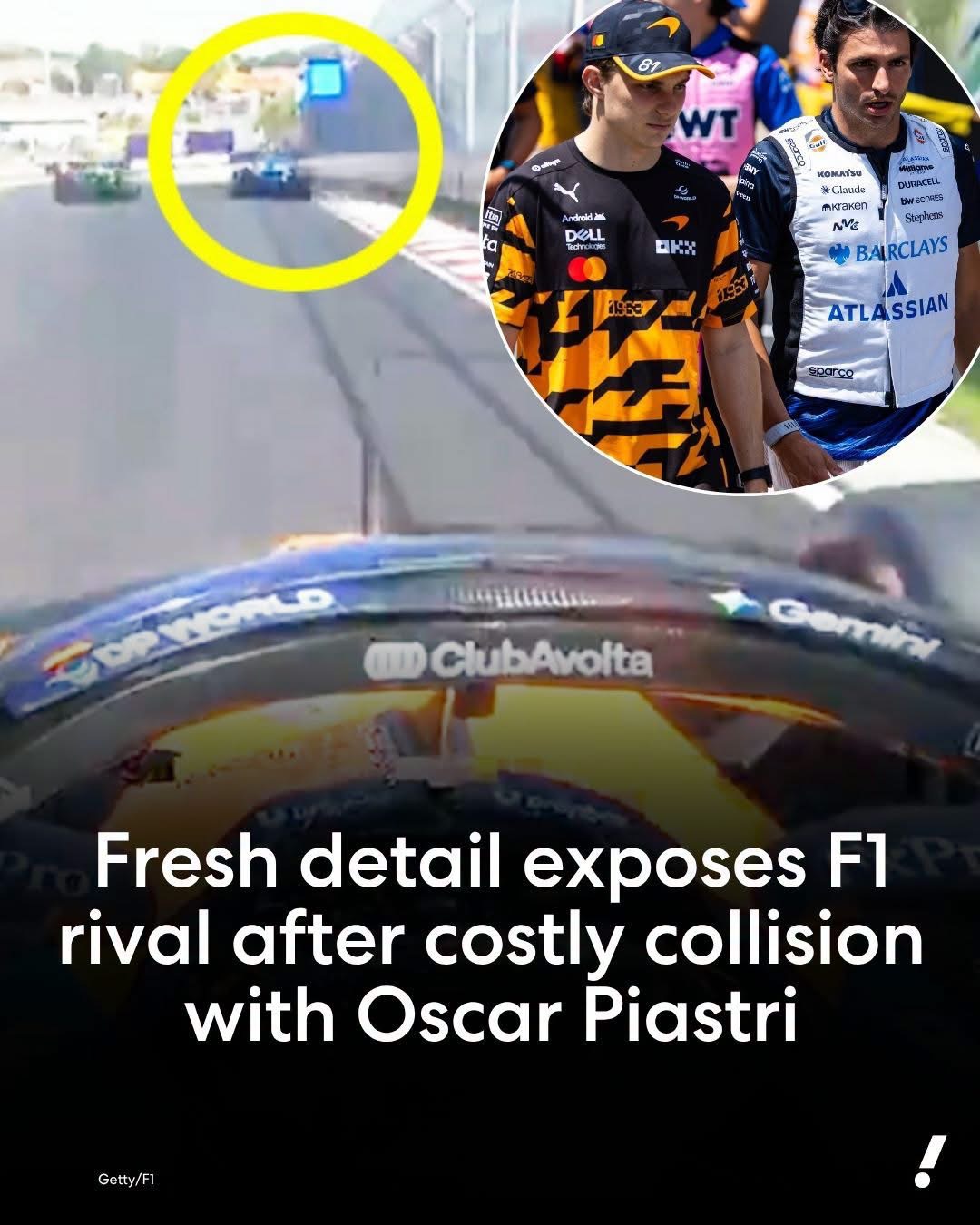
Oscar Piastri’s Hungarian Grand Prix disappointment continues to dominate Formula 1 headlines after new details from the FIA stewards’ report cast fresh doubt on Carlos Sainz’s explanation for the race-altering collision. While the Williams driver has maintained that he was unaware the McLaren was alongside him due to blue flag system issues, official findings have revealed information that has reignited debate across the paddock.
The incident not only cost Piastri a realistic chance of victory but also dealt a significant blow to his championship aspirations. As more evidence emerges, attention has shifted from the collision itself to whether communication failures, driver awareness, or race management procedures were ultimately responsible for one of the season’s most controversial moments.
PIASTRI’S PROMISING AFTERNOON ENDED IN DISASTER
McLaren appeared to have another race-winning car at the Hungaroring, with Piastri firmly in contention after executing a strong strategy during the opening stages of the race.
Following his second pit stop, the Australian rejoined the circuit in traffic but remained within striking distance of the leaders. His race, however, unraveled when he caught Carlos Sainz, who had already been lapped and was battling near the back of the field.
As Piastri attempted to pass, contact between the two cars damaged the McLaren. Although the Australian continued briefly, a gearbox failure later forced him into retirement, turning what could have been a valuable haul of championship points into a costly DNF.
With every race becoming increasingly important in the title battle, the retirement could have long-term consequences for McLaren’s championship campaign.
SAINZ INSISTED HE NEVER SAW THE MCLAREN
Immediately after the incident, Carlos Sainz told his team over the radio that he had no idea Oscar Piastri was alongside him.
The Spaniard later repeated that explanation publicly, claiming that technical issues affecting the blue flag system, combined with the McLaren sitting in a blind spot, contributed to the unfortunate collision.
His explanation initially appeared reasonable given widespread reports that electronic blue flag notifications were malfunctioning throughout the race.
However, subsequent findings have complicated that narrative.
STEWARDS REPORT ADDS A NEW TWIST
One of the most significant developments came from the FIA stewards’ documentation released after the race.
According to the official report, Sainz had already been informed over team radio that Piastri’s McLaren was approaching before the collision occurred. Television footage also appeared to show blue warning lights flashing at multiple marshal posts as the championship contender closed in.
Those details have led many observers to question whether the Williams driver had sufficient warning to avoid the incident despite the electronic system malfunction.
The FIA ultimately issued Sainz a five-second time penalty, although many fans and analysts argued that the sanction did little to reflect the enormous consequences suffered by Piastri.
While the penalty settled the sporting regulations, it has done little to end the wider debate.
OLIVER BEARMAN CONFIRMS BLUE FLAG CONFUSION WAS REAL
Despite growing scrutiny surrounding Sainz’s explanation, fellow driver Oliver Bearman provided important context by confirming that the blue flag system genuinely caused confusion throughout the Hungarian Grand Prix.
Bearman explained that drivers began receiving unexpected blue flag warnings unusually early in the race, creating uncertainty over which notifications required immediate action.
Instead of displaying individual car numbers, several warnings reportedly appeared as generic blue flag alerts, forcing drivers to rely heavily on radio communication from their engineers.
Bearman himself received a five-second penalty for failing to react quickly enough to one blue flag situation, reinforcing the argument that race control’s technical problems affected multiple competitors rather than a single driver.
His comments suggest the incident was not simply about one mistake but also highlighted weaknesses within Formula 1’s communication systems.
PIASTRI REFUSES TO ACCEPT THE EXPLANATION
While others have acknowledged the technical complications, Oscar Piastri remains unconvinced.
The normally reserved Australian described the incident as one of the most frustrating moments of his Formula 1 career, making it clear that he believes there was no acceptable justification for the collision.
From Piastri’s perspective, traditional marshal flags, flashing light panels, team communication, and simple situational awareness should have provided enough warning for any experienced Formula 1 driver.
His unusually emotional response reflected the magnitude of the opportunity that disappeared in an instant.
For a driver known for measured, analytical interviews, the strength of his criticism demonstrated just how deeply the incident affected him.
THE INCIDENT EXPOSES A BIGGER PROBLEM FOR FORMULA 1
Beyond assigning blame, the Hungarian Grand Prix has exposed broader questions about Formula 1’s race management systems.
Modern Formula 1 depends heavily on electronic communication between race control, teams, and drivers. When those systems fail, even briefly, confusion can spread rapidly across the field.
Although physical blue flags and marshal lights remain part of the regulations, today’s drivers have become increasingly accustomed to receiving detailed digital information directly through their steering wheel displays and team radio.
The Budapest controversy has highlighted the importance of having multiple reliable layers of communication, especially when championship contenders are attempting to lap slower traffic.
Several teams are now expected to push for a comprehensive review of the blue flag procedures before racing resumes after the summer break.
CHAMPIONSHIP IMPLICATIONS COULD PROVE DECISIVE
While one collision rarely determines an entire Formula 1 season, every retirement carries enormous weight in an increasingly competitive championship.
Instead of leaving Hungary with valuable points, Piastri watched his title rivals strengthen their positions while McLaren lost ground in both the Drivers’ and Constructors’ Championships.
With Mercedes, Ferrari, and Red Bull continuing to capitalize on every opportunity, McLaren cannot afford many more setbacks if it hopes to remain firmly in contention.
The team will undoubtedly spend the summer break analyzing every detail of the Hungarian weekend—not only the collision itself but also the reliability issues that ultimately ended Piastri’s race.
THE CONTROVERSY IS UNLIKELY TO DISAPPEAR ANYTIME SOON
Although the FIA has issued its verdict, the conversation surrounding the incident is far from over.
The combination of conflicting driver accounts, technical failures, official radio evidence, and differing opinions across the paddock has made the Hungarian Grand Prix one of the season’s defining controversies. It also serves as a reminder that in Formula 1, success often depends as much on flawless communication and race management as it does on outright speed.
For Oscar Piastri, the focus now shifts to recovering lost ground when the championship resumes. For Carlos Sainz, questions about the collision may continue to follow him for several races. And for Formula 1 itself, the events in Hungary could accelerate discussions about improving blue flag technology and ensuring that a similar incident does not influence another championship battle.