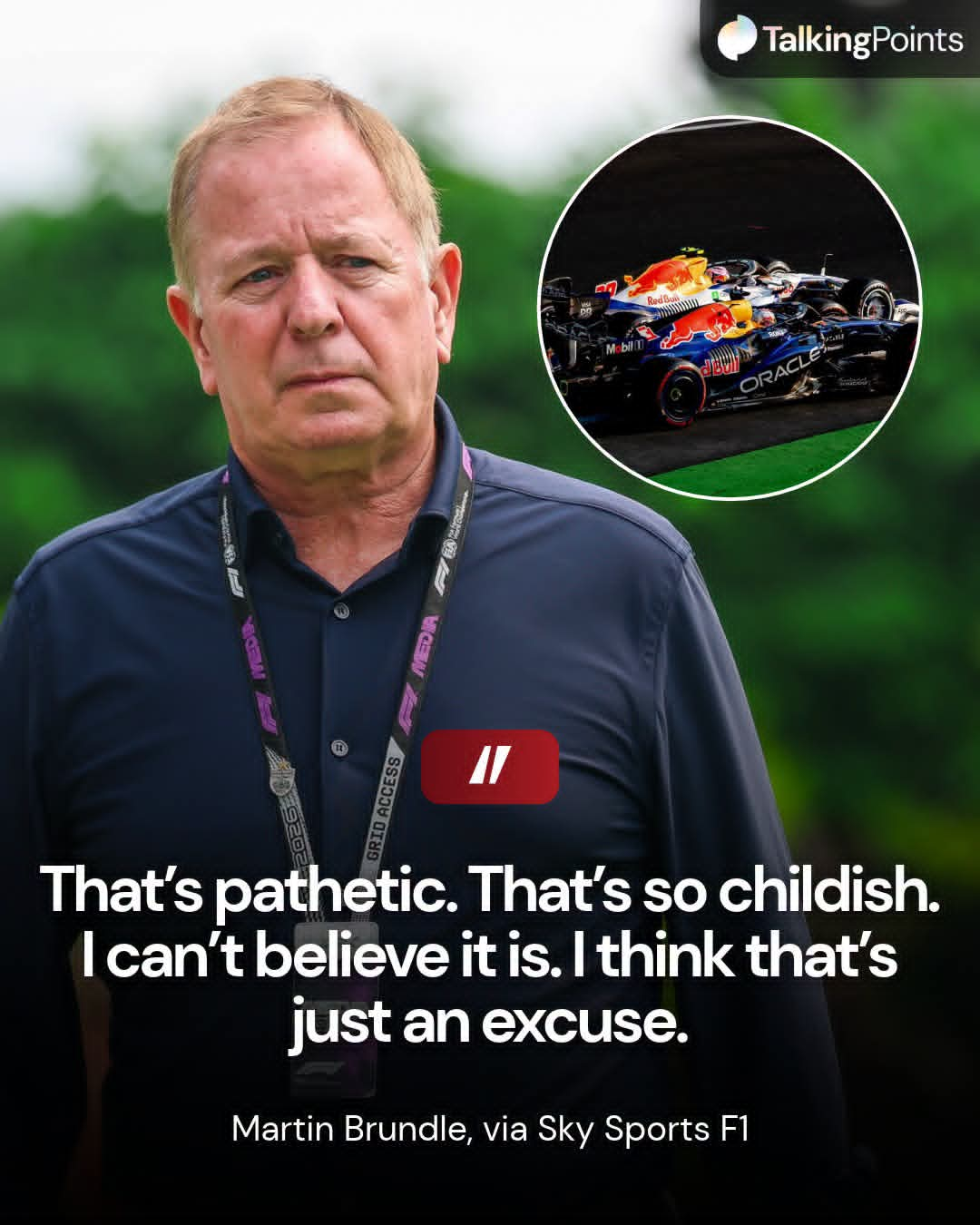
Martin Brundle does not mince words. The Sky Sports F1 commentator and former Grand Prix winner has made it clear that using Liam Lawson’s practice collision with Max Verstappen in Mexico City as grounds to drop the New Zealander from Racing Bulls would be both pathetic and childish.
That blunt assessment cuts through the usual paddock politeness and forces a harder look at how Red Bull manages its junior programme, what performance actually means in the midfield, and whether short-term optics still outweigh consistent results when driver seats are decided.
WHAT ACTUALLY HAPPENED IN MEXICO CITY FP2
During second practice at the Autódromo Hermanos Rodríguez, Verstappen and Lawson came together in the stadium section. Verstappen was on a preparation lap. Lawson was cooling down ahead of another push. They ran side-by-side through multiple corners. Contact followed. Debris forced a red flag. Both cars sustained damage.
The stewards reviewed the footage and data, spoke to both drivers, and handed each a one-place grid penalty plus a penalty point on their super licences. Both men admitted the moves were unnecessary and clumsy. The stewards noted a prior warning about practice conduct and chose to escalate beyond a simple reprimand.
Verstappen was characteristically direct afterwards, calling Lawson’s behaviour “not very smart” and linking it to the pressure of fighting for a seat. Lawson later sought Verstappen out to apologise, describing the incident as something that simply did not need to happen.
It was messy, avoidable, and entirely typical of the intensity that still flares even in free practice when two drivers refuse to yield. It was not, however, a career-defining moment of recklessness.
WHY BRUNDLE’S REACTION MATTERS
Brundle’s criticism lands because he has lived the other side of these decisions. He knows how quickly teams can invent justifications when the real reasons are longer-term planning, commercial considerations, or simply the desire to open a seat for the next junior in the pipeline.
He has praised Lawson’s 2026 season as a tremendous job. The New Zealander has regularly been the highest-placed driver outside the established top four teams and has contributed to Racing Bulls’ strongest constructors’ challenge in years. Dropping him solely because of one clumsy practice exchange with the four-time champion would, in Brundle’s view, be an excuse rather than a genuine evaluation.
That distinction is important. Red Bull has never been sentimental about its drivers. The organisation’s history is full of rapid promotions and equally rapid demotions. Lawson himself experienced that first-hand when he was moved out of the senior team after a difficult start to a previous campaign. The difference this time is that the on-track evidence no longer supports a performance-based case against him.
THE REAL PRESSURE ON RACING BULLS’ LINE-UP
Three names are in the mix for two seats in 2027: Lawson, current teammate Arvid Lindblad, and Formula 2 contender Nikola Tsolov. Tsolov received an FP1 outing in Mexico as part of the team’s junior development commitments. Lindblad has shown flashes of genuine speed as a rookie. Lawson has delivered the most consistent points-scoring form.
The tension is structural. Racing Bulls exists both as a competitive midfield outfit and as a finishing school for Red Bull. When those two roles conflict, the finishing-school priority often wins. Promoting a highly rated junior who still needs race experience can make long-term sense even if it means sidelining a driver who is currently delivering more. The question is whether the team is honest about that motivation or whether it reaches for convenient narratives.
Using a practice clash as the public reason would be the weakest possible justification. It would also send a damaging message to every driver in the Red Bull system: that standing your ground against the senior team’s star, even in free practice, can cost you your career.
IMPACT ON THE DRIVERS AND THE TEAM
For Lawson the uncertainty is already corrosive. He has spoken openly about not knowing what more the organisation wants to see from him. Strong results have not produced the clarity most drivers would expect at this stage of the season. That kind of prolonged ambiguity affects focus, confidence, and the ability to plan a future beyond the current contract.
For Lindblad and Tsolov the situation is different but equally high-stakes. Both need race seats to keep developing. A decision that prioritises youth and long-term potential over current form would accelerate their paths while simultaneously raising the bar for what any “experienced” midfield driver must achieve to stay relevant inside the Red Bull ecosystem.
For Racing Bulls itself the choice carries sporting consequences. The team has shown it can fight for fifth in the constructors’ championship when both cars are scoring regularly. Introducing a new driver always carries a performance risk, particularly late in a season when the remaining races still matter for prize money and prestige. Stability has value. So does the clear performance benchmark Lawson currently provides.
BROADER LESSONS FOR FORMULA 1’S DRIVER MARKET
This episode sits inside a larger pattern. Midfield seats have become harder to hold because junior programmes are more structured and more aggressive than they were a decade ago. Teams now plan multiple seasons ahead. A driver who is merely “very good” rather than “exceptional and young” can find himself surplus to requirements even after delivering solid results.
Brundle’s intervention is a useful counterweight. It reminds observers that not every decision needs a dramatic on-track justification. Sometimes the real reasons are colder and more strategic. Pretending otherwise only muddies the conversation.
The Mexico City incident was clumsy. Both drivers accepted that. It does not define Lawson’s season, nor should it decide his future. If Red Bull ultimately chooses to promote Tsolov or retain Lindblad over Lawson, the organisation should own the longer-term rationale rather than lean on a single practice collision that both parties have already moved past.
Anything less would, as Brundle put it, look exactly like what it is: an excuse.