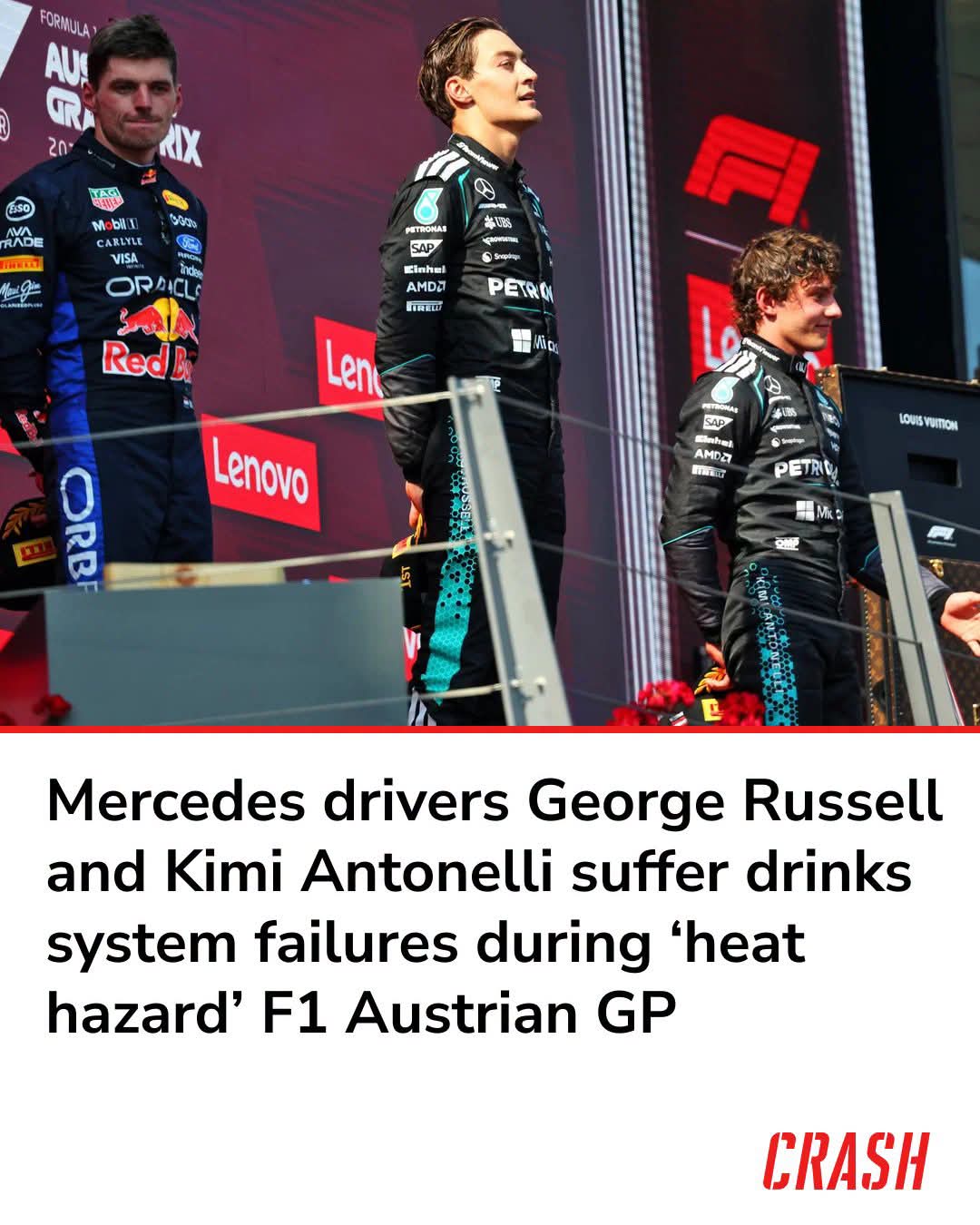
George Russell’s triumph at the 2026 Austrian Grand Prix became even more remarkable after Mercedes confirmed that both he and teammate Andrea Kimi Antonelli completed the race without functioning drinks systems in one of the hottest Formula 1 events of the season. In temperatures exceeding 35°C at the Red Bull Ring, Mercedes not only battled fierce competition from Red Bull and Ferrari but also had to cope with an unexpected technical issue that turned an already demanding afternoon into a severe physical test.
Russell eventually converted his controversial pole position into his second victory of the season, while Antonelli fought through the same problem to secure a podium finish. Their performances highlighted not only Mercedes’ improving competitiveness but also the extraordinary physical endurance required to succeed under extreme racing conditions.
EXTREME HEAT TURNED AUSTRIAN GP INTO A SURVIVAL TEST
The FIA had already classified the Austrian Grand Prix as a “heat hazard” event before the weekend began due to soaring temperatures caused by the ongoing European heatwave. Under Formula 1 regulations, races where ambient temperatures exceed 31°C receive special safety consideration, allowing teams to equip drivers with cooling systems designed to reduce the risk of overheating.
With track temperatures rising throughout Sunday’s 71-lap contest, hydration became one of the biggest factors affecting driver performance. Long periods spent inside Formula 1 cockpits regularly expose drivers to temperatures well above the surrounding air, making proper hydration critical for maintaining concentration, reaction times, and physical endurance.
Unfortunately for Mercedes, neither Russell nor Antonelli could rely on their onboard drinks systems when they needed them most.
MERCEDES SUFFERS DOUBLE DRINKS SYSTEM FAILURE
Despite executing an excellent race strategy, Mercedes faced an unexpected setback when both of its cars developed identical drinks system failures during the Grand Prix.
After taking the checkered flag, Russell informed the team over radio that his hydration system had stopped working.
“Drink system failed. Nice race for it to do so… I’m a little bit thirsty,” Russell joked after completing one of the toughest races of the season.
The problem was not isolated to Russell’s car. During the post-race cooldown room, Antonelli revealed that his own drinks system had also failed during the race, forcing him to complete the demanding event without access to water.
Meanwhile, Max Verstappen humorously noted that even though his own drinks system functioned, the liquid inside had become so hot that it resembled “tea” rather than a refreshing drink.
The comments offered a glimpse into just how brutal conditions had become inside the cockpit.
RUSSELL DELIVERS WHEN MERCEDES NEEDED HIM MOST
Mechanical inconveniences did little to distract Russell from producing one of his strongest performances of the campaign.
After securing pole position in dramatic circumstances following Max Verstappen’s qualifying crash, Russell controlled the race brilliantly, managing tyre degradation, strategy, and relentless pressure from behind.
His victory marked an important response following several inconsistent weekends earlier in the season and significantly strengthened his position in the championship battle.
Speaking after the race, Russell credited Mercedes for continuing to improve the car despite difficult periods earlier in the year.
He admitted the recent struggles had tested his confidence but believed the Austrian weekend proved both he and the team remained capable of winning races when everything came together.
The timing could hardly have been better, with Silverstone now looming as another major opportunity for Mercedes to build momentum.
ANTONELLI CONTINUES TO IMPRESS DESPITE ADVERSITY
Although Russell celebrated victory, Antonelli once again demonstrated why he remains the championship leader.
The young Italian fought through the same hydration issues while maintaining impressive pace throughout the race to secure another valuable podium finish.
His consistency has become one of the defining stories of the 2026 season. Even when circumstances work against him, Antonelli continues delivering points that strengthen his title challenge.
Mercedes will be encouraged that both drivers showed excellent physical resilience under extreme conditions. However, the simultaneous drinks system failures will almost certainly trigger a detailed internal investigation before the British Grand Prix.
Reliability extends beyond engines and aerodynamics; driver comfort systems become increasingly important during physically demanding races, particularly as Formula 1 continues expanding into hotter climates.
WHAT THIS MEANS FOR THE CHAMPIONSHIP
Russell’s victory provides a significant boost to both his confidence and Mercedes’ title ambitions. While Antonelli remains ahead in the standings, the gap between the two teammates has narrowed, adding another fascinating dimension to the intra-team battle.
Ferrari, despite showing encouraging pace throughout the Austrian weekend, ultimately had to settle for another podium without converting its improved qualifying performance into victory. Red Bull, meanwhile, continues searching for consistency after Verstappen’s difficult qualifying session left him recovering rather than fighting from the front.
The Austrian Grand Prix also reinforced how fine the margins have become among Formula 1’s leading teams. Small operational details, strategic decisions, reliability issues, and even functioning drinks systems can influence the outcome of races.
As Formula 1 heads to Silverstone next, Mercedes appears to have rediscovered genuine race-winning pace. If the team can eliminate reliability concerns while maintaining its recent performance gains, the battle for both championships could become considerably tighter over the second half of the season.