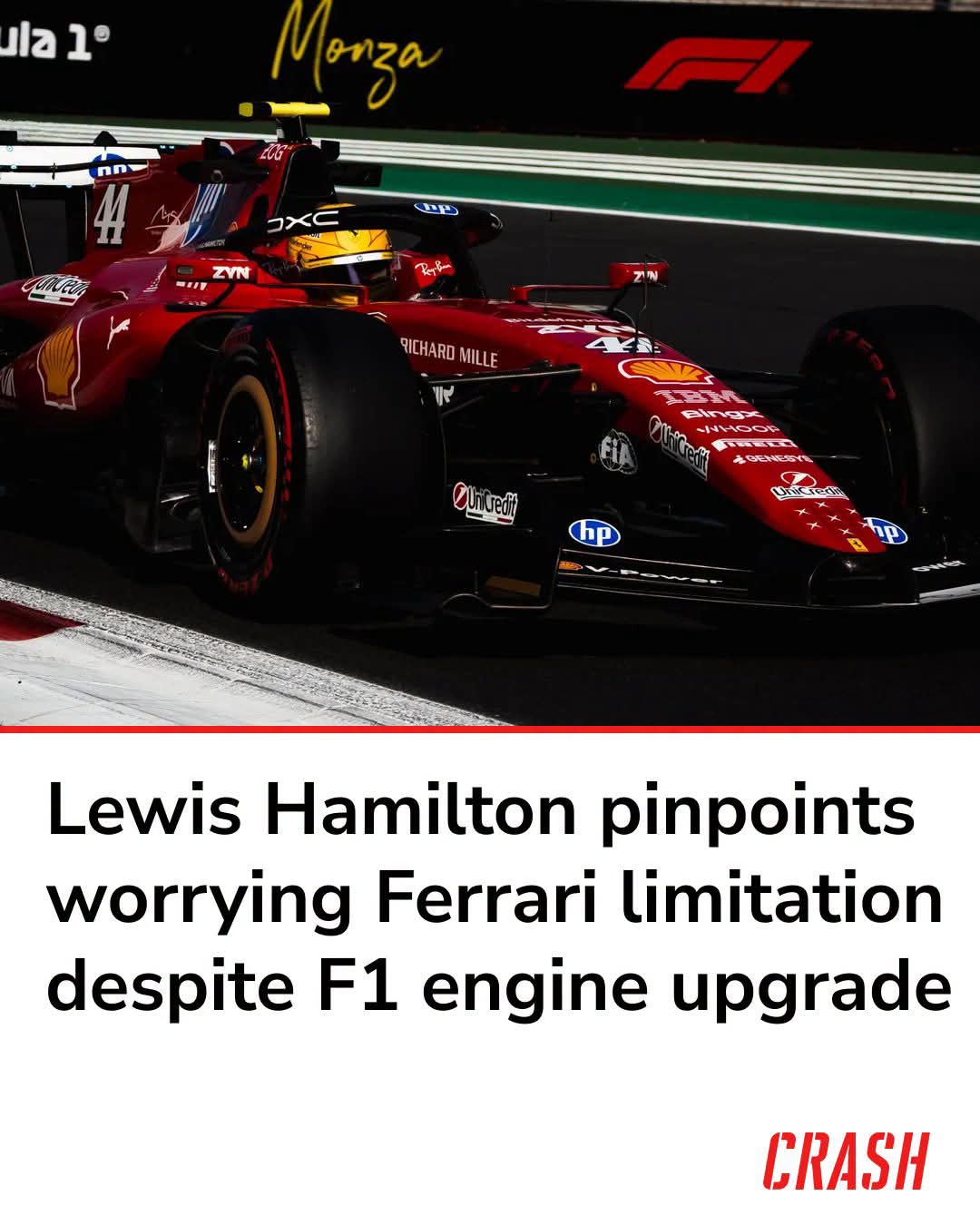
Lewis Hamilton has identified a major weakness that could prevent Ferrari from challenging Mercedes for victory at the Italian Grand Prix, despite the team bringing an upgraded power unit to its home race at Monza.
Ferrari entered the weekend hoping its latest engine development would significantly reduce the performance gap to Mercedes. However, after Friday practice, Hamilton revealed that the Scuderia was still giving away a substantial amount of time on the straights. The seven-time world champion suggested the deficit could be as much as six tenths of a second compared with George Russell’s Mercedes.
HAMILTON REVEALS A SIX-TENTH STRAIGHT-LINE DEFICIT
Hamilton finished Friday’s running fifth-fastest, almost half a second behind Russell, who set the pace. While Ferrari’s overall lap time remained competitive enough to keep the team in contention, Hamilton’s comments suggested that the problem extends beyond simply extracting more performance from the new engine.
The Ferrari driver said the straight-line deficit was “considerable” and explained that he was losing around six tenths to Russell specifically on the straights. At a circuit like Monza, that is potentially devastating because the track is dominated by long acceleration zones and high-speed sections where top speed and efficiency are crucial.
The concern is particularly notable because Ferrari had specifically hoped its latest permitted engine development would close the gap to Mercedes.
THE ENGINE IS BETTER — BUT FERRARI MAY HAVE ANOTHER PROBLEM
Hamilton was careful not to criticize Ferrari’s engineers or dismiss the new power unit. In fact, he acknowledged that the engine represents an improvement and praised the factory team for its work.
The bigger question is where Ferrari is actually losing the time.
Hamilton pointed toward several possibilities, including aerodynamic drag and energy deployment. Ferrari may be sacrificing too much straight-line performance through its aerodynamic configuration, while differences in how electrical energy is deployed could also be contributing to the deficit.
That distinction is crucial. If the problem were purely engine power, Ferrari would have a relatively obvious target. But if the Mercedes advantage comes from a combination of power deployment, aerodynamic efficiency and lower drag, fixing the problem becomes considerably more complicated.
FRED VASSEUR ADMITS MERCEDES STILL HAS AN ADVANTAGE
Ferrari team principal Fred Vasseur offered a similar assessment after Friday’s sessions.
Vasseur stressed that straight-line performance is determined by more than the power unit alone. Drag, vehicle weight and the overall aerodynamic package all influence how quickly a car can accelerate and reach its maximum speed.
His comments effectively reinforced Hamilton’s theory: the new Ferrari engine has delivered an improvement, but it has not magically eliminated the team’s deficit to Mercedes.
That leaves Ferrari with an important setup decision before qualifying. Reducing downforce could improve straight-line speed, but doing so risks compromising the car’s performance through Monza’s slower corners.
HAMILTON’S FIRST FERRARI MONZA WIN IS NOW A MUCH BIGGER CHALLENGE
Hamilton’s personal motivation makes the situation even more intriguing.
The Ferrari driver is still chasing his first Italian Grand Prix victory as a Ferrari driver, and there would be few more significant places for him to achieve it than Monza in front of the team’s passionate home crowd.
But Friday’s evidence suggests Hamilton may need Ferrari to find something overnight if he is going to fight Russell and the other front-runners for pole position and victory.
Qualifying could be particularly important because Hamilton believes the slipstream, or “tow,” will play a major role. At Monza, gaining a strong tow down the straights can provide a significant advantage, making strategic positioning during qualifying potentially just as important as outright car performance.
FERRARI HAS ONE NIGHT TO FIND THE ANSWER
Ferrari’s new engine has apparently made progress, but Hamilton’s feedback shows that the team still has a potentially serious Monza-specific weakness.
The encouraging part is that the problem may not be entirely related to power. If Ferrari can identify excessive drag, optimize its deployment strategy and find a better balance without sacrificing too much cornering performance, the gap could potentially be reduced.
The worrying part is that Mercedes already appears extremely strong at a circuit where straight-line efficiency is critical.
For Hamilton, the objective is simple: Ferrari needs to turn its promising engine upgrade into actual lap-time performance. Otherwise, his dream of delivering a first Monza victory in Ferrari red could once again be overshadowed by Mercedes’ advantage.