Formula 1’s governing body has made a rare admission of error after confirming that Charles Leclerc should have been penalized for his controversial collision with Oscar Piastri during the 2026 Belgian Grand Prix. The acknowledgment came during a scheduled meeting between FIA stewards and Formula 1 drivers ahead of this weekend’s Hungarian Grand Prix, marking one of the most significant officiating reversals of the season.
The decision has reignited debate over stewarding consistency in Formula 1, particularly after several controversial rulings at Spa-Francorchamps. While the outcome of the Belgian Grand Prix will remain unchanged, the FIA’s willingness to admit a mistake could have major implications for future race officiating as the championship battle intensifies.
FIA FINALLY ACKNOWLEDGES LECLERC SHOULD HAVE BEEN PENALIZED
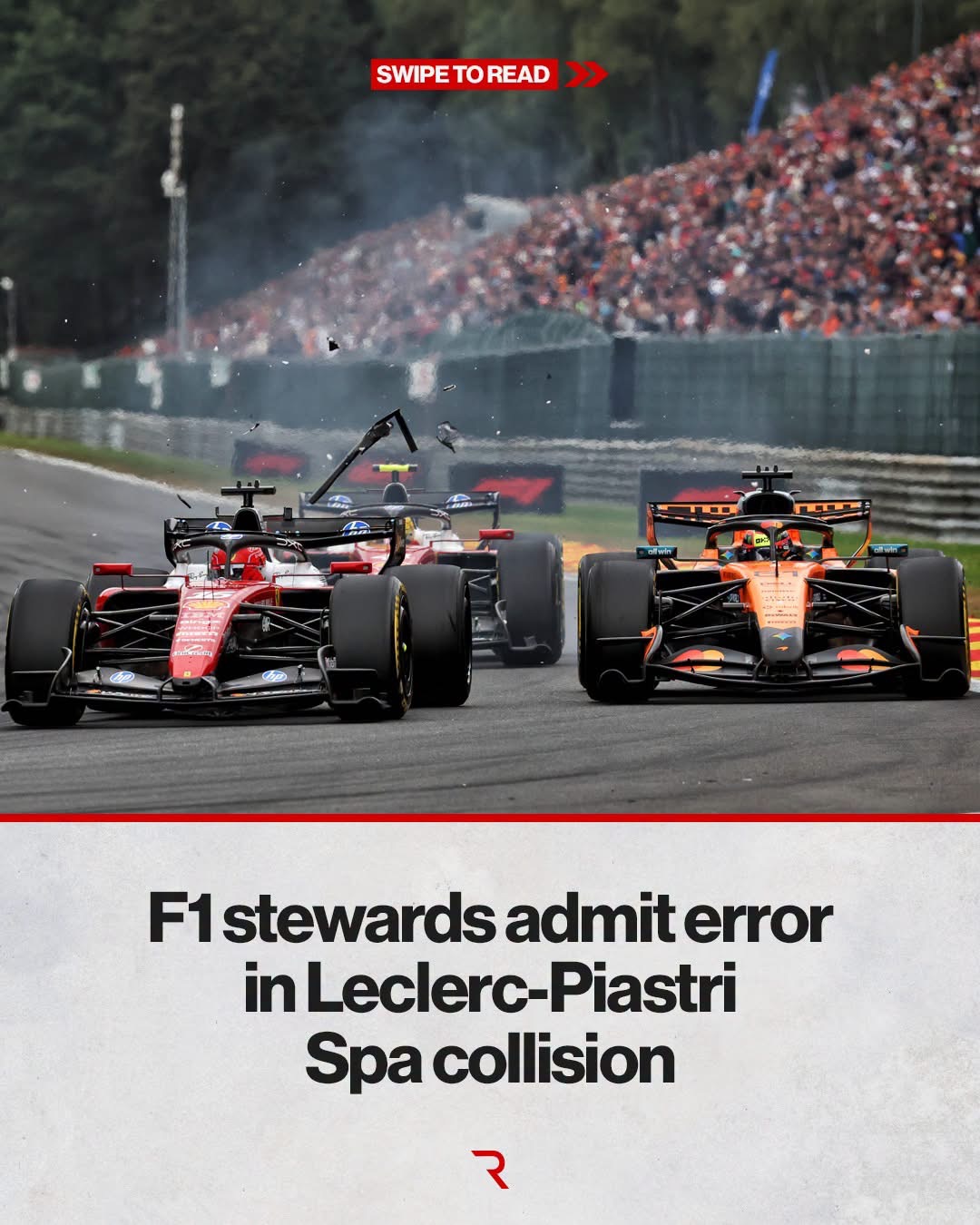
The Leclerc-Piastri incident became one of the defining talking points from the Belgian Grand Prix.
During an aggressive battle at high speed on the Kemmel Straight, contact between the Ferrari and McLaren drivers sparked immediate debate among fans, teams, and television commentators. Despite reviewing the incident, the race stewards initially chose to take no further action against Leclerc, allowing him to continue without penalty.
However, after further discussions with drivers during Thursday’s meeting in Hungary, FIA officials reportedly accepted that their original judgment was incorrect.
Such admissions remain extremely uncommon in Formula 1, where stewarding decisions are rarely revisited publicly once a race has concluded.
WHY THIS DECISION MATTERS EVEN AFTER THE RACE
Although the Belgian Grand Prix results will not be altered, the FIA’s acknowledgment carries considerable weight.
Formula 1 operates under strict regulations designed to ensure consistent interpretation of racing incidents. When drivers lose confidence in that consistency, it creates uncertainty over what is—and is not—acceptable during wheel-to-wheel racing.
The Spa controversy arrived during a weekend already filled with stewarding debates.
Lewis Hamilton received a five-second penalty following his opening-lap collision with George Russell, while Ferrari escaped with only a financial penalty after Hamilton’s unsafe pit release. Adding Leclerc’s unpunished clash with Piastri only increased criticism that similar incidents were being judged differently.
By recognizing the mistake, the FIA appears determined to restore confidence before the championship enters its crucial second half.
PRESSURE FROM DRIVERS FORCED THE ISSUE
The discussion was never simply about one incident.
Formula 1 drivers have increasingly pushed for greater transparency regarding stewarding decisions, arguing that unclear interpretations make racing more difficult. The Belgian Grand Prix provided several examples where competitors questioned whether penalties matched previous precedents.
During the Hungarian Grand Prix weekend, drivers met directly with FIA representatives to discuss those concerns.
Leclerc’s clash with Piastri reportedly became one of the central topics, alongside Hamilton’s penalty and several other controversial calls from Spa.
The willingness of the FIA to openly admit an error suggests those conversations may already be influencing how race control approaches future incidents.
FERRARI AND MCLAREN TITLE FIGHT COULD BE AFFECTED
The timing of this development is particularly significant given the competitive landscape of the 2026 season.
Ferrari and McLaren remain locked in an intense Constructors’ Championship battle behind dominant Mercedes, with every point becoming increasingly valuable. Small stewarding decisions can dramatically influence championship momentum, especially when podium positions are separated by only a few seconds.
Oscar Piastri has consistently demonstrated race-winning pace throughout the year, while Leclerc has helped Ferrari remain firmly in contention despite Mercedes’ overall advantage.
Had Leclerc received a penalty in Belgium, the finishing order—and potentially valuable championship points—might have looked very different.
While those points cannot now be redistributed, the incident serves as a reminder that officiating decisions can shape entire title campaigns.
THE FIA NOW FACES GREATER EXPECTATIONS
Admitting a mistake is one thing.
Ensuring similar errors do not occur again is a far greater challenge.
Formula 1 continues to grow globally, attracting millions of new fans who expect clear, consistent rule enforcement. Every controversial ruling immediately becomes a major topic across social media, television broadcasts, and paddock discussions.
The FIA’s admission now places additional pressure on race stewards to maintain a more predictable standard throughout the remainder of the season.
Consistency—not perfection—has become the benchmark drivers increasingly demand.
WHAT THIS MEANS FOR THE HUNGARIAN GRAND PRIX AND BEYOND
The Hungarian Grand Prix may become the first opportunity to judge whether the FIA has learned from Spa.
Drivers now enter the weekend knowing that officials have acknowledged at least one incorrect decision from Belgium. That transparency could encourage greater trust between competitors and race control, but it also raises expectations that similar incidents will be handled differently going forward.
With Mercedes’ Andrea Kimi Antonelli leading the Drivers’ Championship while Ferrari and McLaren continue fighting for every available point, stewarding decisions are likely to face even greater scrutiny over the coming months.
The FIA’s admission over the Leclerc-Piastri collision will not rewrite Belgian Grand Prix history. But it could become a pivotal moment in shaping how Formula 1 enforces its racing rules for the remainder of the 2026 championship—and perhaps for seasons to come.