FERRARI FACES FRESH ENGINE CONCERNS AFTER OLIVER BEARMAN SUFFERS BAKU POWER UNIT FAILURE
Ferrari’s Azerbaijan Grand Prix weekend has taken an unexpected turn after Oliver Bearman suffered a power unit failure during FP2, raising questions about the reliability of the latest Ferrari engine specification.
The Haas driver was forced to stop his VF-26 shortly after returning to the circuit following a red-flag interruption. The failure prevented Bearman from completing his planned qualifying simulations and left Ferrari facing questions about whether the problem was isolated or connected to the demands of the Baku City Circuit.
The timing of the failure is particularly significant because both Lewis Hamilton and Charles Leclerc are using Ferrari power units at a circuit where long periods of full-throttle running place substantial demands on the engine and its supporting systems.
WHAT HAPPENED TO OLIVER BEARMAN IN FP2?
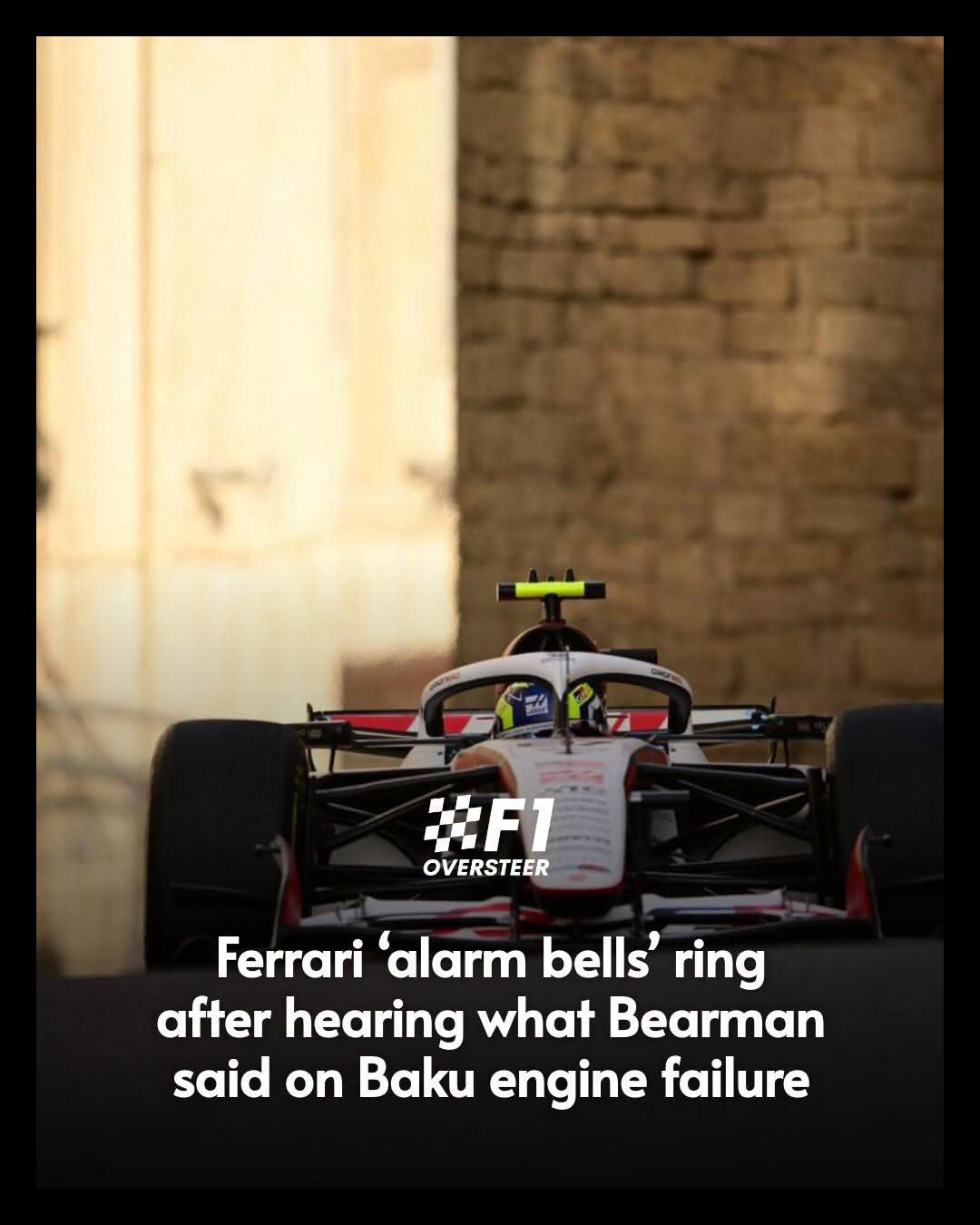
Bearman’s FP2 session ended abruptly when his Ferrari-powered Haas stopped on track.
After returning to the circuit following a red flag caused by Arvid Lindblad’s Racing Bulls crash, Bearman reported over team radio that his engine had switched off.
He subsequently parked the car, bringing his session to an early conclusion.
The incident meant Bearman finished at the bottom of the FP2 classification, while the interruption prevented him from completing the representative qualifying-style running that would normally be crucial for understanding the car’s performance before qualifying.
For Haas, the immediate priority is determining exactly what caused the shutdown.
For Ferrari, however, the situation carries a wider significance because the engine powering Bearman’s Haas is part of the same Ferrari power-unit family used by the Scuderia’s factory drivers.
WHY FERRARI WILL BE WATCHING THE FAILURE CLOSELY
One engine failure does not automatically establish a systemic reliability problem.
That distinction is important.
At this stage, there is no confirmed evidence in the supplied report that Ferrari’s upgraded power unit has a widespread reliability defect. The concern comes from the possibility that Bearman’s failure could reveal a weakness under the particularly demanding conditions in Baku.
The Azerbaijan circuit is unusual because drivers spend a significant amount of time at very high speed, with the long main straight providing one of the biggest full-throttle sections on the calendar.
That makes Baku an important real-world test for an engine upgrade.
A power unit that performs well in shorter bursts at another circuit can face a different challenge when subjected to sustained high-speed operation.
THE ADUO2 ENGINE UPGRADE IS UNDER THE SPOTLIGHT
Bearman’s Haas was fitted with Ferrari’s ADUO2 power-unit specification, which had made its debut at the Italian Grand Prix.
The upgrade was introduced as Ferrari attempted to improve its performance deficit to Mercedes and other leading rivals.
However, the reported gains at Monza were smaller than some expectations had suggested. The original report states that Ferrari’s upgrade delivered approximately five horsepower rather than the anticipated 15-horsepower increase.
That makes the Baku weekend especially interesting.
If Ferrari’s new engine can combine improved straight-line performance with reliable operation, it could represent an important step forward.
If reliability problems emerge, however, Ferrari may have to balance performance gains against the risk of additional power-unit replacements.
FERRARI’S PERFORMANCE IN FP2 ADDED TO THE CONCERN
The engine failure was not the only reason for Ferrari to be cautious about the weekend.
George Russell set the FP2 benchmark with a 1:43.347, while Leclerc was fourth and Hamilton fifth.
Leclerc finished 1.126 seconds away from Russell’s best time, with Hamilton 1.318 seconds behind the Mercedes driver.
Those gaps need to be interpreted carefully because practice times can be affected by fuel loads, tyre compounds, traffic, energy deployment and different run programmes.
Russell also benefited from a slipstream on the long Baku straight.
Nevertheless, the figures showed that Mercedes appeared to have strong one-lap performance heading into the later stages of the weekend.
WHY BAKU’S LONG STRAIGHTS MATTER
Baku presents a unique technical challenge for Formula 1 teams.
The circuit combines slow corners with a long, high-speed run toward the start-finish line. Teams therefore have to find a compromise between aerodynamic efficiency and cornering performance.
Too much downforce can make a car competitive through the slower sections but vulnerable on the straights.
Too little downforce can produce impressive top speed while making the car difficult to control through the technical parts of the circuit.
Power-unit performance becomes particularly important because acceleration onto the long straight can determine how effectively a driver converts the car’s available horsepower into lap time.
That is why Ferrari’s engine behaviour in Baku deserves close attention.
LECLERC AND HAMILTON FACE A DIFFERENT KIND OF PRESSURE
Charles Leclerc and Lewis Hamilton are not directly responsible for Bearman’s failure, and there is currently no confirmation that either Ferrari driver has experienced the same problem.
However, any potential power-unit reliability concern naturally becomes more important when two factory cars are competing at the same event.
A modern F1 power unit is not simply an engine in the traditional sense. It is part of a highly complex system involving electrical energy deployment, energy recovery, turbocharging, cooling and sophisticated control software.
A failure in one component can therefore have consequences far beyond the internal-combustion engine itself.
Ferrari will need to identify the exact cause before drawing conclusions about its other cars.
HAMILTON’S POWER DEFICIT ADDS CONTEXT
Ferrari’s engine performance has already been an important topic during the 2026 season.
Hamilton previously indicated that Ferrari was losing significant time to Mercedes on the straights, including a reported deficit of around six-tenths at Monza.
That made the ADUO2 upgrade particularly important for the Scuderia.
Any improvement in straight-line performance could help Ferrari reduce one of its biggest disadvantages.
But the ideal power-unit upgrade has to provide more than peak horsepower.
Reliability, energy deployment, drivability and thermal management are all essential parts of the equation.
An engine that is marginally faster but significantly less reliable could ultimately create more problems than it solves.
WHY BEARMAN’S FAILURE IS ALSO IMPORTANT FOR HAAS
The consequences extend beyond Ferrari.
Haas depends on Ferrari for its power units, meaning a technical issue involving the Ferrari specification can directly affect one of Ferrari’s customer teams.
Bearman also has a unique connection to the Scuderia after progressing through Ferrari’s driver development system before becoming a full-time Formula 1 driver with Haas.
That makes his technical feedback particularly valuable.
If Ferrari engineers discover that the failure was connected to a component specific to the upgraded specification, they will have an opportunity to investigate it before the same hardware completes more race mileage.
In that sense, an unexpected FP2 failure can provide important information—provided engineers can identify its root cause.
COULD BEARMAN FACE A GRID PENALTY?
One immediate question is whether Bearman will need a new power-unit component for the remainder of the Azerbaijan weekend.
A replacement does not automatically mean a grid penalty.
Formula 1 has strict allocation limits for power-unit components, and the sporting consequences depend on which component needs to be replaced, how many units the driver has already used and whether the replacement exceeds the permitted allocation.
Therefore, Bearman’s eventual starting position cannot be determined solely from the FP2 failure.
Haas and Ferrari will first need to establish the extent of the damage and decide whether the existing unit can safely be returned to service.
WHAT FERRARI NEEDS TO FIND OUT
The most important question is simple: why did the engine stop?
Ferrari engineers will likely examine several possibilities, including electrical systems, control electronics, energy deployment, fuel delivery, cooling and internal engine components.
The distinction between a component failure and a broader specification problem will be crucial.
If the problem is isolated, Ferrari may be able to continue using the ADUO2 specification without major changes.
If the same component shows abnormal behaviour across multiple power units, the situation would become considerably more serious.
That is why the next technical updates from Ferrari and Haas will be closely watched.
MERCEDES’ PERFORMANCE MAKES THE SITUATION MORE INTERESTING
Ferrari’s concerns are arriving at a weekend where Mercedes has already demonstrated impressive pace.
Russell’s FP2 performance showed that Mercedes can extract strong speed from its package around Baku.
That puts additional pressure on Ferrari to maximise every available performance advantage.
The Scuderia cannot afford to lose power on the straights if its rivals are already competitive in the same areas.
At the same time, Ferrari cannot simply chase maximum performance without considering reliability.
That balance could become one of the defining technical stories of the Azerbaijan Grand Prix.
WHAT COULD HAPPEN NEXT?
The most likely immediate response from Ferrari will be investigation rather than panic.
Engineers will analyse Bearman’s power unit, compare its data with Leclerc and Hamilton’s systems and determine whether the failure originated from a specific component or a wider issue.
If the data points toward an isolated problem, the weekend may continue without major consequences for Ferrari’s factory cars.
If engineers discover a pattern, however, Ferrari may have to make precautionary changes or adjust how aggressively the new specification is operated.
The latter scenario would potentially affect both performance and race strategy.
THE BIGGER PICTURE FOR FERRARI
The Bearman failure matters because Ferrari is trying to close a performance gap during a season when every technical gain can have championship consequences.
The ADUO2 upgrade was supposed to help improve the team’s competitiveness.
Baku now presents an unusual test of whether that progress can be delivered consistently under extreme operating conditions.
It would be premature to describe Bearman’s failure as proof that Ferrari’s new power unit is fundamentally unreliable.
But it is equally understandable that the incident has attracted attention inside the Ferrari camp.
The difference between an isolated mechanical failure and the first sign of a recurring technical weakness can only be established through further data.
FERRARI’S NEXT MOVE WILL BE CRUCIAL
For Hamilton and Leclerc, the focus will now return to qualifying and race preparation.
For Ferrari’s engineers, however, Bearman’s parked Haas could prove just as important.
The team needs to understand whether the failure was a one-off event or something that could affect the wider Ferrari power-unit programme.
With Mercedes showing strong pace and Baku’s long straights putting power units under considerable strain, Ferrari faces a delicate weekend.
The real answer will come not from speculation, but from the technical investigation and how the Ferrari-powered cars perform through qualifying and the race.
For now, Bearman’s failure is best viewed as a warning signal rather than definitive proof of a Ferrari reliability crisis. The next sessions should reveal whether Ferrari has a genuine problem to solve—or simply an isolated failure to explain.