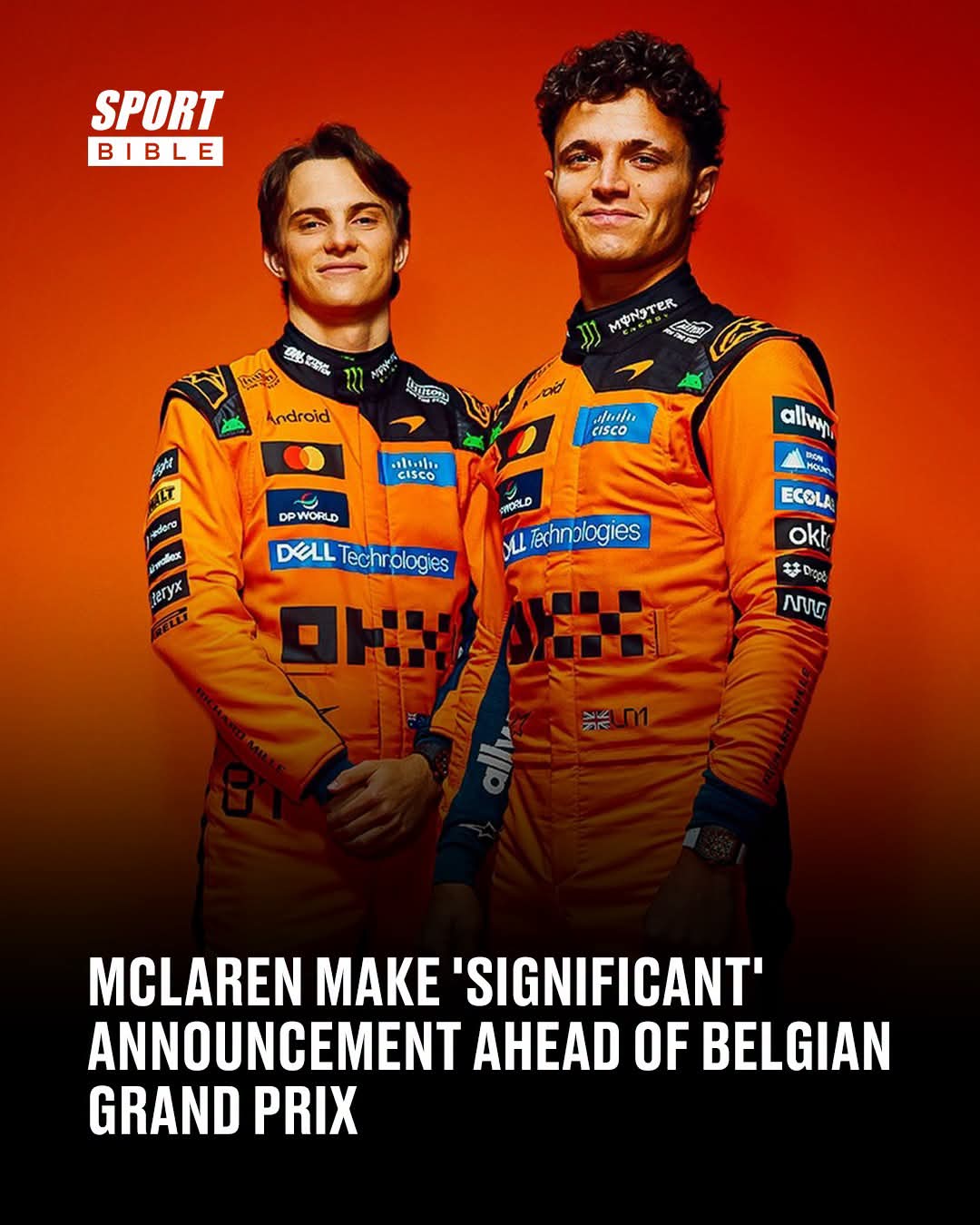
McLaren has officially launched a crucial phase of its 2026 Formula 1 recovery by confirming a significant technical upgrade ahead of this weekend’s Belgian Grand Prix at Spa-Francorchamps. Alongside a newly developed rear-wing assembly, the team is also set to introduce Mercedes’ latest power unit specification—an important move that could help address one of the MCL40’s biggest weaknesses this season.
After dominating Formula 1 in 2025 with consecutive Constructors’ Championships and Lando Norris securing his maiden Drivers’ Championship, McLaren entered 2026 with expectations of remaining at the front. Instead, the team has found itself chasing Mercedes, sitting third in the Constructors’ standings while Norris and Oscar Piastri occupy fifth and sixth in the drivers’ rankings. The Belgian Grand Prix now represents an opportunity to halt that slide before the championship slips completely out of reach.
SPA PRESENTS THE PERFECT TEST FOR MCLAREN’S NEW PACKAGE
Few circuits expose a Formula 1 car’s strengths and weaknesses quite like Spa-Francorchamps. The legendary Belgian venue combines long straights with high-speed corners, making aerodynamic efficiency and power delivery absolutely critical.
This year’s race carries even greater significance after the FIA confirmed there will be five Straight Mode zones around the circuit—the highest number seen since the Australian Grand Prix. Those zones place enormous emphasis on top speed, battery deployment, and drag reduction, precisely the areas where McLaren struggled during its disappointing outing at Silverstone.
The timing of McLaren’s upgrade could therefore be no coincidence. Rather than introducing isolated changes, the team appears to be targeting its biggest competitive weakness with a carefully planned technical package designed specifically for circuits that reward straight-line performance.
MERCEDES’ LATEST ENGINE COULD BE THE GAME-CHANGER
Perhaps the biggest boost comes underneath the bodywork.
Reports indicate McLaren will finally introduce Mercedes’ newest power unit specification after delaying its arrival during the Austrian and British Grands Prix. The upgraded engine has already proven itself within the Mercedes camp, and McLaren hopes it will deliver improved acceleration, stronger energy deployment, and greater efficiency over long-distance runs.
At Spa, those advantages become even more valuable. The Kemmel Straight, the run toward Blanchimont, and several other flat-out sections reward every extra kilometer per hour. If the new Mercedes engine performs as expected, Norris and Piastri should have far fewer difficulties defending against rivals or launching overtaking moves in sectors where McLaren previously lost valuable time.
NEW REAR WING SIGNALS A MORE AGGRESSIVE DEVELOPMENT STRATEGY
McLaren technical director of applied engineering Neil Houldey confirmed that the team will also evaluate a completely new rear-wing assembly throughout Friday’s practice sessions.
Unlike previous experimental components that were ultimately left unused, this latest design has been integrated into McLaren’s broader development roadmap. According to Houldey, the upgrade should improve overall performance, although he acknowledged that it is unlikely to transform the team’s competitiveness overnight.
That realistic approach reflects the complexity of modern Formula 1 development. Small aerodynamic improvements rarely produce dramatic gains individually, but combined with engine updates and future chassis refinements, they can significantly narrow the gap to the frontrunners over several races.
ENERGY MANAGEMENT MAY DECIDE THE BELGIAN GRAND PRIX
While outright speed will be important, energy management could become the defining factor of Sunday’s race.
Houldey described Spa as one of the most energy-demanding circuits on the calendar, warning that drivers are expected to experience substantial “super clip”—the point where electrical deployment is exhausted before the end of the straight.
Managing battery harvesting and deployment will therefore be just as important as outright horsepower. Teams must carefully balance when to release electrical energy and when to conserve it, especially during qualifying laps and extended race stints.
If McLaren’s upgraded package successfully improves both efficiency and deployment, the team could finally eliminate one of the strategic disadvantages that has limited its race pace throughout much of 2026.
A BIGGER UPGRADE IS ALREADY ON THE HORIZON
Spa may only be the beginning of McLaren’s recovery plan.
The team is reportedly preparing a much larger upgrade package for next week’s Hungarian Grand Prix, suggesting the Belgian changes are only the first phase of an aggressive mid-season development push.
That larger package is expected to include further aerodynamic refinements designed to improve balance through medium and slow-speed corners, complementing the straight-line improvements debuting this weekend.
If both upgrade phases perform as expected, McLaren could emerge from the summer break with a far more complete package capable of consistently challenging Mercedes and Ferrari during the second half of the season.
PRESSURE IS GROWING ON NORRIS AND PIASTRI
Neither Lando Norris nor Oscar Piastri has forgotten what McLaren achieved just one season ago.
After celebrating championship glory in 2025, expectations entering 2026 were understandably enormous. Instead, both drivers have often found themselves fighting simply to remain inside the top five, while Mercedes has established itself as the benchmark team.
The Belgian Grand Prix therefore carries importance beyond championship points. A strong performance would restore confidence throughout the garage, validate months of development work, and provide momentum heading into one of the most important upgrade periods of the season.
For Norris, it is another opportunity to remind the paddock why he remains one of Formula 1’s elite talents. For Piastri, consistent progress would further strengthen his reputation as one of the sport’s brightest young stars despite the limitations of the current package.
WHY THIS WEEKEND COULD DEFINE MCLAREN’S CHAMPIONSHIP HOPES
McLaren understands that championship campaigns are rarely revived by a single upgrade. However, they can certainly be lost if problems continue unresolved.
By combining a new rear wing, Mercedes’ latest engine specification, and a clear development pathway extending into Hungary, McLaren has demonstrated that it is refusing to accept its current position as the third-fastest team.
Spa will provide the first real indication of whether those efforts are beginning to close the performance gap. If the upgrades produce meaningful gains in straight-line speed and energy efficiency, McLaren could quickly re-establish itself as a regular podium contender.
Should the improvements fall short, however, the team’s hopes of mounting any meaningful championship comeback may become increasingly difficult. Either way, the Belgian Grand Prix promises to be one of the most revealing weekends of McLaren’s entire 2026 Formula 1 campaign.