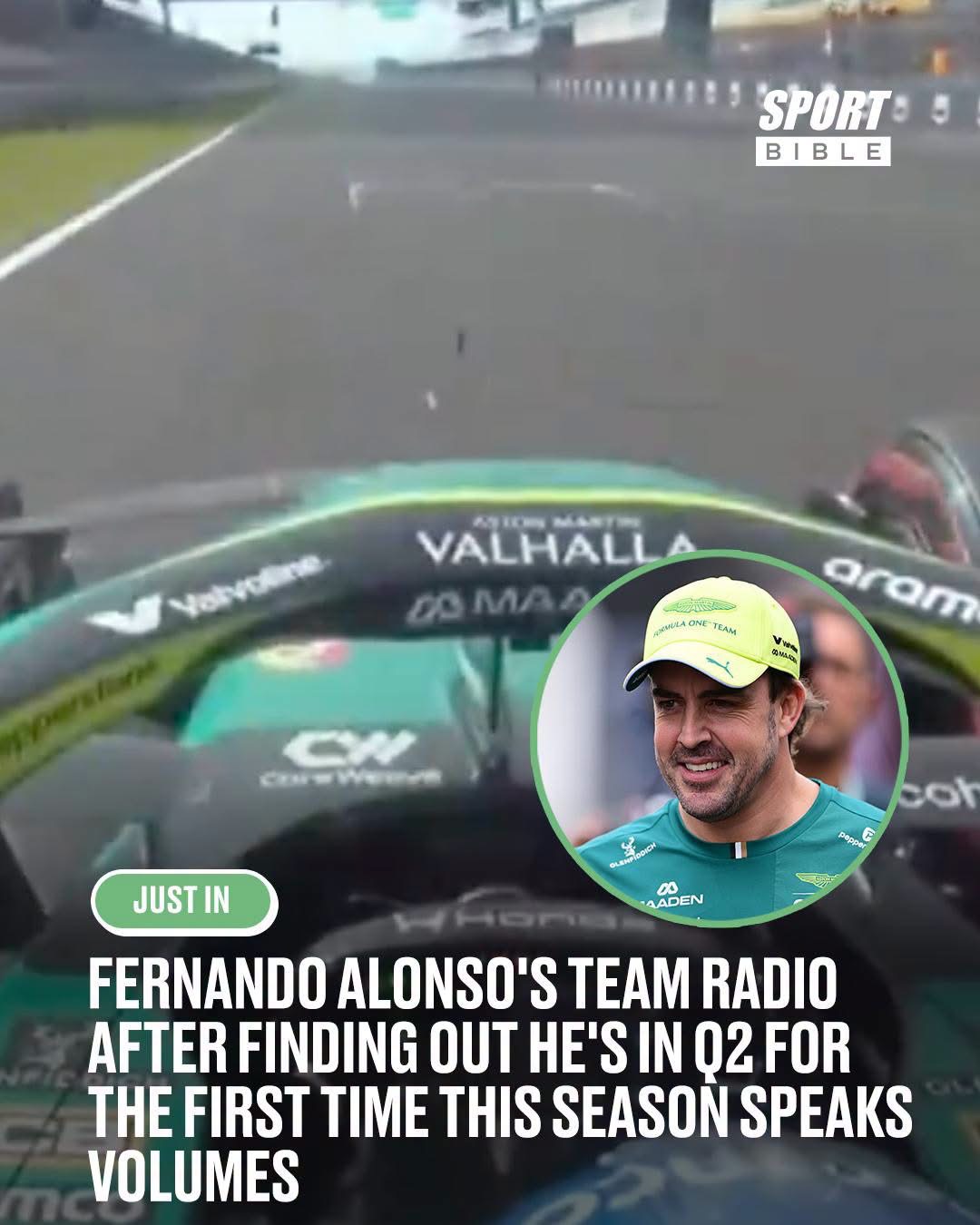
Fernando Alonso’s understated radio message after reaching Q2 for the first time in the 2026 Formula 1 season may have lasted only a few seconds, but it perfectly captured what has been an incredibly difficult campaign for Aston Martin. After months of frustration, technical setbacks, and disappointing performances, the two-time world champion finally had something positive to celebrate at the Hungarian Grand Prix.
Although Alonso ultimately qualified 16th, his reaction—and later comments over team radio—suggested the result represented far more than just a place in the second qualifying session. For Aston Martin, it was the first genuine indication that months of development work under Adrian Newey could finally be paying off.
ALONSO FINALLY SEES SIGNS OF PROGRESS
The Hungarian Grand Prix weekend marked a noticeable shift in Aston Martin’s fortunes after the team introduced an extensive upgrade package featuring 16 new components across both cars.
While Alonso only advanced to Q2 before eventually qualifying 16th, the Spaniard immediately recognized the improvement. Rather than celebrating wildly, his message to the team reflected cautious optimism.
“Alright, good job. Maybe a bit more to come from the next set. Let’s go.”
That calm confidence contrasted sharply with the frustration heard over Aston Martin’s radios throughout much of the season.
Later during qualifying, Alonso delivered perhaps the most revealing statement of the weekend.
“This is a car to drive.”
For a driver of Alonso’s experience, those six words may have been the strongest endorsement Aston Martin has received all season.
ASTON MARTIN’S NIGHTMARE 2026 SEASON MAY BE TURNING A CORNER
The Silverstone-based team entered 2026 with enormous expectations following Adrian Newey’s arrival, yet reality proved brutally different.
Early-season reliability concerns, severe vibrations, battery shortages, and an uncompetitive Honda power unit left Aston Martin fighting near the back of the grid instead of challenging the frontrunners.
Before Hungary, the team had scored only a single championship point through Alonso’s 10th-place finish in Monaco.
Questions surrounded nearly every aspect of the project:
- Was the chassis fundamentally flawed?
- Could Honda solve its performance deficit?
- Would Newey’s influence take effect quickly enough?
- Could Alonso remain motivated?
The Hungarian upgrades do not answer all of those questions, but they provide the first encouraging evidence that Aston Martin’s recovery plan is moving in the right direction.
WHY THE UPGRADE PACKAGE MATTERS BEYOND THIS WEEKEND
Perhaps the most important takeaway from Hungary is not where Alonso qualified—but that Aston Martin’s simulation data matched what happened on track.
That correlation is invaluable for any Formula 1 team.
Alonso explained that the new package behaved almost exactly as engineers had predicted, giving the team confidence that its development tools are finally producing accurate results.
That matters because every improvement introduced during the remainder of 2026 will also influence development of the team’s 2027 challenger.
For Adrian Newey and Aston Martin’s engineering department, predictable development is arguably more valuable than a single strong qualifying result.
ALONSO’S COMMENTS OFFER HOPE FOR THE FUTURE
Following qualifying, Alonso painted a noticeably more optimistic picture than he has for most of the year.
According to the veteran Spaniard, the upgraded AMR26 feels significantly more stable through corners and remains planted under load.
He admitted the team still needs more outright performance from both the chassis and power unit, but emphasized that the direction of travel is finally positive.
Perhaps most telling was his observation that the atmosphere inside Aston Martin has changed.
Confidence can be difficult to measure in Formula 1, but it often becomes a major performance factor once teams believe their development path is working.
That renewed belief may prove just as important as the mechanical upgrades themselves.
WHAT THIS COULD MEAN FOR ALONSO’S FORMULA 1 FUTURE
At nearly 45 years old, Alonso continues to defy expectations with both his speed and determination.
His future beyond the 2026 season remains undecided, with retirement continuing to be discussed throughout the paddock.
However, weekends like Hungary could significantly influence that decision.
Few drivers enjoy developing projects more than Alonso. If Aston Martin genuinely begins closing the gap to the front, the Spaniard may see enough potential to continue leading the team’s rebuild into another season.
With additional Honda engine improvements reportedly scheduled for Zandvoort after the summer break, Alonso could soon have an even stronger package beneath him.
CAN ASTON MARTIN BUILD ON THIS MOMENTUM?
The Hungarian Grand Prix does not suddenly transform Aston Martin into a podium contender.
Mercedes, Ferrari, McLaren, and Red Bull still maintain sizeable performance advantages, while midfield competition remains incredibly tight.
Nevertheless, Hungary represents something Aston Martin has desperately needed throughout 2026: proof that its development program is producing measurable gains.
If the upgraded package continues delivering improvements over the second half of the season—and the upcoming engine developments perform as expected—the team could gradually move away from the back of the grid and begin competing regularly for points.
For Fernando Alonso, qualifying 16th would rarely be considered a success.
In the context of Aston Martin’s troubled 2026 campaign, however, his simple team radio message revealed exactly what the result meant.
For the first time this season, the car gave him something he has been missing for months—belief.