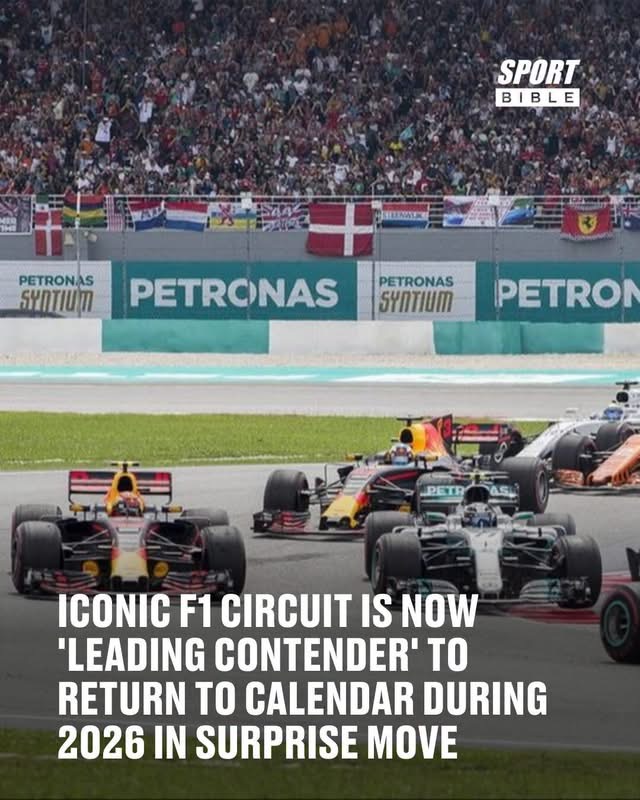
Formula 1 could be heading back to one of its most beloved venues much sooner than expected, with the Malaysian Grand Prix reportedly becoming the leading candidate to make a surprise return to the 2026 calendar. Following the cancellation of both the Bahrain and Saudi Arabian Grands Prix due to escalating conflict in the Middle East, Formula 1 officials are now searching for replacement events to preserve a full championship schedule.
While several circuits have been linked with filling the vacant slots, Sepang International Circuit has rapidly emerged as one of the strongest options. If the deal is finalized, it would mark the first Formula 1 race in Malaysia since the circuit disappeared from the calendar nearly a decade ago, creating one of the biggest surprises of the 2026 season.
FORMULA 1 SCRAMBLES TO REBUILD ITS 2026 CALENDAR
The 2026 championship has already faced one of its biggest logistical challenges before reaching its halfway point.
The FIA confirmed that both Bahrain and Saudi Arabia would not host their scheduled races in April due to regional security concerns. Those cancellations left two significant gaps in the calendar and forced Formula 1 management to explore alternative venues capable of hosting a Grand Prix on relatively short notice.
Several scheduling possibilities have since emerged, including a window between the Azerbaijan Grand Prix and the Singapore Grand Prix later in the year. That period offers enough flexibility for Formula 1 to insert another race without creating major disruptions to team travel or freight operations.
With championship points becoming increasingly valuable in an intense title battle, Formula 1 remains determined to avoid permanently reducing the number of races this season.
SEPANG HAS LONG BEEN A FAN FAVORITE
For many Formula 1 supporters, the prospect of returning to Malaysia is an exciting one.
The Sepang International Circuit built a reputation as one of the sport’s finest modern venues after joining the championship in 1999. Designed by renowned circuit architect Hermann Tilke, the track became famous for its wide racing surface, heavy braking zones, fast sweeping corners, and unpredictable tropical weather.
Rainstorms frequently transformed races into dramatic strategic battles, while the combination of long straights and technical corners consistently produced overtaking opportunities.
Some of Formula 1’s most memorable moments unfolded at Sepang, making the circuit a favorite among drivers and fans alike before financial challenges led to its removal from the calendar after the 2017 season.
Its return would immediately restore one of the championship’s most respected racing venues.
WHY MALAYSIA IS NOW A REALISTIC OPTION
Unlike some circuits that would require extensive preparation, Sepang remains in excellent condition.
The venue continues to host MotoGP, endurance racing, and various international motorsport events throughout the year, meaning much of the infrastructure required for Formula 1 already exists. That significantly reduces the amount of work needed to stage a Grand Prix on relatively short notice.
Its strategic location in Southeast Asia also fits naturally within Formula 1’s Asian leg of the calendar, minimizing additional travel demands compared to introducing a completely new destination.
From both a logistical and commercial perspective, Malaysia represents one of the most practical replacement options currently available.
THE CHAMPIONSHIP COULD BENEFIT FROM AN EXTRA CLASSIC CIRCUIT
Adding Sepang would not simply replace a canceled race—it could reshape the championship itself.
The circuit traditionally rewards well-balanced cars rather than those relying solely on straight-line speed. High temperatures, changing weather conditions, and demanding tyre management often produce unpredictable results, giving teams additional strategic challenges.
Current championship leader Andrea Kimi Antonelli has excelled on a variety of circuits this season, but Ferrari’s Lewis Hamilton and Mercedes teammate George Russell could both welcome another opportunity to close the points gap.
Meanwhile, Max Verstappen and Red Bull would likely view Sepang as another chance to recover ground after a difficult start to the campaign.
An additional race at such a technically demanding venue could become one of the defining weekends of the championship.
WHAT HAPPENS NEXT?
Although Malaysia is reportedly the leading contender, Formula 1 has yet to make any official announcement.
Commercial agreements, promoter arrangements, freight schedules, and FIA approval must all be finalized before any replacement race can be confirmed. Time remains a significant factor, but the available scheduling window between Azerbaijan and Singapore gives organizers a realistic opportunity to complete negotiations.
Formula 1 has shown increasing flexibility in adapting its calendar during recent years, and the sport has repeatedly demonstrated its ability to respond quickly when unforeseen circumstances arise.
A RETURN THAT WOULD DELIGHT THE PADDOCK
Few replacement venues would generate as much excitement as Sepang.
The Malaysian Grand Prix combines challenging racing, passionate fans, unpredictable weather, and a circuit layout that has consistently delivered memorable Formula 1 moments. At a time when the championship is searching for stability after unexpected cancellations, bringing back such an iconic venue would not only solve a scheduling problem but also provide one of the highlights of the entire 2026 season.
If negotiations are successful, Formula 1 could soon be returning to one of the circuits many fans never wanted to lose in the first place.