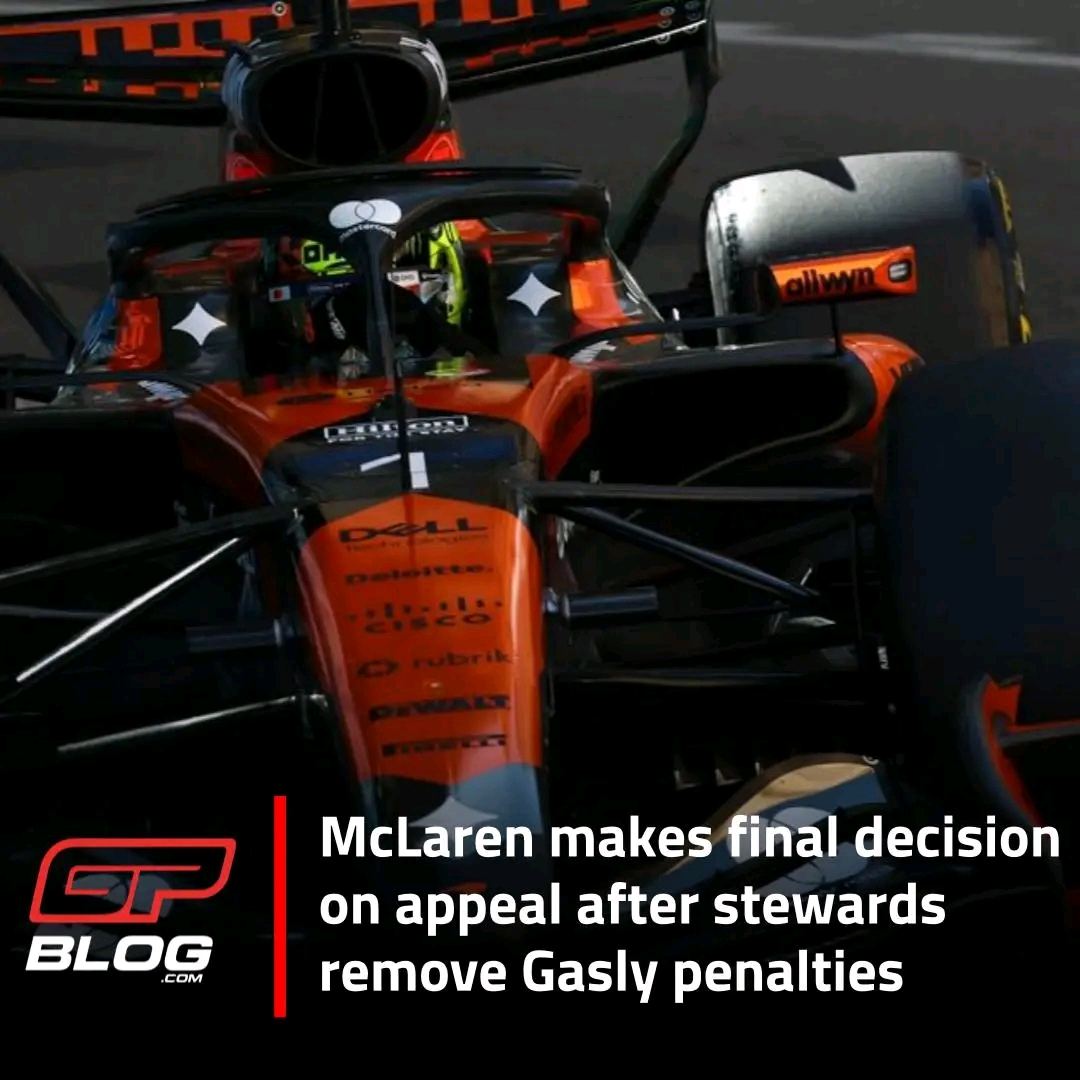
McLaren have reportedly decided not to pursue an appeal following the stewards’ decision to overturn penalties originally issued to Pierre Gasly after the Monaco Grand Prix. The ruling, which ultimately worked in favour of Alpine after a successful right of review, has now closed another tense chapter in a weekend already filled with controversy in Formula 1.
While the immediate sporting result may seem minor in isolation, the wider implications touch on how teams interpret stewarding decisions, the consistency of race penalties, and the growing frustration among midfield rivals fighting for every single point.
WHAT HAPPENED IN MONACO AND WHY IT MATTERED
The Monaco Grand Prix is always a high-pressure event where track position is everything and overtaking opportunities are extremely limited. In that environment, even a small penalty can completely reshape a driver’s race result.
Pierre Gasly was initially penalised during the race, a decision that appeared to disadvantage Alpine at a critical moment. However, after the race, Alpine successfully submitted a right of review, arguing that new evidence or clarification warranted a reversal of the original ruling.
The stewards agreed, and the penalty was removed, effectively restoring Gasly’s race outcome.
This kind of post-race reversal is not common, and when it does happen, it often sparks debate about consistency and fairness in officiating.
WHY MCLAREN CONSIDERED AN APPEAL IN THE FIRST PLACE
McLaren’s interest in the case was not random. In modern Formula 1, midfield battles are incredibly tight, and a single point can influence championship positioning, prize money distribution, and even development direction for the following season.
If McLaren believed the decision indirectly affected their competitive standing or set an inconsistent precedent, an appeal would have been a logical step.
However, appeals are not just sporting decisions—they are also political and strategic. Teams must weigh:
Likelihood of success
Relationship with FIA stewards
Resource cost and legal complexity
Potential backlash from rivals and fans
In this case, McLaren ultimately decided the risks outweighed the potential reward.
WHY THE DECISION NOT TO APPEAL IS SIGNIFICANT
At first glance, withdrawing an appeal may look like a simple administrative decision. In reality, it reveals several deeper truths about the current Formula 1 environment.
First, teams are increasingly cautious about escalating stewarding disputes unless there is a clear competitive gain. The FIA’s review system allows for corrections, but it also highlights how subjective certain decisions can be.
Second, McLaren’s decision signals confidence in moving forward rather than prolonging controversy. With development battles intensifying across the grid, teams are reluctant to waste time and focus on legal disputes unless absolutely necessary.
Finally, it reflects a broader trend: midfield teams are becoming more selective about when to challenge decisions, reserving their political capital for only the most impactful situations.
STEWARDING CONSISTENCY UNDER THE MICROSCOPE AGAIN
The Gasly Monaco case adds to an ongoing narrative in Formula 1 about inconsistency in stewarding decisions.
While the FIA has introduced clearer guidelines in recent seasons, racing incidents still often fall into grey areas. Monaco, with its narrow layout and limited overtaking zones, amplifies these inconsistencies because positioning decisions carry higher consequences than at most circuits.
Fans and teams alike often ask the same question:
Are similar incidents being judged the same way every race weekend?
Cases like this do little to silence that debate.
IMPACT ON ALPINE AND PIERRE GASLY
For Alpine, the reversal is more than just a corrected penalty—it is a validation of their protest process and race interpretation.
Pierre Gasly benefits directly in terms of points and championship positioning, but the psychological boost may be even more important. In a tightly packed midfield, confidence often translates into performance gains.
It also strengthens Alpine’s trust in their internal decision-making and race strategy department, knowing they successfully challenged a ruling and changed the outcome.
WHAT THIS MEANS FOR MCLAREN’S CHAMPIONSHIP APPROACH
For McLaren, stepping away from an appeal suggests a calculated shift in focus. Rather than engaging in post-race disputes, the team appears more committed to extracting performance from upgrades, race execution, and driver consistency.
In a season where every top midfield team is fighting for marginal gains, McLaren’s decision reflects a pragmatic mindset: protect energy, avoid distractions, and focus on track performance.
It also prevents escalation with rival teams and the FIA, something McLaren will likely want to avoid as development battles intensify.
BROADER IMPLICATION: THE GROWING POWER OF POST-RACE REVIEWS
One of the most important takeaways from this situation is the increasing influence of post-race review systems in Formula 1.
Modern F1 is no longer decided solely on track. Instead, it now includes:
Stewards’ decisions during races
Post-race right of review hearings
Data and telemetry reinterpretation
Legal arguments from team representatives
This layered system means that a race result is not always final when the chequered flag falls.
Teams are adapting to this reality, building stronger legal and analytical departments to support sporting outcomes.
CONCLUSION: A SMALL DECISION WITH BIG SIGNALS FOR F1
McLaren’s decision not to appeal Pierre Gasly’s Monaco penalty reversal may not change the championship table dramatically, but it highlights a much bigger trend in Formula 1.
Teams are becoming more strategic about when to fight off-track battles, and more focused on preserving resources for performance gains rather than procedural disputes.
Meanwhile, the Gasly case reinforces ongoing questions about consistency in stewarding and the evolving role of post-race reviews in shaping modern Formula 1 results.
In a sport where margins are already razor-thin, even decisions made in the stewards’ room can carry as much weight as those made on the circuit.