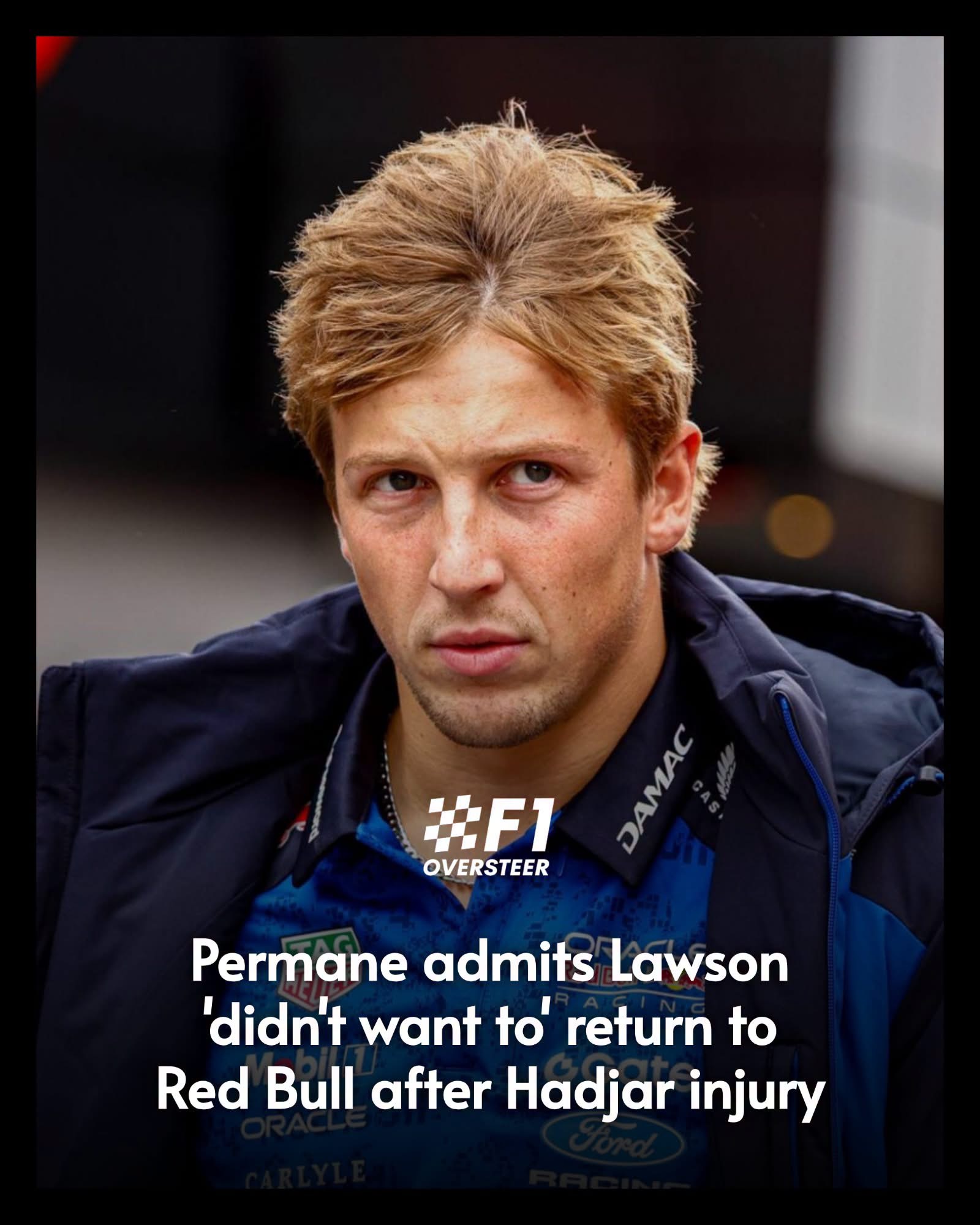
Liam Lawson’s return to Red Bull during the 2026 Formula 1 season was not the opportunity he necessarily wanted, according to Racing Bulls team principal Alan Permane, who has offered a revealing explanation of the circumstances surrounding the driver’s unexpected promotion.
Lawson was called up to replace Isack Hadjar after the Frenchman fractured his wrist during the summer break, leaving Red Bull with an urgent decision to make ahead of several important races.
Although returning to the senior team might traditionally be viewed as a major career opportunity, Lawson was reportedly reluctant to leave Racing Bulls at a time when his performances were beginning to improve significantly.
Permane has now admitted that the New Zealander would have preferred to continue building momentum with the sister team rather than return to the environment where his first opportunity had ended so quickly.
LAWSON WAS BUILDING MOMENTUM BEFORE RED BULL’S CALL
The timing of Hadjar’s injury was particularly unfortunate for Lawson because he had started to establish consistency at Racing Bulls.
After being demoted from Red Bull following just two races, the 2026 campaign had become an opportunity to rebuild his reputation and demonstrate that he deserved a permanent place in Formula 1.
His performances before the summer break suggested that he was making progress, having recorded six points finishes in seven races.
That consistency was important. Rather than constantly fighting to prove himself after every disappointing weekend, Lawson was beginning to build confidence and deliver results that strengthened his position within the Racing Bulls project.
A sudden return to Red Bull threatened to interrupt that progress.
The senior team had different expectations, greater scrutiny and the additional pressure that comes with competing alongside an established championship contender. For a driver who had already experienced an unsuccessful spell there, the situation was far from straightforward.
ALAN PERMANE REVEALS LAWSON’S TRUE FEELINGS
Permane acknowledged that Lawson was not particularly enthusiastic about the prospect of returning to Red Bull when the team needed a replacement for Hadjar.
Speaking to Autosport, the Racing Bulls team principal explained that the driver would have preferred to continue his progress with the junior team.
“If I’m being really frank with you, he didn’t want to go there if you’d given him the choice,” Permane said.
He was careful to clarify that Lawson’s reluctance was not an indication that the driver had a problem with Red Bull itself.
Instead, the issue was the progress he had been making at Racing Bulls and his desire to continue the work that was beginning to produce positive results.
Permane’s explanation offers an important insight into the situation. For Lawson, the immediate priority was not necessarily the prestige of driving for Red Bull, but maintaining the stability and confidence he had started to develop.
HADJAR’S INJURY CREATED AN UNEXPECTED OPPORTUNITY
Hadjar’s wrist fracture forced Red Bull into a difficult situation just before the end of the summer break.
The injury ruled him out of the Dutch, Italian and Madrid Grands Prix, creating an opening that required the team to make a quick decision about its replacement.
Lawson was selected to step into the senior car, despite the progress he had been making with Racing Bulls.
From Red Bull’s perspective, the decision was understandable. Lawson already had experience with the organisation and had previously driven for the main team. Bringing him back avoided the uncertainty of introducing an unfamiliar driver during a demanding part of the season.
However, the decision also placed Lawson in an uncomfortable position.
He had to leave a team where he was developing confidence and return to a highly demanding environment that had already tested his reputation.
The circumstances were also beyond his control. Hadjar’s injury created the vacancy, and Lawson was expected to respond when the opportunity came.
WHY LAWSON’S RELIEF WAS NOTICEABLE WHEN HADJAR RETURNED
Permane also revealed that he could sense Lawson’s relief when the New Zealander returned to the Racing Bulls car ahead of the Azerbaijan Grand Prix.
That reaction is understandable when the circumstances are considered.
Lawson had been making progress with the sister team, and returning to that familiar environment meant he could continue working with the people and systems that had helped him find consistency.
It also gave him another opportunity to focus on his own development rather than dealing with the pressure associated with replacing a driver at Red Bull.
The experience could prove valuable in the long term. Formula 1 careers are not always determined by the biggest opportunities available, but by the environment in which a driver can consistently perform.
For Lawson, Racing Bulls appeared to offer a setting where he could rebuild confidence and demonstrate his potential without the same level of immediate scrutiny.
RED BULL’S DRIVER MANAGEMENT STRATEGY UNDER SCRUTINY
The situation also raises wider questions about Red Bull’s approach to developing and managing its drivers.
The organisation has built a reputation for producing talented Formula 1 drivers, but its promotion and demotion decisions have frequently attracted attention because of the pressure placed on those competing for seats.
Lawson’s initial promotion ended after only two races, making his subsequent progress at Racing Bulls particularly important.
His temporary return to the senior team demonstrated that Red Bull still considered him a suitable option when circumstances demanded it. However, Permane’s comments suggest that the driver himself valued the opportunity to continue developing with Racing Bulls more than another immediate spell in the spotlight.
That distinction matters because confidence and stability can be just as important as raw speed when evaluating a driver’s potential.
Red Bull must also consider how its decisions affect the wider driver programme. Young drivers need opportunities to progress, but they also need enough time and support to establish themselves.
WHAT THIS MEANS FOR LAWSON’S FUTURE
Lawson’s experience highlights the complicated nature of his position within the Red Bull system.
He has already experienced the pressure of competing for the senior team, the disappointment of an early demotion and the challenge of rebuilding his reputation at Racing Bulls.
The latest comments from Permane suggest that Lawson understood where he was making progress and wanted to protect that development.
That does not necessarily mean he has given up on the ambition of becoming a successful Red Bull driver. Rather, it indicates that he recognised the importance of continuing his progress in an environment where he was beginning to deliver consistent results.
As Formula 1 approaches the final stages of the 2026 season, Lawson’s performances will remain important in determining how Red Bull views his long-term future.
The biggest takeaway from Permane’s revelation is that returning to a top team is not automatically the best move for every driver at every moment.
Sometimes, the most valuable opportunity is the one that allows a driver to keep building confidence, improving performances and proving his worth on his own terms.