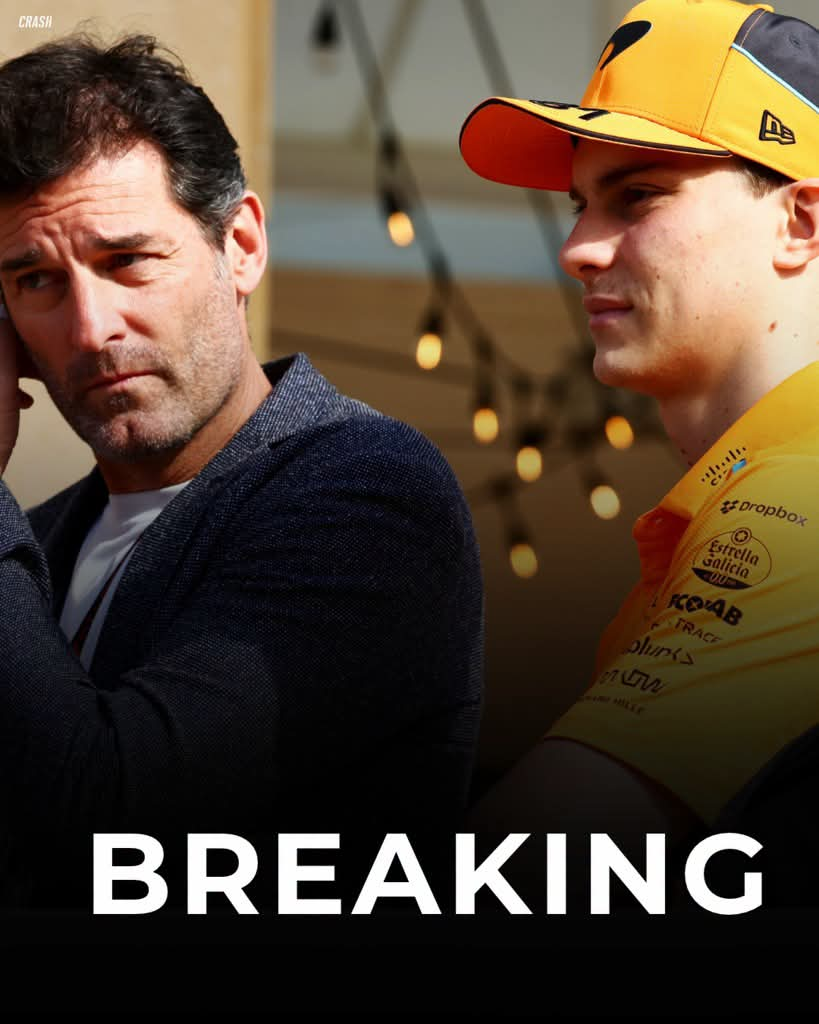
Oscar Piastri and Mark Webber have brought their long-running management partnership to a close. The McLaren driver and the nine-time Grand Prix winner, working alongside Ann Webber, mutually agreed to end their contract in a statement released on Monday after the Brazilian Grand Prix weekend.
The move ends a relationship that began in 2019, when Piastri was still climbing the junior ranks. It guided him through Formula Renault Eurocup success, Formula 3 and Formula 2 titles, the high-profile switch from Alpine’s junior program to McLaren, and his rapid rise into genuine championship contention.
Webber stepped back from a regular trackside presence ahead of the 2026 season. Piastri has been supported more closely at race weekends by former Prema Formula 2 race engineer Pedro Matos and performance coach Emma Murray. The formal termination of the management agreement now completes that transition.
A PARTNERSHIP THAT DELIVERED RESULTS FROM THE START
When Webber and Ann took on Piastri, the young Australian was already showing elite potential but still needed shrewd career navigation. Webber’s own experience as a Red Bull and Williams driver, combined with Ann’s long background in driver management, proved valuable. They helped position Piastri for a seat at McLaren just as the team began its resurgence under Zak Brown and Andrea Stella.
Piastri’s 2023 debut season delivered podiums. By 2025 he was leading the championship for long stretches and scoring multiple wins before a late-season drop left him third overall. That trajectory does not happen without strong guidance on contracts, commercial deals, and paddock politics. Both sides have been careful to stress the positive nature of the split.
Piastri said: “I’d like to thank Mark and Ann for all their support and advice over the years. Their guidance has been invaluable, particularly in navigating the beginning of my F1 career. I wish them all the best going forward.”
Webber responded in kind: “We are proud to have played a pivotal role in the formative years of Oscar’s career and to have placed him in F1 so that he could compete at the front so early on. Following our reduced trackside involvement this season, we have collectively agreed that now is an appropriate time to bring our management agreement to a close. This will allow Oscar to build on his achievements under a new management structure, and for us to embark on our new ventures. We wish Oscar all the very best for a long and successful career.”
The language is mutual, respectful, and forward-looking. That matters in a sport where public fallouts can create lasting friction.
WHY THE TIMING MAKES SENSE
Drivers often outgrow the structures that served them early on. Piastri is now 25, a proven race winner, and an established McLaren driver. The questions that once required Webber’s experience—how to handle team orders, media scrutiny, or long-term contract strategy—are ones Piastri can increasingly answer himself.
The reduced trackside role in 2026 already signaled evolution rather than rupture. Bringing Matos back into the fold created continuity with Piastri’s successful junior career, while Murray’s presence reflects the growing emphasis on mental performance in modern Formula 1. Formalizing a clean break allows both parties to move without lingering obligations.
There has been quiet speculation in the paddock about whether McLaren preferred a less confrontational management style after the intense 2025 title fight between Piastri and teammate Lando Norris. Webber was reportedly unimpressed by some of the team’s internal decisions during that campaign. Whether those tensions influenced the eventual split remains unconfirmed by either side. What is clear is that the official narrative presents a natural progression rather than a crisis.
IMPACT ON PIASTRI, MCLAREN, AND THE WIDER GRID
For Piastri, the change arrives during a more difficult 2026 campaign. He sits well back in the championship order after strong earlier seasons. A new management structure gives him the chance to reset commercial and strategic priorities while focusing purely on performance.
McLaren benefits from clarity. The team has invested heavily in both of its drivers. Removing any potential friction between the driver’s personal camp and the factory reduces one variable in an already complex environment. Stability around Piastri’s long-term future at the team looks more straightforward without an external manager who once pushed hard on his behalf.
Webber and Ann gain freedom to pursue other projects. Webber has remained a respected voice in the sport and may expand into broader advisory or media roles. Their success with Piastri strengthens their reputation for developing talent.
Across the grid, the move is another reminder that driver management in Formula 1 is rarely permanent. Relationships that work brilliantly in the junior categories and early F1 years often need recalibration once a driver becomes a proven commodity. Similar evolutions have occurred with other top talents as they mature and assert greater control.
WHAT COMES NEXT FOR THE AUSTRALIAN STAR
Piastri has not yet detailed his new management arrangements. That announcement will be closely watched. Options range from bringing commercial and performance support fully in-house under McLaren’s umbrella to appointing a new independent representative with different strengths.
The sporting priority remains performance. After challenging for the title in 2025, Piastri needs to re-establish consistent podium pace in the current regulations. A clearer personal structure can only help that process.
Longer term, the split may even strengthen his position. Drivers who successfully navigate early career management transitions often emerge more self-reliant and commercially sophisticated. Piastri already possesses the on-track talent. Greater ownership of his off-track affairs could accelerate the next phase of his career.
The Webber partnership delivered exactly what it was designed to deliver: a smooth, rapid rise into Formula 1 contention. Ending it on mutual terms, after the foundations were securely laid, looks like the logical next step for a driver ready to take fuller control of his own story.
Formula 1 rarely stands still. For Oscar Piastri, the next chapter begins without the manager who helped write the opening ones—and that, for a driver of his calibre, may prove exactly the right timing.