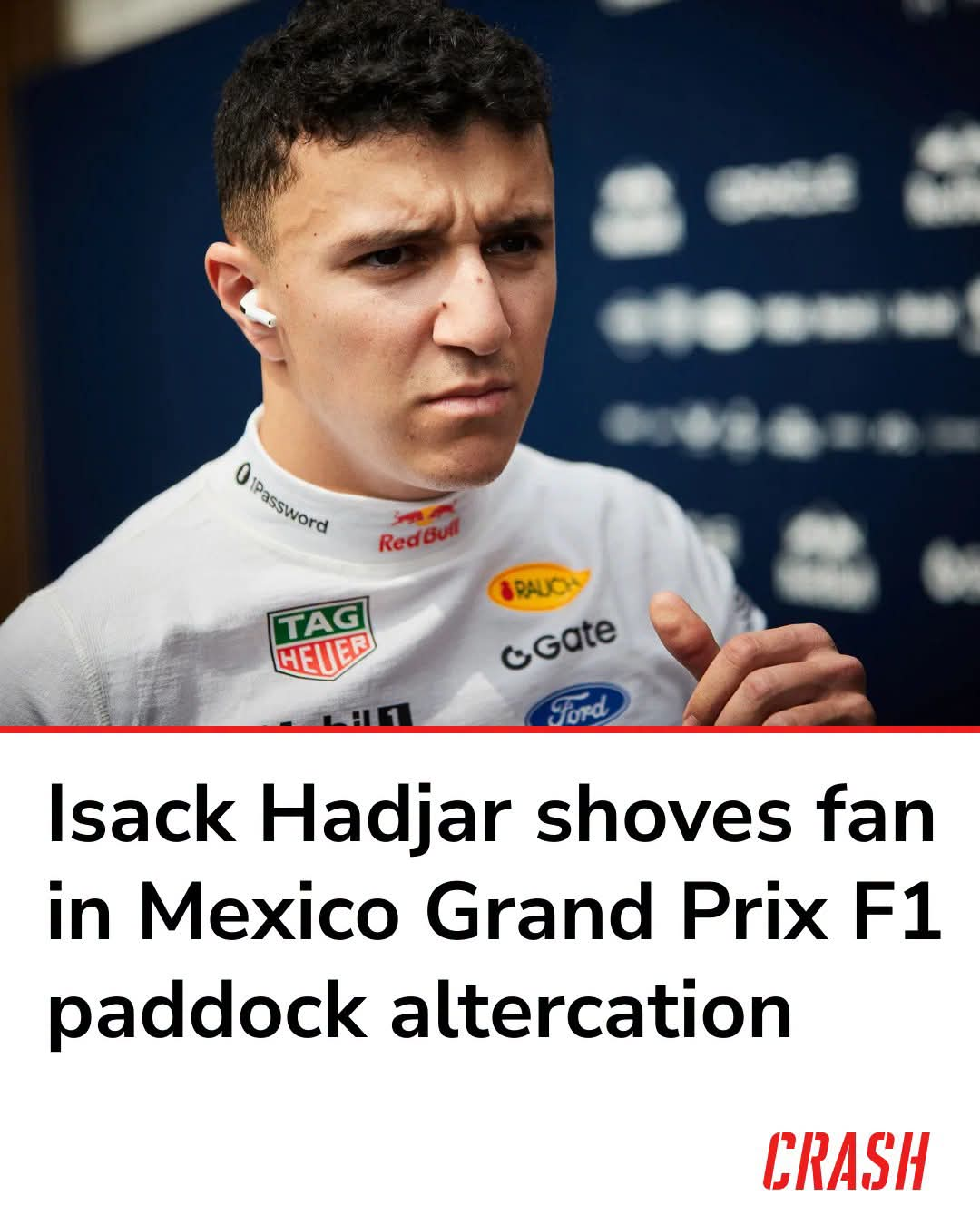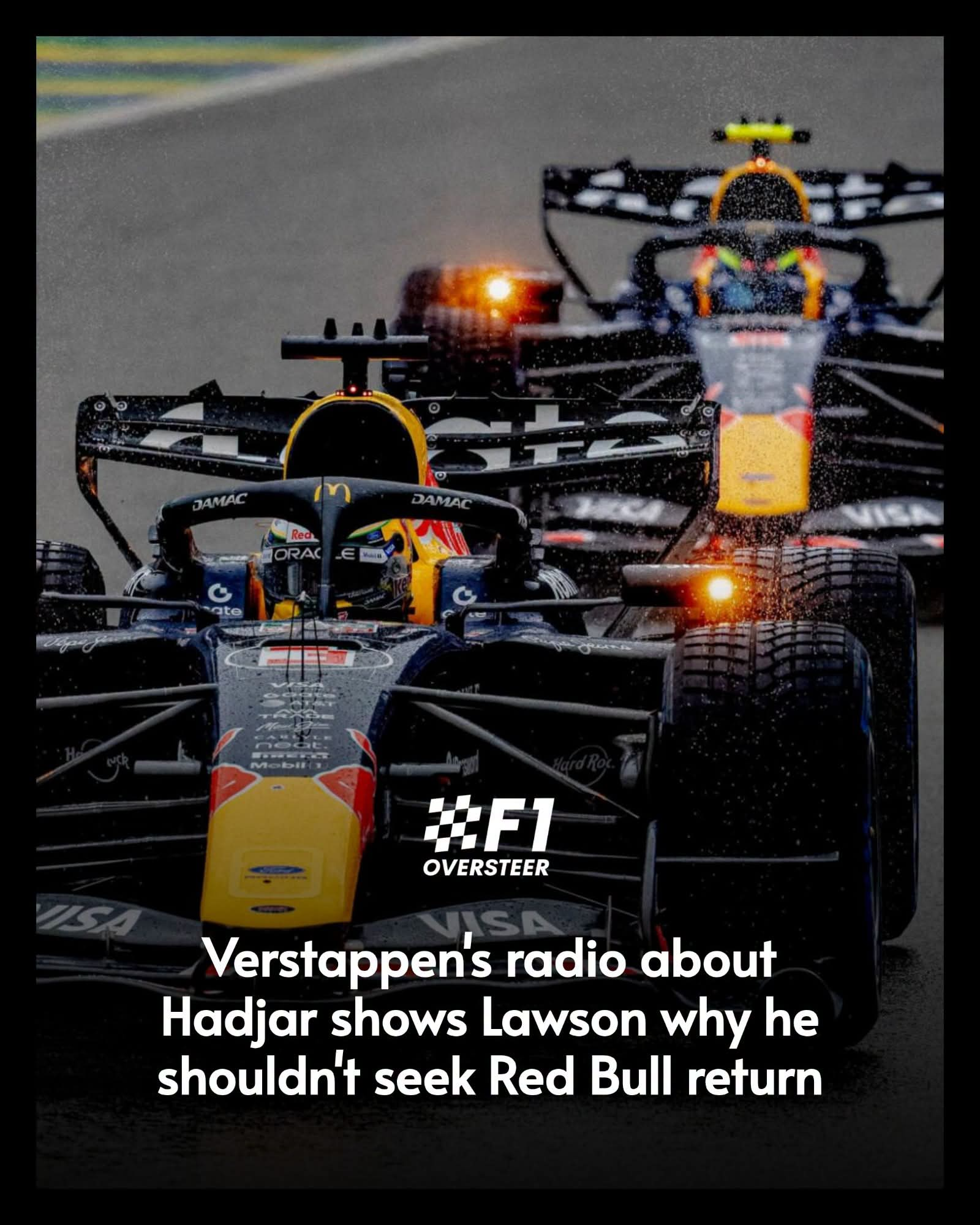
Max Verstappen’s reaction to Red Bull’s team orders during the 2026 São Paulo Grand Prix has raised fresh questions about the team’s approach to managing his teammates, with Isack Hadjar’s impressive podium finish becoming another example of the difficult position facing drivers alongside the four-time world champion.
Hadjar delivered one of his strongest performances of the season at Interlagos, finishing third behind race winner Lando Norris and Verstappen. The Frenchman had started fifth but benefited from penalties affecting George Russell and Charles Leclerc, eventually finding himself in second place during the race.
However, his opportunity to finish ahead of Verstappen disappeared when Red Bull instructed him to surrender his position after the Dutchman recovered from a back-of-the-grid start.
The most revealing moment came through an otherwise untelevised radio exchange. As Verstappen approached the podium positions, he asked his race engineer, Tom Hart, a brief question: “So?” Hart responded that Hadjar had been instructed to give him the position.
The exchange suggested Verstappen expected the order to happen. While team orders are not unusual in Formula 1, the circumstances surrounding this particular decision have reignited debate about whether Red Bull’s second driver is genuinely allowed to compete freely against its leading star.
For Liam Lawson, who has previously experienced the pressure of being Verstappen’s teammate, the situation could provide another reason to reconsider whether returning to the senior Red Bull team would be the best long-term move for his career.
VERSTAPPEN’S EXPECTATION OF TEAM ORDERS RAISES QUESTIONS
There was little surprise when Red Bull decided to move Verstappen ahead of Hadjar. The Dutchman had started from the back of the grid after taking a complete new engine and produced an extraordinary recovery to reach the podium positions.
His experience, race pace and ability to extract performance from difficult situations made him an obvious priority for the team. Red Bull also had an interest in maximising the points available from both drivers.
However, the controversy lies in whether the order was necessary.
Hadjar had been competitive throughout the race and was already running ahead of Verstappen before the instruction. Although a mistake had reduced the gap between the two Red Bull drivers, the Frenchman remained close enough to demonstrate that he was not simply occupying the position without maintaining competitive pace.
The situation therefore raised a reasonable question: should Red Bull have allowed the two drivers to race, at least until Verstappen demonstrated that he could make progress towards Norris?
Verstappen’s brief radio question was particularly interesting because it gave the impression that he already understood how the situation would be handled. Hart’s response confirmed that the team had instructed Hadjar to move aside.
There is nothing inherently unusual about a leading team prioritising its strongest championship contender. But repeated decisions of this nature can create an environment in which the second driver begins to understand that certain positions are effectively reserved for the team’s established star.
ISACK HADJAR’S PODIUM HIGHLIGHTS HIS GROWING VALUE TO RED BULL
Despite losing second place, Hadjar deserves considerable credit for his performance at Interlagos.
The Frenchman has made significant progress during the 2026 campaign, establishing himself as a competitive Formula 1 driver after his rookie season with Racing Bulls.
His latest podium was particularly impressive because he finished third despite having missed three races earlier in the season. He has now collected 122 points, a substantial improvement on the 51 points he managed during his previous campaign.
Those numbers underline how quickly Hadjar has developed. He has shown that he can compete at the front when given the right machinery, while his ability to remain close to Verstappen provides another encouraging indication of his potential.
The comparison with Verstappen is still difficult. The Dutchman remains one of the most accomplished drivers on the grid, and Hadjar has yet to finish ahead of him this season.
However, that does not mean Hadjar should automatically be treated as a supporting driver.
A young competitor joining a leading team needs opportunities to demonstrate his ability. If every promising performance is followed by an instruction to surrender position, it becomes increasingly difficult to measure what that driver could achieve when allowed to compete without restrictions.
Hadjar appears willing to accept the arrangement for now, especially because Red Bull offers the opportunity to fight for podiums and victories. But his long-term ambitions could eventually depend on whether the team gives him greater freedom.
LIAM LAWSON SHOULD THINK CAREFULLY BEFORE DREAMING OF A RED BULL RETURN
The situation is particularly relevant to Lawson because he has already experienced the pressure associated with competing in the Red Bull environment.
The New Zealander’s future remains an important talking point as the 2027 driver market approaches. Although he continues to fight for his place in Formula 1, the possibility of returning to the senior Red Bull team may still appeal to him.
However, the Hadjar situation highlights the potential disadvantages of such a move.
Red Bull’s structure is built around Verstappen, who has extended his contract until 2030. That gives the team long-term certainty over its leading driver and makes it difficult for any potential teammate to expect equal status.
A driver joining Red Bull would receive access to one of the sport’s strongest organisations and potentially a car capable of fighting for championships. But that opportunity could come with significant limitations.
Lawson would need to ask himself whether joining Red Bull would genuinely improve his career or simply place him in another environment where his main responsibility is supporting Verstappen.
For a young driver trying to establish himself, regular opportunities to compete for strong results may be more valuable than a prestigious seat that offers limited freedom.
WHY A MIDFIELD TEAM COULD OFFER LAWSON A BETTER FUTURE
One argument is that Lawson could benefit more from joining a midfield team with serious long-term ambitions than continuing to pursue a return to Red Bull.
Such a move would not necessarily provide immediate opportunities to fight for podiums, but it could offer something equally important: a chance to become the central figure in a team’s development.
At a midfield organisation, Lawson could potentially receive greater responsibility, build a stronger relationship with the engineering department and establish himself as a driver capable of leading a project.
That experience could improve his reputation across the paddock.
Formula 1 teams do not evaluate drivers solely by the number of victories they have achieved. Consistency, technical feedback, qualifying performances, race management and the ability to extract maximum performance from a car all contribute to a driver’s value.
A strong season with a developing team could therefore create opportunities that might not be available if Lawson remains focused on becoming Verstappen’s next teammate.
There is also a practical consideration. Verstappen’s contract through 2030 makes the senior Red Bull seat a difficult target for anyone expecting to build a long-term championship project around themselves.
Lawson may eventually get another opportunity, but he should not assume that a return to Red Bull automatically represents the best outcome.
RED BULL’S SECOND DRIVER PROBLEM IS BECOMING HARDER TO IGNORE
Red Bull has repeatedly faced questions about its ability to find a teammate capable of delivering consistent performances alongside Verstappen.
The challenge is understandable. Verstappen operates at an exceptionally high level, and any driver joining the team must adapt quickly to its car, working environment and expectations.
However, the organisation also needs a second driver capable of contributing strongly to the constructors’ championship.
A team cannot depend entirely on one competitor if it wants to maintain consistent success. Strong performances from both cars provide strategic flexibility, increase the number of available points and make it more difficult for rivals to exploit weaknesses.
Hadjar’s Brazilian Grand Prix performance demonstrated that Red Bull may have found a driver capable of delivering valuable results.
Yet the team must also consider the psychological impact of its decisions. If a second driver repeatedly receives instructions to move aside, even when competitive, it could affect confidence and create uncertainty about their actual position within the organisation.
That does not mean Red Bull should abandon team orders. There are situations where prioritising one driver is strategically sensible, particularly when a championship is at stake.
But the team must establish clear principles. Drivers need to understand when they are free to race, when they are expected to support a teammate and what circumstances justify changing positions.
Without that clarity, frustration can develop even when both competitors are delivering strong results.
VERSTAPPEN’S CONTRACT MAKES THE RED BULL SEAT EVEN MORE COMPLICATED
Verstappen’s extended contract until 2030 is another important part of this discussion.
The Dutchman has become the central figure around whom Red Bull’s Formula 1 operation is organised. His experience, technical understanding and ability to deliver results make him extremely valuable to the team.
From Red Bull’s perspective, protecting that relationship is an obvious priority.
However, the contract also creates a difficult situation for potential teammates. Anyone joining the team must recognise that Verstappen is not simply another driver competing for the same position. He is the established leader of the project.
For Hadjar, the immediate opportunity to compete in a front-running car may make that arrangement worthwhile. He is still developing and has plenty of time to establish his reputation.
For Lawson, the calculation could be different. He needs stability, consistent performances and a secure future in Formula 1. Returning to Red Bull without a realistic opportunity to compete freely could create more pressure than progress.
The strongest career decision may therefore involve looking beyond the prestige of the team and identifying where he can become a more complete and valuable driver.
HADJAR AND LAWSON FACE DIFFERENT DECISIONS AHEAD OF 2027
Although the two drivers are connected by the Red Bull system, their situations are not identical.
Hadjar has demonstrated that he can deliver podium-level performances and is currently benefiting from the opportunity to race at the front. His immediate challenge is to maintain that progress while adapting to the expectations of a leading team.
Lawson, meanwhile, must concentrate on securing his place in Formula 1 and identifying the environment that offers the strongest long-term prospects.
Both drivers will be watching how Red Bull handles its second-seat situation. The team’s decisions could influence not only its own driver line-up but also the wider market as teams evaluate available talent.
The Brazilian Grand Prix may ultimately be remembered as another successful weekend for Red Bull, with Verstappen finishing second and Hadjar completing the podium.
But beneath the impressive result lies a bigger question about the team’s internal structure.
If Red Bull wants to develop a genuinely competitive second driver, it must provide opportunities to challenge rather than simply expecting that driver to support Verstappen.
For Lawson, the message is equally important: returning to Red Bull should not be the ultimate ambition if another team can offer a better platform for his career. A prestigious seat is valuable, but having the freedom to prove his ability could be even more important.