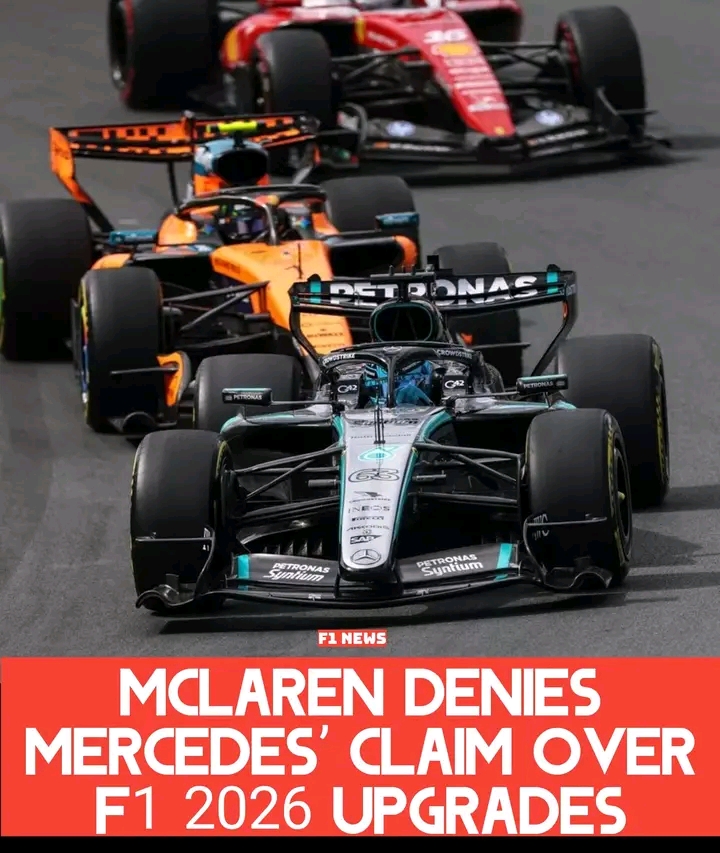
The Formula 1 development war is entering a fascinating phase, with McLaren and Mercedes taking very different approaches to the remainder of the 2026 season.
Following the Dutch Grand Prix, McLaren has pushed back against suggestions that Mercedes’ quieter upgrade schedule means the Silver Arrows have been outdeveloped. The disagreement highlights one of the most important battles beneath the headline race results: which team can extract the most performance from its 2026 concept while working within the cost cap?
McLaren has enjoyed a clear recent surge, with Lando Norris claiming consecutive victories in Hungary and the Netherlands. Mercedes, meanwhile, has been more conservative with its development programme, carefully managing resources and deciding when major upgrades can produce the greatest competitive return.
That does not necessarily mean Mercedes has stopped progressing.
Instead, the situation could represent two different philosophies for attacking the second half of a Formula 1 season.
MERCEDES REFUSES TO PANIC OVER UPGRADE TIMING
Mercedes’ decision not to introduce a constant stream of major upgrades should not automatically be interpreted as a sign that the team has fallen behind.
Under Formula 1’s cost-cap environment, teams cannot simply spend without limits whenever a rival produces a performance gain. Every development decision has to be considered in terms of manufacturing costs, aerodynamic potential, reliability and the number of races remaining.
For Mercedes, the timing of an upgrade can therefore be just as important as the upgrade itself.
A package introduced too early may provide an immediate benefit but leave the team without sufficient resources for another major development later in the season. A carefully timed package, however, could deliver a larger competitive advantage when the championship battle becomes more decisive.
That strategy could explain why Mercedes appears less aggressive than McLaren at this stage.
The bigger question is whether Mercedes’ patience will ultimately pay off.
McLAREN HAS TURNED DEVELOPMENT INTO MOMENTUM
McLaren’s recent results suggest that its latest development work has been highly effective.
Norris’ victories in Hungary and the Netherlands have transformed the narrative around the team. Rather than simply possessing a fast car over one particular circuit type, McLaren is increasingly demonstrating the ability to convert technical improvements into race-winning performance.
The Dutch Grand Prix was particularly significant because of the demands placed on the cars.
Zandvoort requires strong aerodynamic efficiency, confidence through high-speed corners and a platform capable of maintaining performance across a demanding lap. McLaren’s progress in those areas has not gone unnoticed.
Mercedes drivers Kimi Antonelli and George Russell have both acknowledged the step McLaren has made, particularly in high-speed performance.
That admission is important because it demonstrates that the performance gap is not merely being created by qualifying execution or race strategy.
McLaren appears to have found genuine performance through development.
NORRIS STILL SEES A STRENGTH IN THE MERCEDES PACKAGE
Despite McLaren’s recent success, Norris’ assessment provides an intriguing twist.
The McLaren driver believes Mercedes still possesses the stronger all-round car in certain areas, particularly through slower corners.
That suggests the competitive picture is considerably more complicated than simply declaring McLaren the new benchmark.
A Formula 1 car can gain time in several different ways. One team may have an advantage through high-speed corners, another through traction and slow-speed rotation, while a third could be stronger on tyre management.
The importance of those characteristics also changes from circuit to circuit.
That could make the upcoming races particularly interesting.
If McLaren’s advantage is strongest on high-speed layouts while Mercedes remains competitive in slower sections, neither team can afford to assume that the current order will remain unchanged.
KIMI ANTONELLI AND GEORGE RUSSELL FACE A NEW CHALLENGE
The development battle also has major implications for Mercedes’ drivers.
George Russell has established himself as one of Mercedes’ most consistent performers, while Kimi Antonelli continues to develop his reputation as one of the most exciting young talents on the grid.
But a rapidly improving McLaren creates an additional challenge.
Drivers can only exploit the performance their cars provide. If McLaren continues closing the gap or moving ahead in key areas, Mercedes will need its drivers to maximize every qualifying opportunity and capitalize on strategic openings.
For Antonelli in particular, this phase of the season could be an important learning experience.
The young Italian is not simply competing against Russell anymore. He is also learning how to operate in a championship environment where technical development can change the competitive order from one race to another.
Russell, meanwhile, will be expected to provide Mercedes with consistency while the team searches for additional performance.
WHY MCLAREN IS NOT ABANDONING THE 2026 CAR
One of the most interesting aspects of the situation is McLaren’s apparent commitment to continuing development of its current car.
With teams already looking toward future regulations and next-generation projects, there is always a temptation to shift resources toward the following season.
McLaren appears unwilling to do that prematurely.
That makes sense.
A team that is already fighting for victories has an opportunity to collect valuable points, strengthen its championship position and learn more about its technical concept. Abandoning development too early could surrender opportunities that may not return.
The key is finding the correct balance between current-season performance and future preparation.
McLaren’s willingness to keep developing the 2026 machine suggests the team believes there is still meaningful performance available.
THE COST CAP MAKES THIS DEVELOPMENT WAR DIFFERENT
The modern Formula 1 development race is fundamentally different from the unrestricted spending battles of previous eras.
Under the cost cap, teams have to prioritize.
Every major floor revision, aerodynamic component or suspension-related development carries an opportunity cost. Resources committed to one project cannot simply be redirected without consequences.
That makes the McLaren-Mercedes battle particularly fascinating.
McLaren’s recent upgrades appear to have delivered an immediate competitive return. Mercedes, meanwhile, seems to be placing greater emphasis on development timing.
Neither approach is automatically correct.
The winner could ultimately be the team that makes the fewest costly mistakes.
THE CHAMPIONSHIP COULD BE DECIDED BY DEVELOPMENT
The significance of this battle extends beyond individual races.
If McLaren can maintain its recent momentum, Norris could become an increasingly serious factor in the championship fight. Consecutive victories provide more than points; they create confidence throughout the organization.
Mercedes cannot afford to allow that momentum to continue unchecked.
Even a relatively small performance deficit can become significant over several races. A team that consistently finishes second or third behind a rival may eventually lose a substantial number of championship points.
That is why Mercedes’ next major upgrade could be so important.
If the package delivers the expected performance, the competitive order could tighten dramatically. If it fails to produce a meaningful gain, McLaren could establish a much stronger advantage heading into the final stages of the season.
WHAT COULD HAPPEN AT THE ITALIAN GRAND PRIX?
The Italian Grand Prix should provide another useful test of the two concepts.
Monza’s characteristics are very different from Zandvoort. Long straights, heavy braking zones and low-downforce requirements place different demands on the cars.
That could expose strengths and weaknesses that were less obvious in the Netherlands.
If McLaren remains highly competitive, it would strengthen the argument that its latest development package has produced a genuine all-round improvement rather than a circuit-specific advantage.
If Mercedes responds strongly, however, it could demonstrate that the Silver Arrows’ current package remains fundamentally competitive.
Either outcome would provide valuable evidence about the direction of the championship.
OUR VERDICT ON THE MCLAREN-MERCEDES BATTLE
The biggest mistake would be to assume Mercedes is finished simply because McLaren has enjoyed a stronger recent run.
Formula 1 development rarely moves in a straight line.
McLaren has clearly made an important step, and Norris’ consecutive victories are the strongest evidence of that progress. But Mercedes still appears to possess competitive strengths, particularly in slower corners, while its development programme is being managed with the cost cap in mind.
The real battle may therefore be about who develops smarter rather than who develops more.
McLaren has momentum.
Mercedes has time to respond.
And with both teams continuing to invest in their 2026 cars, the fight could become one of the defining technical stories of the second half of the Formula 1 season.
For Norris, Russell and Antonelli, that means every qualifying session and every race could become increasingly important. For the teams, the next upgrade may not simply change lap time—it could change the championship narrative entirely.
FINAL THOUGHTS
McLaren’s recent resurgence has undoubtedly raised the pressure on Mercedes, but the Silver Arrows’ quieter development schedule should not be mistaken for surrender.
The coming races will reveal whether Mercedes’ calculated approach can match McLaren’s aggressive momentum.
One thing already seems clear: the 2026 development war is far from over, and the team that gets its next major decision right could gain a crucial advantage when the championship reaches its decisive phase.