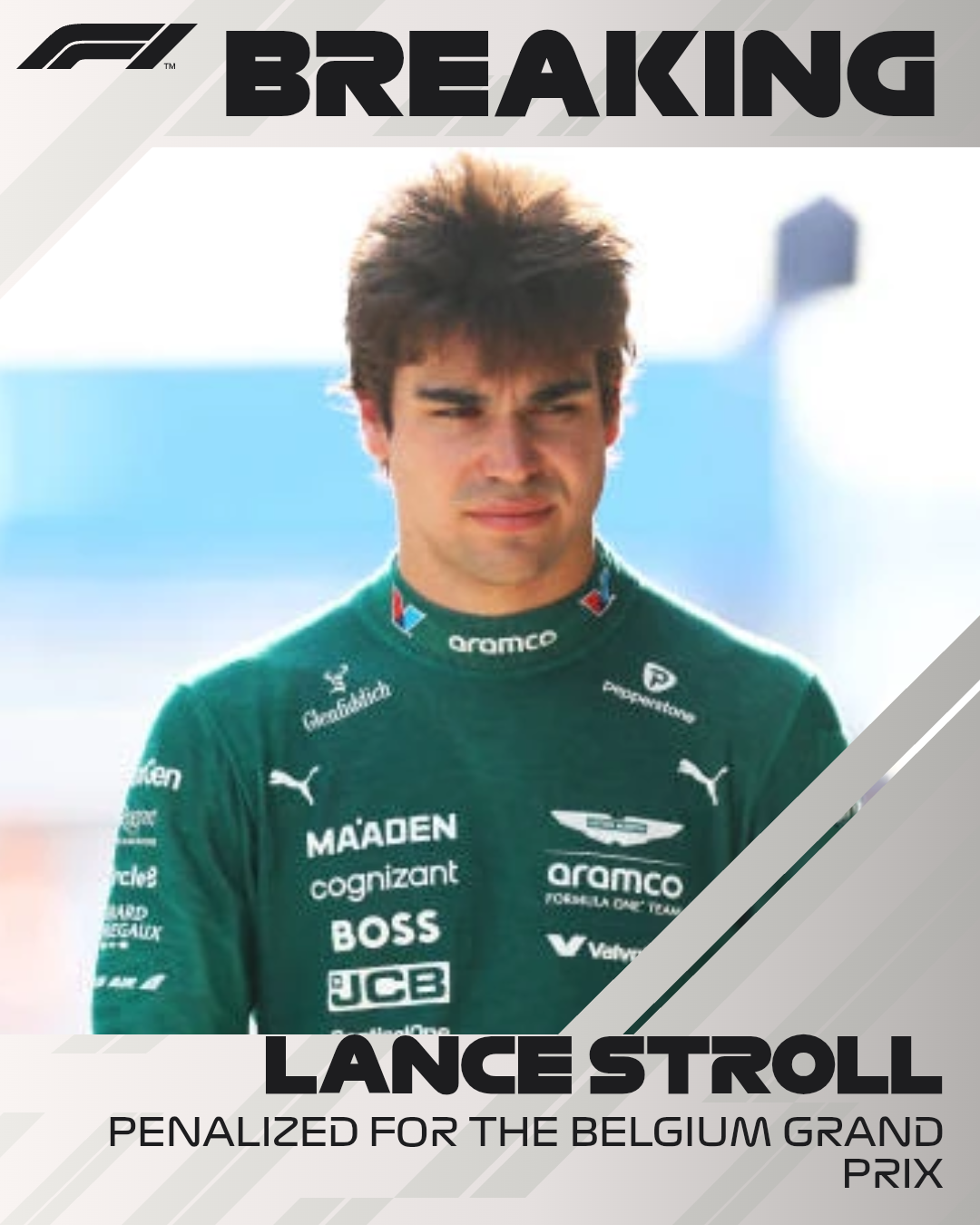
Aston Martin’s Belgian Grand Prix weekend has become significantly more challenging after Lance Stroll was handed a 10-place grid penalty for exceeding his permitted allocation of MGU-K components. The penalty comes at a pivotal stage of the 2026 Formula 1 season, where every championship point carries increased importance and teams are carefully managing both performance upgrades and power unit reliability.
While Spa-Francorchamps offers more overtaking opportunities than many circuits on the calendar, losing ten places before qualifying even begins creates a difficult task for both Stroll and Aston Martin. The Canadian driver will now need an aggressive recovery drive if he hopes to score valuable points on Sunday.
WHY STROLL HAS BEEN PENALIZED
Formula 1’s power unit regulations place strict limits on how many key components each driver can use throughout the season. The MGU-K, which recovers kinetic energy under braking and converts it into additional electrical power, is one of the most important elements of the hybrid power unit.
By exceeding his permitted allocation, Stroll automatically triggered a 10-place grid penalty under FIA Sporting Regulations. The rule is designed to prevent teams from freely introducing fresh components throughout the year while encouraging manufacturers to build durable and reliable power units.
Although painful from a sporting perspective, teams occasionally accept these penalties when reliability concerns outweigh the disadvantages of starting further down the grid.
WHY ASTON MARTIN MAY HAVE ACCEPTED THE PENALTY
For Aston Martin, taking the penalty now could prove to be a calculated strategic decision rather than an unavoidable setback.
Spa-Francorchamps is widely regarded as one of Formula 1’s best circuits for overtaking, thanks to long straights such as the Kemmel Straight and multiple heavy braking zones. If a team must serve an engine-related penalty, Belgium is often considered one of the more forgiving venues compared to tighter circuits like Monaco or Hungary.
Installing a fresh MGU-K could also improve reliability for the remaining races, reducing the likelihood of costly retirements later in the championship.
THE IMPACT ON ASTON MARTIN’S RACE WEEKEND
The penalty immediately changes Aston Martin’s priorities heading into qualifying.
Rather than focusing solely on securing the highest possible grid position, the team must now build a race package capable of making consistent overtaking progress. That could influence setup choices, tire strategy, and even aerodynamic balance, with greater emphasis placed on straight-line speed and race pace instead of one-lap performance.
Fernando Alonso, starting without the same penalty, could also become central to Aston Martin’s hopes of maximizing points while the team works to recover Stroll through the field.
WHY POWER UNIT MANAGEMENT IS BECOMING MORE IMPORTANT
The 2026 Formula 1 season has already highlighted how critical reliability has become under the current regulations.
Several teams have already been forced into engine-related penalties after encountering unexpected failures or introducing upgraded components. As manufacturers continue developing increasingly complex hybrid systems, balancing outright performance with durability has become one of the defining challenges of modern Formula 1.
For Aston Martin, avoiding further component penalties later in the season may ultimately justify sacrificing grid position this weekend.
CAN STROLL RECOVER AT SPA?
History suggests Spa-Francorchamps offers genuine opportunities for recovery drives.
Its combination of high-speed sections, slipstreaming opportunities, and unpredictable weather frequently produces dramatic races where drivers starting outside the top ten can fight back into the points. Safety Cars and changing conditions have also played decisive roles at Spa over the years, creating strategic opportunities for teams willing to gamble.
If Aston Martin delivers a competitive race car and executes its strategy effectively, Stroll could still emerge from Belgium with a valuable points finish despite the setback.
WHAT THIS MEANS FOR THE CHAMPIONSHIP
While a single grid penalty rarely defines a season, it illustrates the increasingly fine margins separating success and disappointment in Formula 1.
Every decision surrounding engine components now involves weighing immediate performance against long-term reliability. Teams chasing championship positions cannot simply think about one race—they must consider the remaining calendar and the risk of additional penalties down the road.
For Aston Martin, the Belgian Grand Prix now becomes a test of resilience. Stroll’s challenge will not simply be overcoming a 10-place penalty but proving that smart strategy, racecraft, and a reliable package can still turn a difficult weekend into a productive one. With Spa known for producing unforgettable races, Aston Martin will believe recovery remains well within reach.