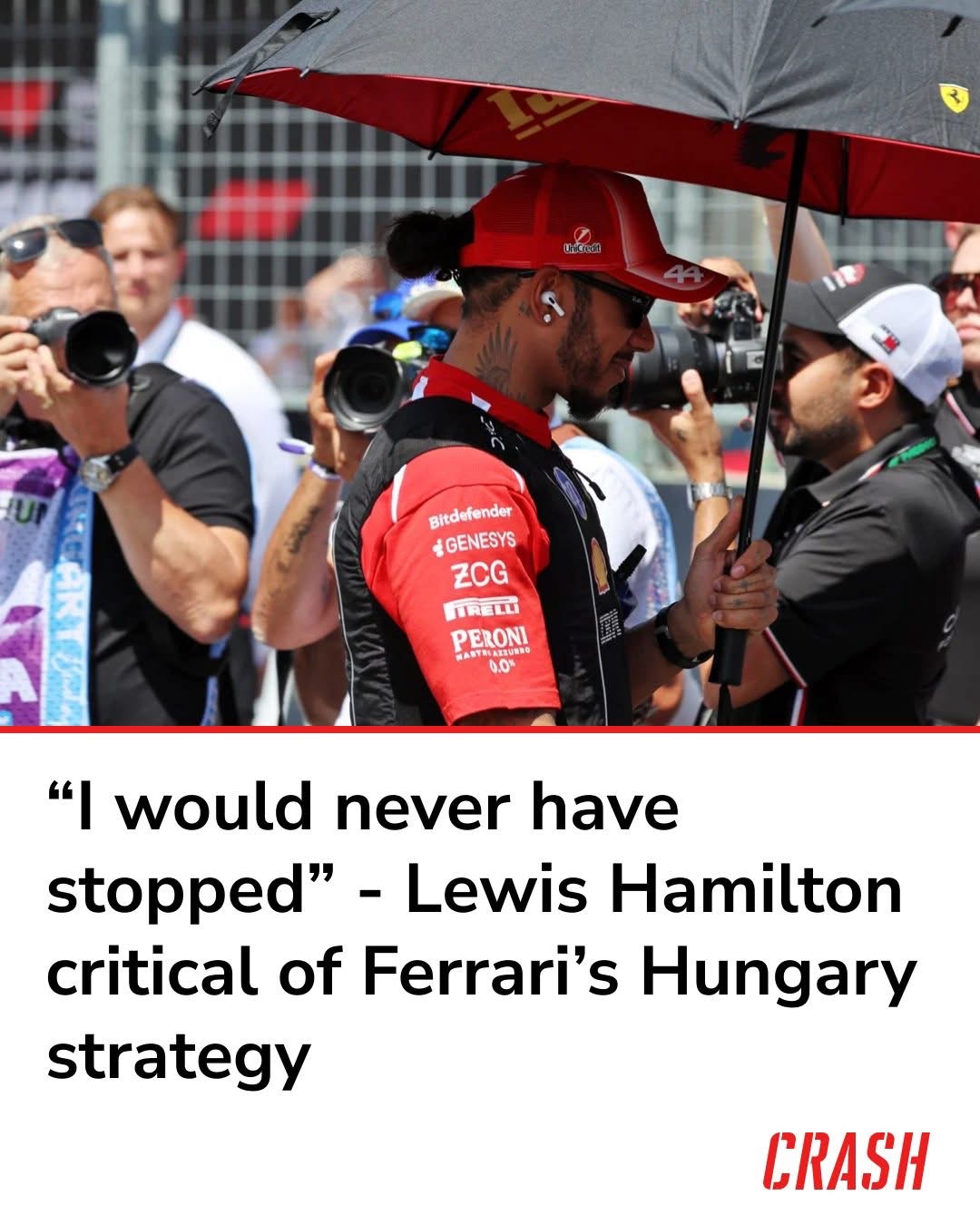
Ferrari’s hopes of securing a strong result at the 2026 Hungarian Grand Prix ended in frustration after a controversial late-race strategy call left Lewis Hamilton questioning one of the team’s biggest decisions of the afternoon. The seven-time Formula 1 world champion openly admitted he would have chosen a completely different approach during the closing stages, believing the decision ultimately cost him valuable championship points.
The race highlighted both Ferrari’s improving pace and the fine margins that continue to separate success from disappointment in Formula 1. While the Scuderia appeared capable of fighting near the front throughout the weekend, a combination of penalties, strategic decisions, and unfortunate circumstances ensured the team left the Hungaroring empty-handed when it came to podium finishes.
HAMILTON BELIEVES TRACK POSITION SHOULD HAVE BEEN THE PRIORITY
Hamilton entered the race already facing an uphill battle after receiving a three-place grid penalty, dropping from an impressive qualifying result to fifth on the starting grid. Despite that setback, the Ferrari driver produced an excellent recovery drive, steadily working his way through the field and positioning himself in second place after his second round of pit stops.
Everything changed when Oscar Piastri’s car stopped on circuit with a gearbox issue, triggering a Virtual Safety Car. Ferrari seized what appeared to be an opportunity by calling Hamilton into the pits for fresh soft tyres, expecting the reduced speed under VSC conditions to minimize the time lost during the stop.
However, the gamble failed to deliver the desired outcome.
Hamilton rejoined in third position but was forced into an awkward situation involving Mercedes rookie Andrea Kimi Antonelli. To avoid the risk of a penalty for potentially overtaking under Virtual Safety Car conditions, Hamilton surrendered the position, immediately undoing much of the intended benefit from the strategy.
Reflecting after the race, Hamilton made it clear he would have preferred to stay on track rather than sacrifice valuable track position.
From a driver’s perspective, defending a podium with worn tyres can often be preferable to rejoining behind rivals, especially on a circuit like the Hungaroring where overtaking remains notoriously difficult. Hamilton acknowledged Max Verstappen, running fresher tyres, may eventually have caught him, but believed finishing second—or at worst third—was a realistic possibility had Ferrari kept him out.
PIT LANE PENALTY TURNED A DISAPPOINTING DAY INTO A COSTLY ONE
If the strategy decision wasn’t damaging enough, Hamilton’s afternoon became even more frustrating after the chequered flag.
A five-second penalty for speeding in the pit lane demoted him from fourth to fifth in the final classification, costing additional championship points in an increasingly competitive title race.
The incident added another chapter to what has become an unusually penalty-heavy period for one of Formula 1’s most experienced drivers.
Over the past three race weekends, Hamilton has accumulated multiple penalties, including a false start sanction at Silverstone, a collision penalty at Spa, a grid penalty for impeding during Hungarian Grand Prix qualifying, and now the pit lane speeding infringement.
For a driver renowned throughout his career for precision and consistency, the recent string of mistakes represents an uncommon dip in execution. While none of the incidents individually define his season, together they have significantly reduced Ferrari’s points haul during a critical phase of the championship.
HAMILTON QUESTIONS THE CONSISTENCY OF FIA DECISIONS
Hamilton also revisited several recent stewarding decisions, arguing that Formula 1 still faces challenges in delivering consistent rulings.
He pointed specifically to discussions held during drivers’ briefings regarding false starts, suggesting that similar incidents have received different interpretations in previous races. Hamilton maintained that his Silverstone penalty felt unnecessarily harsh because he had not fully left his grid box before the lights went out.
He also questioned the penalty issued following his collision with George Russell at Spa, noting that even Russell himself viewed the incident as a normal racing accident.
Although Hamilton accepted responsibility for his qualifying impeding penalty in Hungary, admitting he should have been more aware of traffic behind him, his broader comments underline a concern shared by many drivers: consistency remains one of Formula 1’s biggest officiating challenges.
As FIA regulations become increasingly detailed, drivers continue pushing for clearer standards that reduce uncertainty when racing wheel-to-wheel at the highest level.
FERRARI’S STRATEGY WILL FACE INCREASED SCRUTINY
Perhaps the biggest talking point emerging from Budapest is Ferrari’s race management.
The Scuderia has shown considerably stronger pace throughout the 2026 season than in previous campaigns, frequently placing both drivers in contention for podium finishes. Yet strategy has remained an area where the team occasionally leaves opportunities on the table.
Calling Hamilton into the pits during the Virtual Safety Car was likely based on sophisticated simulations predicting the advantage of fresh soft tyres. On paper, the numbers may have supported the decision. In reality, however, Formula 1 races rarely unfold exactly as computer models predict.
The VSC restart, traffic, and subsequent battle for position combined to erase much of the theoretical gain. Hamilton’s criticism suggests there may have been a disconnect between the team’s strategic calculations and what the driver was experiencing from inside the cockpit.
These situations often spark valuable post-race analysis within teams, as engineers review whether simulations adequately accounted for real-world race dynamics.
FERRARI’S MISSED OPPORTUNITY COULD HAVE CHAMPIONSHIP CONSEQUENCES
Hungary was widely viewed as one of Ferrari’s strongest opportunities to secure a major result this season. The characteristics of the Hungaroring traditionally suit the Ferrari package, and expectations inside the paddock were high heading into the weekend.
Instead, neither Ferrari driver reached the podium.
In a championship where every point could prove decisive, missing out on a potential second-place finish may become increasingly significant as the season progresses. Hamilton’s recovery drive demonstrated that both driver and car possessed genuine race-winning pace, making the final result feel even more frustrating.
The team now faces the challenge of ensuring similar strategic misjudgments do not become a recurring theme. While Ferrari’s outright speed appears capable of challenging the frontrunners consistently, converting that pace into trophies will require flawless execution in every department—from qualifying discipline to race strategy and pit lane operations.
WHAT THIS MEANS FOR THE REST OF THE SEASON
Despite the disappointment, Ferrari can still draw positives from the Hungarian Grand Prix. Hamilton’s pace through the field reinforced the competitiveness of the SF-26, while the team’s ability to challenge near the front suggests victories remain well within reach.
However, Formula 1 championships are rarely won through speed alone. They are secured by combining performance with strategic precision, operational excellence, and minimizing costly mistakes.
Hamilton’s public comments should not be viewed simply as criticism but as a reflection of the incredibly high standards expected within a championship-contending team. Ferrari has made undeniable progress in 2026, but races like Hungary serve as reminders that the smallest strategic decisions can determine whether a team celebrates on the podium or leaves wondering what might have been.
With the season entering a crucial stretch, Ferrari’s ability to learn from Budapest may prove just as important as any future upgrade package. If the Scuderia can eliminate these costly errors, Hamilton could yet transform competitive performances into the victories and championship challenge both he and Ferrari are chasing.