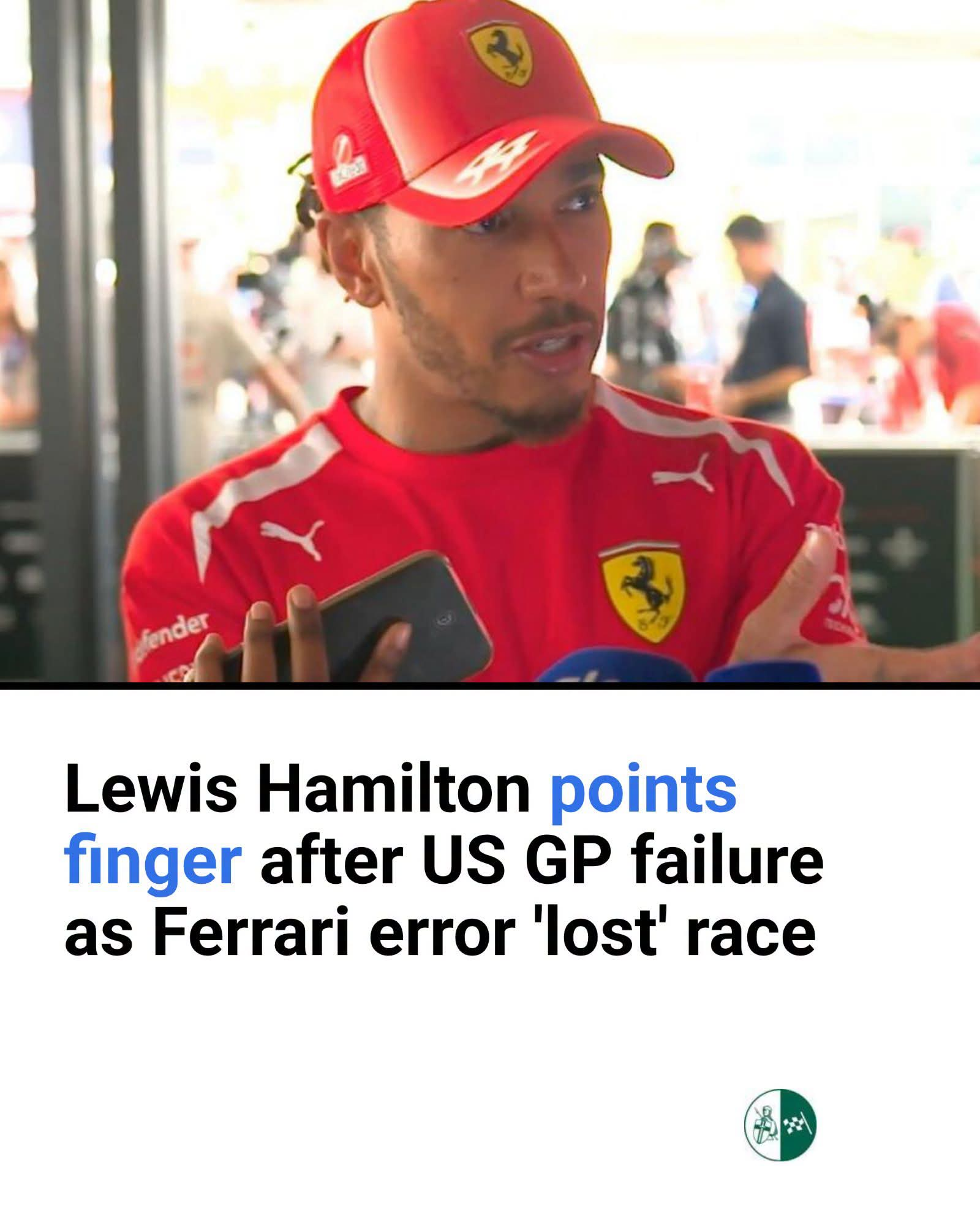
Lewis Hamilton has pointed to Ferrari’s early-race car balance problems as a major reason he missed out on a podium finish at the 2026 United States Grand Prix, insisting that the decisive damage had been done long before a late Virtual Safety Car disrupted his charge.
Ferrari arrived at the Circuit of the Americas hoping to place both drivers inside the top three. While Charles Leclerc delivered a strong performance to finish second behind race winner Kimi Antonelli, Hamilton had to settle for fourth after narrowly missing out on a late opportunity to challenge Max Verstappen.
The result offered Ferrari valuable encouragement, but it also exposed a problem that could prove costly as the team continues its fight against Mercedes and Red Bull. Hamilton believes the Scuderia could have achieved more if the car had started the race with a better balance.
HAMILTON BLAMES EARLY-RACE STRUGGLES FOR MISSED PODIUM
Hamilton was frustrated by the handling of his Ferrari during the opening stages, particularly through the slower corners at the Circuit of the Americas.
The seven-time world champion struggled to rotate the car, experiencing significant understeer that prevented him from carrying the speed he wanted through the tighter sections. While his rivals were able to build an advantage, Hamilton found himself losing valuable time.
When asked about the late Virtual Safety Car, which interrupted his attempt to catch Verstappen, Hamilton explained that he did not believe the neutralisation was the main reason he missed the podium.
Instead, he pointed towards the first two stints as the period when his race had effectively slipped away.
His assessment was clear: Ferrari had not given him the balance required to fight consistently at the front during the early stages. By the time the car began responding more effectively, too much ground had already been lost.
Hamilton explained that he had been making adjustments to his settings throughout the race. Although the balance improved during the final stint, he felt the team should have found that setup much earlier.
That admission raises questions about Ferrari’s preparation and its ability to translate practice performance into race-day competitiveness.
VIRTUAL SAFETY CAR INTERRUPTS HAMILTON’S LATE CHARGE
Despite his early difficulties, Hamilton showed considerable pace towards the end of the race.
He made a strong start, passing Isack Hadjar during the opening lap, while Leclerc also moved forward and managed to get ahead of Verstappen. Hamilton briefly found himself alongside his former rival but ultimately had to abandon the challenge.
As the race progressed, the Briton’s lack of front-end response made it difficult to attack effectively. However, Ferrari’s decision to use a two-stop strategy gave him fresher tyres for the closing stages.
Hamilton began taking advantage of that grip after emerging from the pit lane in sixth place. He moved past Hadjar and then got ahead of Lando Norris, putting himself in position to challenge Verstappen for the final podium spot.
The gap narrowed to approximately one second, giving Hamilton a realistic opportunity to attack.
However, with four laps remaining, Valtteri Bottas encountered a problem with his Cadillac, triggering a Virtual Safety Car. The neutralisation slowed the field and interrupted Hamilton’s momentum, allowing Verstappen to preserve his position.
Verstappen later acknowledged that the VSC may have helped him avoid losing third place.
Hamilton was left to consider what might have happened without the interruption. Nevertheless, his own assessment suggests that the decisive factor was not simply bad timing at the end, but the performance deficit he had experienced earlier in the race.
CHARLES LECLERC DELIVERS THE RESULT FERRARI NEEDED
While Hamilton struggled to find the right balance, Leclerc enjoyed a more competitive afternoon and secured second place.
The Monegasque had been disappointed with Ferrari’s qualifying performance after the team showed encouraging speed during practice. Sunday’s race, however, offered a more positive picture.
Leclerc acknowledged that the opening stint had been challenging, particularly as Antonelli pursued a different strategy with a single pit stop. Ferrari’s two-stop approach gave its drivers fresher tyres later in the race, but it also meant managing the strategic trade-off between tyre performance and track position.
Leclerc said the team had not been in a position to fight for victory, but he considered the race a positive result because of the car’s pace and the battles he enjoyed.
His recovery to second place demonstrated that Ferrari could compete effectively when the balance and circumstances came together. It also ensured that the team left Austin with a podium finish despite Hamilton’s disappointment.
The contrast between the two Ferrari drivers will be particularly interesting for the engineers. Leclerc’s result suggests the car had enough potential to challenge near the front, while Hamilton’s experience highlights how sensitive that performance can be to setup and handling.
FERRARI’S STRATEGY WORKED, BUT THE SETUP CAME TOO LATE
Ferrari’s two-stop strategy gave both drivers the opportunity to attack on fresher tyres during the final stint. Leclerc used that advantage to secure second, while Hamilton recovered positions and came close to taking third.
However, tyre strategy alone could not compensate for the time Hamilton had lost earlier.
Understeer can be especially damaging at a circuit such as Austin, where drivers must navigate a combination of fast changes of direction and slower corners that demand precise front-end response. If a car refuses to rotate properly, a driver may be forced to reduce speed or take a less effective line, allowing competitors to pull away.
That makes Hamilton’s comments about the early balance particularly significant. Ferrari eventually moved closer to the setup he needed, but the improvement arrived too late to maximise the result.
The team will now have to assess whether the problem came from its initial setup choices, changing track conditions or a combination of factors. Hamilton’s comments indicate that the adjustments helped, but they do not establish a single technical cause for the difficulty.
Ferrari’s challenge is to ensure that the lessons from Austin translate into better preparation at the next round.
WHAT THE US GP RESULT MEANS FOR HAMILTON AND FERRARI
Hamilton’s fourth-place finish was a frustrating outcome given how close he came to the podium. Finishing approximately one second behind Verstappen will inevitably leave him wondering whether a better-balanced car could have changed the result.
At the same time, his late-race pace offered a reason for optimism. Once Ferrari improved the balance, Hamilton was able to attack, overtake rivals and close on a driver who ultimately finished on the podium.
For Ferrari, Leclerc’s second place was a welcome reward, but the difference between the teammates’ experiences highlights an area that needs attention. A car capable of fighting for the podium must deliver that performance consistently across the race, not only during its final stages.
Hamilton’s criticism should therefore be viewed as a warning as well as an explanation. Ferrari had the pace to produce a stronger result in Austin, but its early difficulties left Hamilton with too much work to do.
The next step is turning that late improvement into a reliable starting point. If Ferrari can identify why Hamilton struggled so badly with understeer and prevent a repeat, the team could put both drivers in a stronger position to challenge for podiums.
In Austin, Leclerc delivered the result Ferrari wanted. Hamilton, meanwhile, left with a clear message for the team: the car’s balance must be right from the beginning if the Scuderia wants to convert its potential into maximum results.