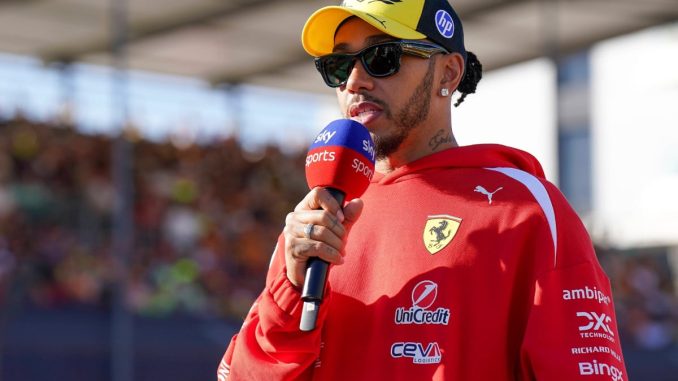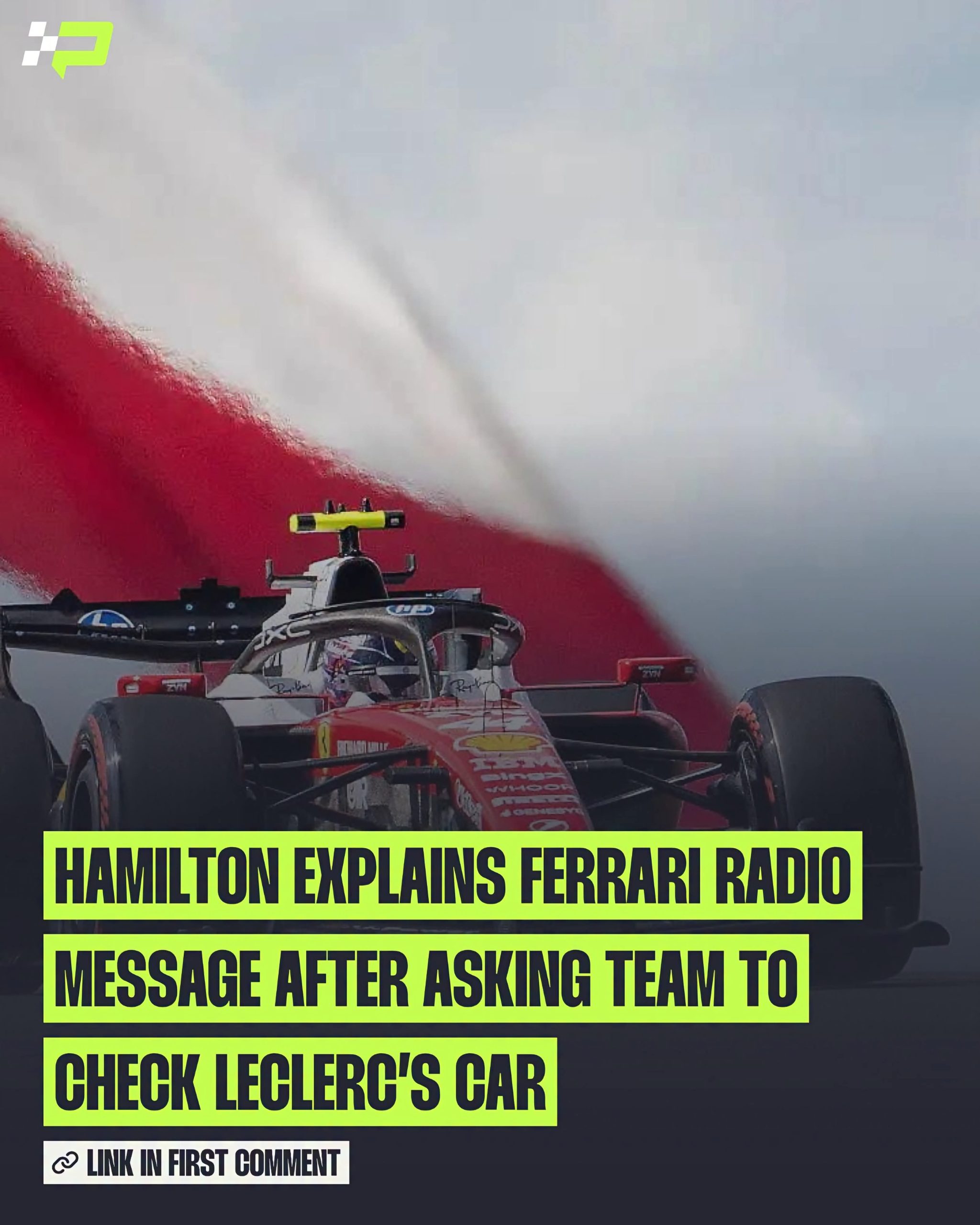
Lewis Hamilton believes a crucial Ferrari setup decision cost him a place on the podium at the 2026 United States Grand Prix, after revealing that a subtle difference between his SF-26 and Charles Leclerc’s car left him struggling with severe understeer during the opening stages of the race.
The seven-time world champion finished fourth at the Circuit of The Americas, while Leclerc secured second place after delivering a stronger performance across the 56-lap contest. Although both Ferrari drivers made progress at the start, Hamilton quickly discovered that his car was not responding as expected, leaving him unable to maintain the pace of the leading drivers. His subsequent radio messages revealed the extent of his frustration, as he urged race engineer Carlo Santi to examine Leclerc’s setup and determine what Ferrari needed to change.
HAMILTON IDENTIFIES THE PROBLEM BEHIND HIS FERRARI STRUGGLES
Hamilton started fifth on the grid, directly behind Leclerc, but both drivers gained positions on the opening lap to run third and fourth behind Kimi Antonelli and Max Verstappen.
However, the Briton soon began losing ground. By Lap 12, he was almost four seconds behind his teammate and approximately eight seconds behind race leader Antonelli. Hamilton reported that he was struggling to turn the car, particularly through slower corners, where a lack of front-end grip was making it difficult to carry the speed he wanted.
Ferrari responded by bringing Hamilton in early to switch from soft tyres to hard Pirelli compounds. Yet the fresh tyres did not immediately solve his handling problems. The underlying issue appeared to be the car’s aerodynamic balance, prompting Hamilton to request a more substantial front-wing adjustment during his next pit stop.
His message to the team was direct: Ferrari needed to compare his configuration with Leclerc’s and determine how much additional front-wing angle would be required. It was a crucial intervention that helped the team understand why the two drivers were experiencing different levels of performance despite competing with the same updated machinery.
A SUBTLE SETUP DIFFERENCE MADE A MAJOR IMPACT
After the race, Hamilton explained that the difference between the two Ferrari cars was relatively small but had significant consequences once the Grand Prix began.
According to the Briton, the main distinction concerned the front-wing flap adjustment, which influences the aerodynamic balance and the amount of grip available at the front of the car. Hamilton believed Ferrari had repeatedly underestimated how much wing he needed to achieve the balance required for competitive racing.
The problem was particularly frustrating because the car had felt reasonable during the reconnaissance lap to the grid. Once the race started, however, the balance deteriorated, producing substantial understeer and making it difficult for him to attack corners effectively.
Hamilton also pointed to the teams’ practice preparations as a possible contributing factor. Leclerc had gained valuable experience with the relevant setup during the long-run programme in the second practice session, while Hamilton had not completed the same long-run preparation on that configuration.
That difference in preparation may have left Hamilton on the back foot when the race began. In Formula 1, small setup variations can influence tyre performance, cornering speed and the driver’s confidence, particularly at a demanding circuit such as Austin.
WHY HAMILTON BELIEVES A PODIUM WAS POSSIBLE
Ferrari eventually adjusted Hamilton’s front wing, and the seven-time champion reported that he was in a much better position during the final stint. His improved balance allowed him to produce stronger pace, although the time lost earlier in the race proved too costly to recover completely.
Hamilton believes the result could have been significantly different had Ferrari made the adjustment before the start.
He indicated that having the improved balance from the opening laps would have put him in contention for the podium, suggesting that the initial setup issue prevented him from fighting at the front throughout the race.
The claim highlights how narrow the margins can be in modern Formula 1. A driver can have competitive machinery and a strong race strategy but still lose valuable positions because the car’s balance is not suited to the conditions or the driver’s requirements.
Ferrari’s pit stops and strategic decisions received praise from Hamilton, who acknowledged that the team performed well operationally. His concern was instead centred on the preparation and setup choices that shaped his early race performance.
For Ferrari, the immediate lesson is that small differences in configuration can produce very different outcomes between teammates. Leclerc’s second-place finish demonstrated the potential of the updated SF-26, while Hamilton’s fourth place highlighted the importance of finding the correct balance before the lights go out.
FERRARI’S AUSTIN UPGRADES OFFER REASONS FOR OPTIMISM
Despite his disappointment, Hamilton remains encouraged by Ferrari’s progress. The team introduced a package of aerodynamic developments in Austin, including changes to the sidepod profile, floor-edge components, diffuser and underbody floor.
These updates were designed to improve the car’s aerodynamic performance and help Ferrari close the gap to its leading rivals. While one race cannot establish the full impact of a development package, Leclerc’s podium and Hamilton’s stronger final stint offered encouraging signs.
The challenge now is to translate that potential into consistent performance across an entire Grand Prix. Ferrari must ensure that its drivers can extract the benefits of the upgrades from the opening lap rather than spending valuable race time correcting setup problems.
Hamilton also revealed that his feedback is increasingly focused on the development of Ferrari’s 2027 car. He has been discussing areas where the team can improve the chassis and aerodynamic package, with the intention of helping engineers make better decisions for the next generation of machinery.
That work could prove particularly important as Ferrari attempts to build a more competitive platform for the future. Hamilton’s experience with different cars, combined with his feedback on steering response and aerodynamic balance, gives the engineering team valuable information to consider during development.
HAMILTON’S CHAMPIONSHIP FIGHT WITH RUSSELL INTENSIFIES
Hamilton’s fourth-place finish also carries implications for the Drivers’ Championship. Following the United States Grand Prix, he remains third in the standings on 241 points, just one point behind George Russell as the fight for second place behind Antonelli continues.
The narrow gap means that every lost opportunity could become increasingly important as the season progresses. A podium in Austin would have given Hamilton valuable points and potentially strengthened his position against Russell.
Instead, Ferrari must now look ahead to the next round and ensure that the setup difficulties experienced in Texas do not become a recurring problem. Hamilton’s improved pace late in the race suggests that the underlying performance is there, but extracting it consistently will be essential.
For Hamilton, the United States Grand Prix was a mixture of frustration and optimism. He missed out on a podium that he believes was achievable, yet the final stint showed what might be possible when the car is closer to his preferred balance.
Ferrari’s next challenge is straightforward: learn from the mistake, refine its setup procedures and give Hamilton a car he can attack with from the beginning. If the team succeeds, the Briton could yet turn the lessons from Austin into stronger results in the remaining races of the 2026 season.