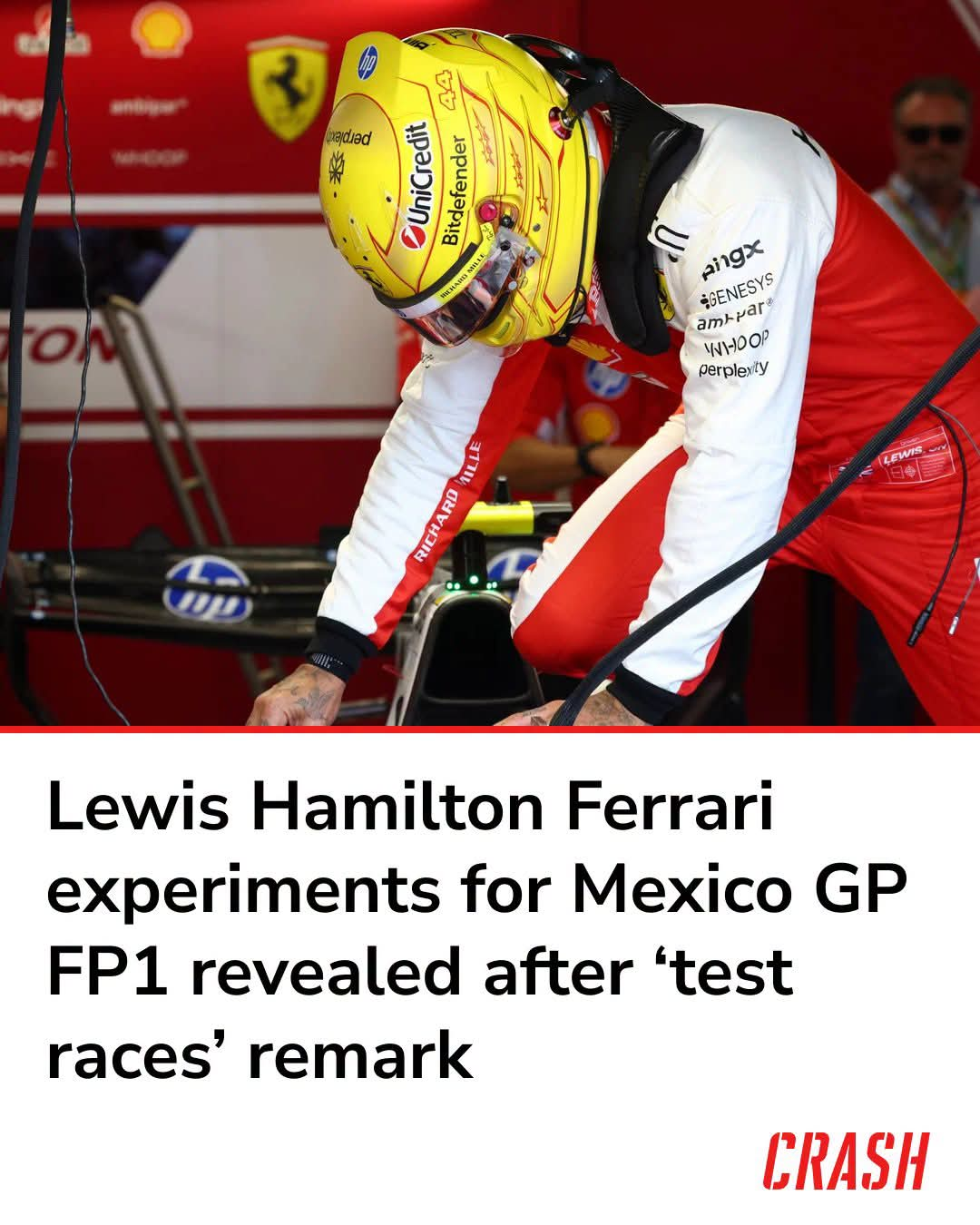
Lewis Hamilton is using the Mexico City Grand Prix weekend for more than simply preparing for another Formula 1 race. The seven-time world champion has begun an important technical testing programme with Ferrari as he attempts to identify the weaknesses preventing the team from consistently fighting at the front.
Hamilton’s Ferrari SF-26 was fitted with a large aerodynamic measuring device during Friday’s opening practice session, providing a clear indication that the team had a specific development objective for the weekend.
The decision follows Hamilton’s recent admission that he intends to approach the remaining five races of the 2026 season as “test races” while Ferrari works towards building a stronger package for next year.
For a driver who has spent much of his career competing for championships, the current situation represents a different kind of challenge. Rather than focusing exclusively on immediate results, Hamilton is increasingly involved in helping Ferrari understand what needs to change before the next campaign.
FERRARI FITS MAJOR AERO RAKES TO HAMILTON’S CAR
Hamilton’s Ferrari attracted attention as soon as FP1 began at the Autódromo Hermanos Rodríguez.
The car was fitted with large aerodynamic rakes positioned behind both front tyres. These devices are designed to collect information about airflow around different parts of the vehicle, allowing engineers to compare real-world aerodynamic behaviour with their simulations and other development data.
Sky Sports F1 pitlane reporter Ted Kravitz explained that Ferrari had confirmed it would be carrying out additional measurements on Hamilton’s car.
He also pointed towards the front of the SF-26 as an important area of investigation, particularly because Hamilton had struggled with understeer during the previous weekend’s United States Grand Prix.
The data collection is therefore particularly relevant. Ferrari needs to understand whether the airflow around the front wing, suspension components and tyres is behaving as expected.
Even relatively small differences between predicted and actual aerodynamic performance can influence how a Formula 1 car handles through corners.
For Hamilton, finding those differences could be essential to improving the balance of a car that has not always responded consistently to his driving preferences.
FRONT-END WEAKNESS REMAINS A MAJOR CONCERN
Hamilton’s difficulties in Austin provided an important reason for Ferrari’s latest experiments.
The British driver finished fourth at the United States Grand Prix but admitted that a setup mistake had contributed to his struggles. Understeer was a particular problem, making it difficult for him to get the front of the car pointing into corners with the precision required.
Understeer can be especially frustrating for drivers because it limits their ability to carry speed through corners and makes the car feel reluctant to follow the intended racing line.
For a driver like Hamilton, who relies heavily on confidence in the front end, this can have a significant impact on lap times and tyre management.
Bernie Collins explained that the aerodynamic rakes would help Ferrari measure airflow coming from the front wing, passing through the wishbones and front suspension, moving around the brake ducts and travelling over the front tyres.
The purpose is to identify potential differences between the information collected by Ferrari’s existing systems and the actual behaviour of the car.
This could help engineers determine whether the problems Hamilton has been reporting are connected to aerodynamic performance, mechanical balance or a combination of factors.
WHY FERRARI GAVE HAMILTON FP1 INSTEAD OF A ROOKIE
Another interesting aspect of Ferrari’s decision was that the team was the only one not running a rookie driver during the opening practice session.
Formula 1 regulations require teams to provide practice opportunities for young drivers, meaning teams regularly replace one of their regular race drivers during selected FP1 sessions.
Ferrari’s decision to keep both Hamilton and Charles Leclerc in the car for the session therefore stood out.
Hamilton’s testing programme provides an explanation for that choice.
With valuable aerodynamic measurements planned, Ferrari evidently considered it important to have Hamilton available throughout the session rather than sacrifice the opportunity to collect development information.
This is particularly significant because Hamilton has been vocal about wanting Ferrari to improve its performance ahead of 2027.
The team needs reliable feedback from its regular drivers, and Hamilton’s experience could be especially valuable when evaluating technical changes.
MEXICO’S HIGH ALTITUDE WILL NOT MAKE THE DATA USELESS
The Mexico City circuit presents a unique engineering challenge because of its high altitude.
The thinner air affects aerodynamic behaviour, cooling requirements and power-unit performance. Teams must adapt their cars to conditions that are significantly different from those encountered at many other circuits.
That raises an important question: can Ferrari collect useful aerodynamic information in Mexico when the air density is lower?
Collins explained that the measurements would still provide valuable information.
Although the absolute aerodynamic conditions differ from those at lower-altitude circuits, engineers can still study how airflow behaves around the car and identify differences between the two sides.
This is particularly useful when investigating whether the front of the Ferrari is producing the expected aerodynamic performance.
The data will not automatically solve every problem, but it can help Ferrari build a clearer picture of how the SF-26 behaves under real track conditions.
HAMILTON IS ALREADY THINKING ABOUT THE 2027 FERRARI
Hamilton’s decision to treat the remaining races as test events reflects a broader shift in his priorities.
The seven-time champion wants Ferrari to become a genuine title contender, and he understands that achieving that objective requires more than occasional improvements in qualifying or race pace.
Ferrari must develop a car that operates consistently across different circuits, temperatures and aerodynamic conditions.
One of the biggest challenges facing the team has been finding a wider operating window. A car that performs well only under very specific conditions can leave drivers struggling whenever the circuit characteristics change.
Hamilton’s feedback, combined with the aerodynamic measurements being collected in Mexico, could help Ferrari identify where its development programme needs to concentrate.
His experience at Mercedes and his understanding of championship-winning machinery give him a useful reference point when evaluating what a competitive package should deliver.
However, Ferrari must also ensure that the information collected translates into practical improvements rather than simply generating more engineering data.
CAN THESE EXPERIMENTS HELP FERRARI RETURN TO TITLE CONTENTION?
The real value of Hamilton’s Mexico experiments will not necessarily be visible in the immediate results.
Friday practice is often about gathering information, testing different configurations and understanding the behaviour of the car. A driver may sacrifice short-term performance to help engineers answer questions that could become important in future races.
Ferrari’s priority should be turning those findings into improvements that benefit both Hamilton and Leclerc.
The team cannot afford to develop a car that works for only one driver. Its long-term competitiveness depends on producing a balanced package capable of delivering consistent performance across different driving styles.
For Hamilton, the Mexico programme is another opportunity to demonstrate that he remains committed to the Ferrari project despite the difficulties experienced during the season.
His ambition is not simply to finish the 2026 championship respectably. He wants to help build a Ferrari capable of fighting for victories and world titles again.
The aerodynamic rake fitted to his SF-26 may look like a relatively small detail, but the information collected could contribute to important development decisions.
Ferrari’s next major challenge is proving that it can turn Hamilton’s feedback and engineering experiments into a car capable of matching the strongest teams.
If that happens, the work being carried out in Mexico could become an important part of Ferrari’s preparation for 2027.