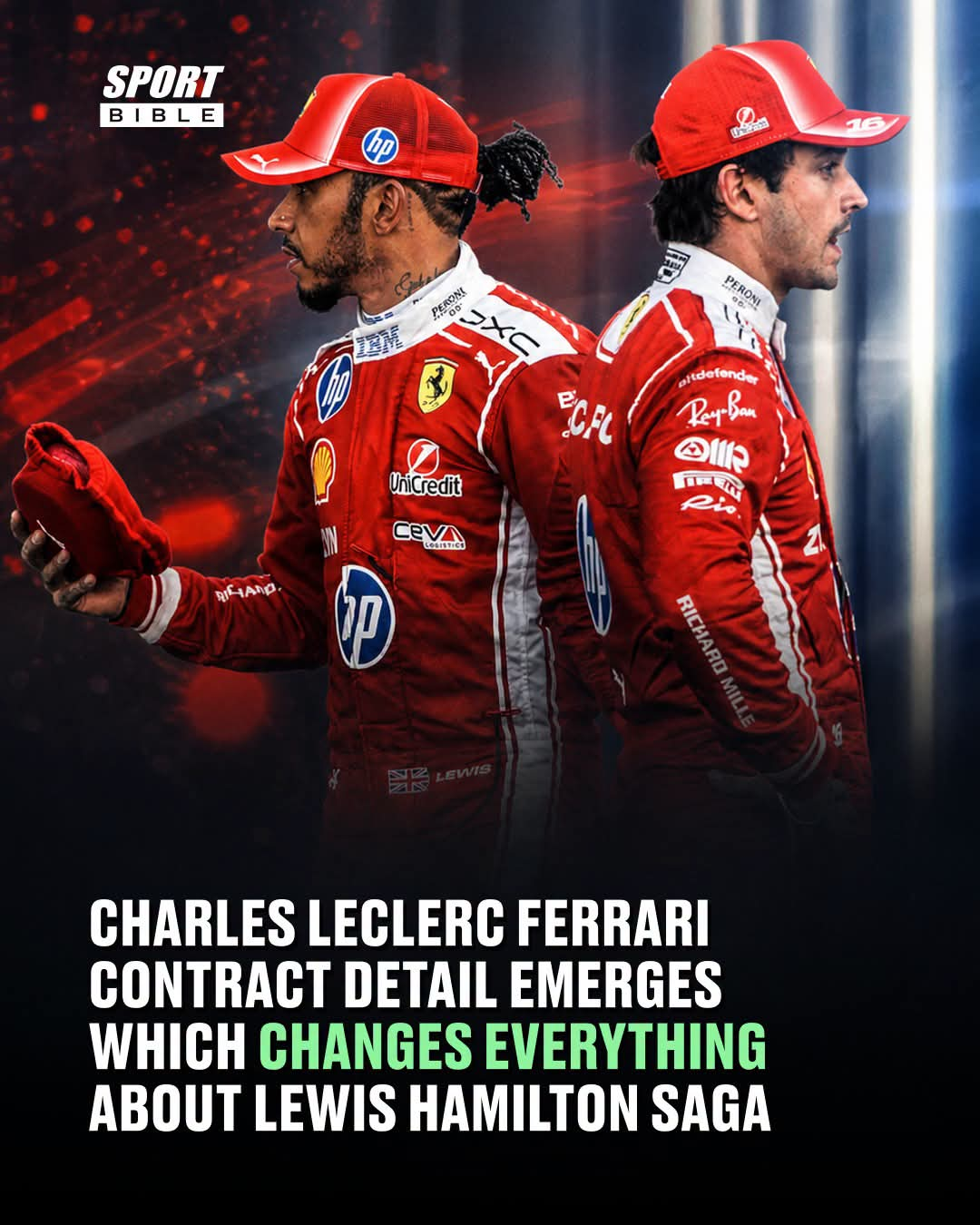
A new report surrounding Charles Leclerc’s Ferrari contract has introduced a potentially explosive complication into the growing disagreement between the Monegasque driver and Lewis Hamilton. According to journalist Marc Limacher, Leclerc has a preferential equity clause in his Ferrari contract dating back to 2020, which could prevent the team from introducing written rules of engagement governing how its drivers compete against each other. If the reported contractual arrangement is accurate, Ferrari could face a difficult situation as Hamilton continues demanding clearer instructions to prevent the kind of internal battles that have already cost the team valuable opportunities in 2026.
The revelation comes after another controversial weekend at the Mexican Grand Prix, where Ferrari’s two drivers found themselves at the centre of a heated discussion over team priorities, racing etiquette and the importance of protecting the Scuderia’s interests. Hamilton had started from pole position but lost ground during the opening-lap battle involving Leclerc and Max Verstappen. The Monegasque remained ahead after cutting across the track at Turn 4, while Hamilton lost another position to Verstappen. Although the seven-time world champion eventually recovered to finish second behind the Red Bull driver, the incident left him questioning whether Ferrari’s current approach to managing its drivers is sustainable.
The controversy is no longer simply about one incident or one disagreement between teammates. It is becoming a much bigger question about authority within Ferrari, the contractual position of its drivers and whether Hamilton’s experience can influence how the team operates.
LECLERC’S REPORTED CONTRACT CLAUSE COULD COMPLICATE FERRARI’S PLANS
According to journalist Marc Limacher, Leclerc has possessed a preferential equity clause in his Ferrari contract since 2020. Limacher suggested that the provision could prevent the team from establishing written rules of engagement.
The journalist wrote on X:
“I hear that Charles Leclerc has had a preferential equity clause (sportive and technique) in his contract since 2020.
“This would prevent the establishment of written engagement rules.”
The claim has introduced a new dimension to the Ferrari disagreement because it suggests that the team’s ability to impose formal restrictions on its drivers could be more complicated than previously understood.
However, it is important to distinguish between a reported contractual provision and an officially confirmed legal restriction. Ferrari has not publicly verified the existence or precise wording of the alleged clause, and there has been no official confirmation that it legally prevents the team from introducing written racing instructions.
Nevertheless, the allegation raises important questions. If Leclerc negotiated contractual protections concerning sporting and technical treatment, Ferrari may need to consider those arrangements carefully before introducing policies that could affect his position within the team.
For Hamilton, this could make his demand for clearer rules considerably more complicated. The seven-time champion wants a system that prevents internal competition from damaging Ferrari’s results, but the team may have contractual and management considerations that cannot simply be ignored.
HAMILTON HAS REPEATEDLY DEMANDED CLEARER RULES AT FERRARI
The Mexican Grand Prix was not the first time Hamilton raised concerns about Ferrari’s approach to managing its drivers.
Following their collision at the Italian Grand Prix in September, the British driver had already called for clearer rules of engagement. Hamilton believes that Ferrari needs a more structured system to determine how its drivers should compete when they are fighting for important positions.
His argument is based partly on his experience at Mercedes, where he operated under established team expectations during his championship-winning years.
Hamilton understands that teammates must compete, but he believes there should be limits when their personal battles threaten the team’s overall result.
That concern became even more significant in Mexico, where Ferrari appeared to have an opportunity to secure a much stronger result.
Hamilton eventually finished second, while Leclerc’s five-second penalty dropped him behind the Briton in the final classification. The team had therefore avoided a complete disaster, but the manner in which the race unfolded left questions about whether Ferrari had allowed an unnecessary battle to develop.
Hamilton made his frustration clear after the race, insisting that discussions behind the scenes were necessary.
“We have to have some serious talks behind the scenes for sure,” Hamilton said, according to PA Media.
He also emphasised that teamwork should be considered an essential responsibility rather than an optional approach.
“Working as a team is a part of our job and a part of our contract. We could have easily done that today.”
The strongest part of Hamilton’s warning came when he suggested that the same problems could continue unless Ferrari takes action.
“This will just continue unless action is taken, unless a real deep, serious conversation is had. So, it shouldn’t happen moving forward.”
Those comments indicate that Hamilton does not consider the Mexico incident an isolated disagreement. He appears concerned that Ferrari could continue losing valuable results if both drivers are left to resolve every major on-track situation independently.
WHY HAMILTON BELIEVES FERRARI IS THROWING AWAY VALUABLE RESULTS
Hamilton’s frustration is rooted in something bigger than his personal battle with Leclerc.
Before joining Ferrari, the British driver watched the team’s previous driver partnership involving Leclerc and Carlos Sainz. He believes the two drivers sometimes fought so aggressively that they allowed competitors ahead to escape, despite Ferrari having the pace to challenge for victories.
Hamilton explained that there is a significant difference between teammates fighting over fourth and fifth positions and battling when a potential one-two finish is available.
“Before I joined this team, when I was in Mercedes, I watched and witnessed the back and forth between Charles and Carlos [Sainz] for several races where they were battling so much that the person ahead just pulled away, and they had the pace to actually win the race,” Hamilton said.
“But it’s one thing when that’s happening for fourth and fifth, as opposed to first and second, and you lose the win. That’s significant.”
His argument is straightforward: Ferrari should not allow its drivers to become so focused on defeating each other that they sacrifice opportunities to defeat their rivals.
In modern Formula 1, the difference between winning and finishing second can have enormous consequences. Every championship point matters, particularly when competing against manufacturers such as Mercedes and Red Bull.
A Ferrari one-two finish would deliver maximum points for the team and strengthen its position in the Constructors’ Championship. Losing that opportunity because of an internal battle is exactly the kind of situation Hamilton wants to prevent.
However, the challenge is determining where the team should draw the line. Both drivers are professional competitors, and neither will willingly surrender positions without a clear understanding of what is expected.
That is why Hamilton believes written rules could provide a solution.
HAMILTON QUESTIONS LECLERC’S ‘DO OR DIE’ APPROACH
The seven-time world champion also offered a pointed assessment of what he considers Leclerc’s approach to wheel-to-wheel competition.
Hamilton suggested that the Monegasque’s aggressive mentality could sometimes work against Ferrari’s wider interests.
“The guy’s 28 years old, so I don’t think it’s an age thing. I think it’s a mentality thing,” Hamilton explained.
“It’s like ‘do or die. Like either I win or none of us do’, and it shouldn’t be that. It should be us getting that one-two because it’s still a good feeling.”
The comments are particularly interesting because Hamilton was not questioning Leclerc’s speed or ability. Instead, he was criticising the decision-making that can occur when two teammates become locked in an intense battle.
Leclerc has built much of his reputation around aggressive qualifying performances and determined wheel-to-wheel racing. His willingness to attack has helped him become one of Ferrari’s most successful drivers of the modern era.
But Hamilton believes that a driver’s responsibility changes when the opportunity to deliver a major team result is available.
He used the British Grand Prix at Silverstone as an example of a situation in which he could have taken a more aggressive approach against Leclerc but chose not to risk the team’s result.
“Silverstone, I could have gone all kamikaze on him and taken him off and lost us the win but instead it was first and third,” Hamilton said.
“For me, I’m happy for the team to have experienced that. But I’m hopeful we’ll work towards a better working place in the future.”
His message is that personal victories should not automatically take priority over the team’s objectives.
FERRARI NOW FACES A DIFFICULT DECISION BETWEEN ITS TWO DRIVERS
The reported contract clause creates an uncomfortable situation for Ferrari because the team must balance the expectations of two drivers with enormous competitive ambitions.
Leclerc has been central to Ferrari’s long-term project since joining the team in 2019. He has developed into one of the most recognisable figures within the Scuderia and has established a strong relationship with the organisation over several seasons.
Hamilton, meanwhile, arrived with seven world championships, enormous commercial influence and extensive experience of competing in a team where clear internal expectations were part of the operating structure.
Ferrari cannot simply ignore either driver’s position.
If the team introduces strict rules that appear to restrict Leclerc’s freedom, it risks creating another source of tension within the garage. If it refuses to introduce clearer guidelines, Hamilton may continue questioning whether the team is sufficiently committed to protecting its collective results.
The challenge is not necessarily choosing one driver over the other. It is establishing a system that allows both competitors to race while recognising that Ferrari’s championship ambitions must remain the priority.
There are several possible approaches. Ferrari could establish clearer instructions for specific racing situations, define when drivers should avoid unnecessary risks against each other, or introduce procedures requiring teammates to give positions back when an advantage has been gained unfairly.
Such arrangements would not necessarily require one driver to become permanently subordinate to the other.
However, if the reported contractual provision genuinely limits Ferrari’s ability to introduce written rules, the team may need to explore alternative ways of managing the relationship.
COULD HAMILTON’S FERRARI FUTURE BE AFFECTED BY THE DISAGREEMENT?
Hamilton’s comments should not automatically be interpreted as a threat to leave Ferrari, but they demonstrate that the British driver wants meaningful improvements in the team’s internal management.
At 41, Hamilton is competing with a clear understanding that his remaining opportunities to add another world championship are limited. He joined Ferrari with enormous expectations and wants the organisation to provide an environment capable of delivering the results he believes are possible.
The Mexican Grand Prix has therefore become another important moment in evaluating whether Ferrari can meet those expectations.
Hamilton’s concerns are not limited to how he personally is treated. He has repeatedly emphasised that decisions made by drivers affect the thousands of people working behind the scenes.
That perspective is central to his argument. Ferrari’s mechanics, engineers and factory personnel invest enormous effort into preparing a competitive car. When teammates allow an internal disagreement to compromise a major result, the consequences extend far beyond the two drivers.
For Leclerc, the situation is equally important. He must protect his competitive identity while demonstrating that he can work within a team structure designed to maximise Ferrari’s overall performance.
The reported contract clause could make those discussions more complicated, but it does not automatically mean Ferrari is powerless to manage its drivers.
THE REAL TEST FOR FERRARI WILL COME IN THE REMAINING RACES
Ferrari’s immediate priority will be ensuring that the controversy does not become a recurring distraction during the final stages of the 2026 season.
The team has competitive machinery, two race-winning drivers and the resources to challenge for major results. What it needs is consistency in how its drivers approach situations in which their individual ambitions conflict with the team’s interests.
The reported Leclerc contract provision has added another layer to an already sensitive situation. However, until Ferrari or the parties involved confirm the details, it would be premature to conclude that the alleged clause legally prevents the team from introducing written rules.
What is clear is that Hamilton wants change, Leclerc remains an intensely competitive driver, and Ferrari must find a way to keep both working towards the same objective.
The biggest question is whether Ferrari can establish a workable agreement without making either driver feel that his position has been compromised.
If it fails, the consequences could extend beyond another lost podium or missed one-two finish. It could create a lasting divide between two drivers whose combined ability should make Ferrari stronger.
For now, Hamilton has made his position clear. He wants Ferrari to operate as a team, not as two individual competitors fighting for personal glory at the expense of the Scuderia.
And with Leclerc’s reported contractual protections now entering the discussion, Ferrari’s next decision could prove just as important as anything that happens on the track.