Jeremy Clarkson never met a quiet moment he couldn’t turn into a headline. At the United States Grand Prix in Austin, the former *Top Gear* presenter and *Clarkson’s Farm* star delivered another reminder of that talent, joking that Alpine driver Franco Colapinto’s grid penalty was handed out “for being Argentinian.” The line, delivered live on Sky Sports F1 while standing next to Martin Brundle, has reignited old Anglo-Argentine tensions, forced the team that invited him to publicly distance itself, and left many asking whether Clarkson’s brand of blunt humour still belongs in the modern paddock.
WHAT CLARKSON ACTUALLY SAID
During an interview ahead of qualifying at the Circuit of the Americas, Clarkson was asked about Alpine’s prospects. Colapinto, the 23-year-old Argentine, was already facing a 10-place grid drop for exceeding his allocation of power-unit components. Clarkson’s response was pure Clarkson: “Franco got a grid penalty for being Argentinian… well probably. I’d give him one for that. But anyway that’s because of what happened when we went there.”
The “we” referred to the infamous 2014 *Top Gear* special in Patagonia. The production was abandoned amid protests after a Porsche appeared with the number plate H982 FKL, which many Argentines read as a reference to the 1982 Falklands War. Clarkson has always insisted it was pure coincidence. Twelve years later, the joke landed with all the subtlety of a brick through a greenhouse.
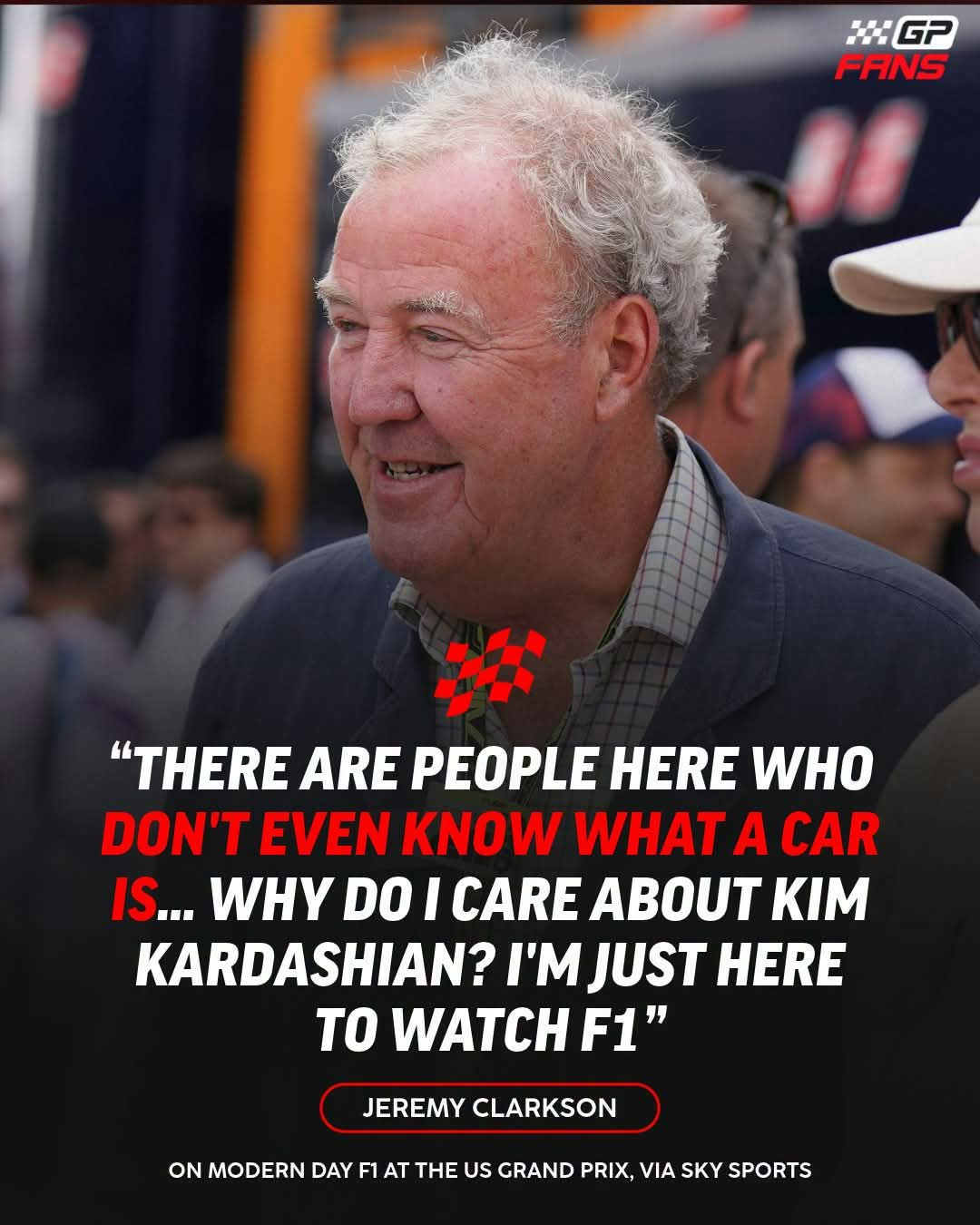
He also took a swipe at the celebrity circus surrounding Formula 1, declaring himself uninterested in Kim Kardashian (Lewis Hamilton’s partner) and questioning why cameras obsess over people who, in his view, barely know what a car is.
THE BACKLASH WAS IMMEDIATE AND PREDICTABLE
Alpine moved quickly. In a carefully worded statement the team noted it was “aware of the comments made in a recent TV interview from a guest of the team in Austin,” stressed that the views were personal and “do not align with the team’s values of promoting kindness and respect,” and underlined that “Franco is our driver and has our full support.”
Colapinto’s co-manager, Jamie Campbell-Walter, was less diplomatic. He called the remarks “completely unacceptable,” adding that there is no place for comments of that nature in Formula 1 regardless of intent. Argentine media and social media reacted with predictable fury, framing the joke as another example of British provocation over the Malvinas/Falklands issue that never quite goes away.
WHY THE JOKE STILL CUTS DEEP
Clarkson’s humour has always thrived on the edge of offence. For years that was part of the appeal: the man who said the quiet part loud while the rest of television polished its language. In the current F1 climate, however, the sport has invested heavily in diversity, respect campaigns, and a more inclusive global image. A high-profile guest of a manufacturer team joking that a driver should be penalised for his nationality sits uncomfortably with that messaging.
The timing makes it sharper. Colapinto is one of the more marketable young drivers on the grid, carrying significant national pride for Argentina. He has already spoken about online abuse directed at his mechanics and engineers. A throwaway line from a celebrity guest risks amplifying the very hostility the sport claims to be fighting.
At the same time, Clarkson’s defenders will argue that context matters. He was clearly referencing a personal history with Argentina, not making a serious claim about the sporting rules. Brundle’s slight chuckle and head-shake suggested the people in the interview recognised the provocation for what it was. In an era of hyper-sensitivity, some will see the outrage as disproportionate to a single clumsy joke.
THE BIGGER PICTURE FOR FORMULA 1 AND ITS CELEBRITY GUESTS
This episode highlights a growing tension in the sport. Formula 1 has never been more glamorous or celebrity-driven. Teams court high-profile visitors because they bring cameras, social media reach, and a sense of occasion. Alpine’s decision to host Clarkson made perfect local sense: the team’s Enstone base sits near his Oxfordshire farm, and personal connections run deep. Yet once the guest is on the broadcast, the team loses control of the narrative.
Clarkson’s comments also revive questions about how much historical baggage the sport is willing to accommodate. The Falklands remain a live political issue for many Argentines. What feels like ancient television history to a British audience can still feel personal and provocative in Buenos Aires. Modern F1 wants to be a global entertainment product; it cannot entirely ignore the national sensitivities of its drivers and fan bases.
WHAT HAPPENS NEXT
Expect the story to burn bright and fade relatively quickly. Clarkson is unlikely to apologise in any meaningful way; that has never been his style. Alpine has already drawn a clear line. Colapinto will almost certainly try to let his driving do the talking from the back of the grid on Sunday. The wider paddock will mostly pretend it never happened while privately noting that inviting Clarkson always carries a risk.
Longer term, the episode may make some teams more cautious about which celebrities they platform on official broadcasts. The commercial upside of star power is real, but the reputational downside is becoming harder to ignore. Formula 1 has spent years trying to look modern and progressive. A high-profile guest recycling a decade-old national grievance, even as a joke, undercuts that effort.
Clarkson remains what he has always been: an unfiltered broadcaster who refuses to sand down his edges. In the polished, image-conscious world of current Formula 1, those edges still draw blood. Whether that is refreshing candour or a liability depends largely on who is listening.