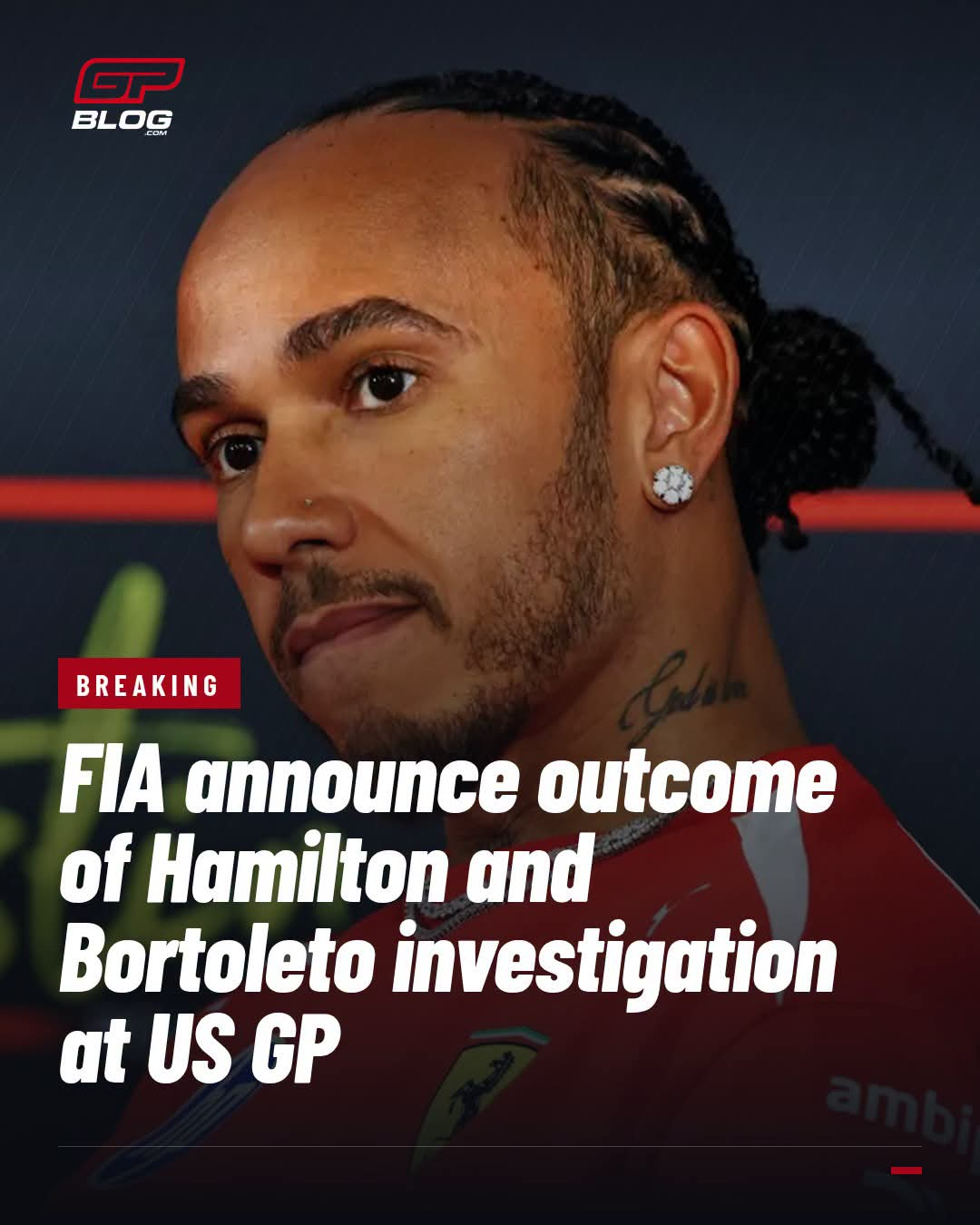
Another tense moment unfolded at the Circuit of the Americas during final practice for the United States Grand Prix. Gabriel Bortoleto, running slowly on the racing line into Turn 12, forced Lewis Hamilton to abandon a strong flying lap. The Brazilian later admitted he missed his engineer’s radio call. Stewards investigated and handed Bortoleto a formal warning. The decision has already sparked debate about consistency, communication, and how free-practice impeding is policed in the modern Formula 1 era.
Hamilton still ended the session fastest, underlining Ferrari’s strong weekend form. But the near-miss raised familiar questions about situational awareness on a circuit that regularly produces traffic drama.
WHAT ACTUALLY HAPPENED AT TURN 12
Late in FP3, Hamilton was on a push lap approaching the heavy braking zone for Turn 12 at the end of the long back straight. Bortoleto was ahead, circulating more slowly and remaining on the ideal line. Closing at high speed, Hamilton had little time to react. He was forced to brake hard and take evasive action, compromising the lap.
According to the stewards’ report, Bortoleto’s race engineer warned him of Hamilton’s approach roughly 15 seconds earlier. The Brazilian said he was focused on managing the car on the downhill approach to the corner and simply did not process the message. No second warning followed. Visibility issues at the crest of the hill meant he only spotted the Ferrari at the last moment. He released the brakes and steered into the runoff, but the reaction came too late.
Ferrari’s representative told the stewards the incident was not dangerous. The panel still concluded that Bortoleto had unnecessarily impeded Hamilton and issued the standard free-practice warning. No grid drop or further sporting penalty was applied.
Hamilton recovered to post a 1:34.893, 0.168 seconds clear of Max Verstappen, with Charles Leclerc third. Ferrari had already topped the earlier free-practice sessions, giving the team genuine momentum heading into qualifying.
WHY THE WARNING FELT LIGHT TO SOME OBSERVERS
Free-practice impeding almost always results in a warning rather than a grid penalty. Stewards have long treated practice sessions differently from qualifying or the race itself, preferring education over punishment when no contact occurs and the session is not directly affected. Hamilton’s own team acknowledging the lack of danger reinforced that approach.
Still, the optics were uncomfortable. Bortoleto already faces a 20-place grid penalty this weekend after Audi fitted a fourth energy store and fourth control-electronics unit. Another black mark, even a minor one, adds to a growing list of stewards interactions for the young Brazilian in his first full season with the works Audi project.
The history between the two drivers also adds context. Earlier this season Hamilton was warned and Ferrari fined after impeding Bortoleto in practice. The roles reversed in Austin. Fans and commentators immediately noted the symmetry and questioned whether the same standard is applied evenly when the drivers involved change.
THE BIGGER PICTURE FOR BORTOLETO AND AUDI
Bortoleto is still learning the rhythms of Formula 1 traffic management. Rookies and second-year drivers frequently struggle with the volume of radio information, the speed differential on long straights, and the need to stay constantly aware of faster cars even while focused on their own programme. The downhill, partially blind approach to Turn 12 at COTA is a known trap. Drivers regularly report difficulty spotting cars until late.
For Audi, the incident arrives at an awkward moment. The team is already managing power-unit component limits and other investigations from the same session. Every unnecessary stewards appearance creates extra workload and public scrutiny while the manufacturer is still establishing its new-era identity.
Hamilton, meanwhile, continues to look comfortable in the Ferrari. Topping FP3 for the first time in a long stretch and maintaining the team’s practice dominance suggests the SF26 is working well around the flowing Austin layout. A clean qualifying performance could put him in genuine contention for a strong result on Sunday.
WHAT THIS MEANS FOR QUALIFYING AND THE RACE
A warning carries no immediate sporting consequence, so Bortoleto starts the weekend with the same 20-place grid drop he already carried. Hamilton faces no restriction. The real impact is psychological and procedural. Drivers will be reminded once again how quickly a missed radio call can ruin a fast lap and attract official attention.
Track-limits issues have already dominated the Austin weekend, with dozens of times deleted. Adding traffic management problems only increases the cognitive load on drivers and engineers. Teams will almost certainly tighten their radio protocols for the remainder of the event, particularly around the high-speed sections where closing speeds are greatest.
Looking further ahead, incidents like this keep the conversation alive about whether free-practice penalties should carry more weight. Some argue that repeated warnings create little deterrent. Others maintain that practice is for learning and that grid drops should be reserved for qualifying and race infringements. The current system prioritises the latter, and the stewards stayed consistent with recent precedent.
THE HUMAN ELEMENT AND THE LEARNING CURVE
Bortoleto’s explanation was straightforward and accepted. He was not deliberately blocking anyone. He simply failed to process critical information at a demanding point on the circuit. That honesty likely helped limit the sanction to a warning. Still, the episode serves as a public reminder that in Formula 1 the margin for error is measured in seconds of radio airtime and metres of track.
Hamilton handled the situation professionally on track and through his team’s statement. The seven-time champion has been on both sides of these incidents often enough to understand the frustration without escalating it publicly.
For the sport, moments like this humanise the drivers. Even at the highest level, attention can slip, messages can be missed, and visibility can be imperfect. The difference between a clean session and a stewards investigation can be as simple as one unheard radio call.
As the field prepares for qualifying under the Texas lights, the focus shifts back to pure performance. Ferrari looks strong. Verstappen remains a constant threat. Bortoleto will try to maximise whatever track position he can salvage from the back of the grid. And every driver will be a little more alert the next time an engineer says “car behind, pushing.”
The Austin weekend has already delivered drama. Whether the stewards’ relatively lenient approach proves the right one will be judged by how the remaining sessions unfold and whether similar incidents continue to surface. For now, the official record shows a warning, a compromised lap, and two teams moving on with different levels of momentum.