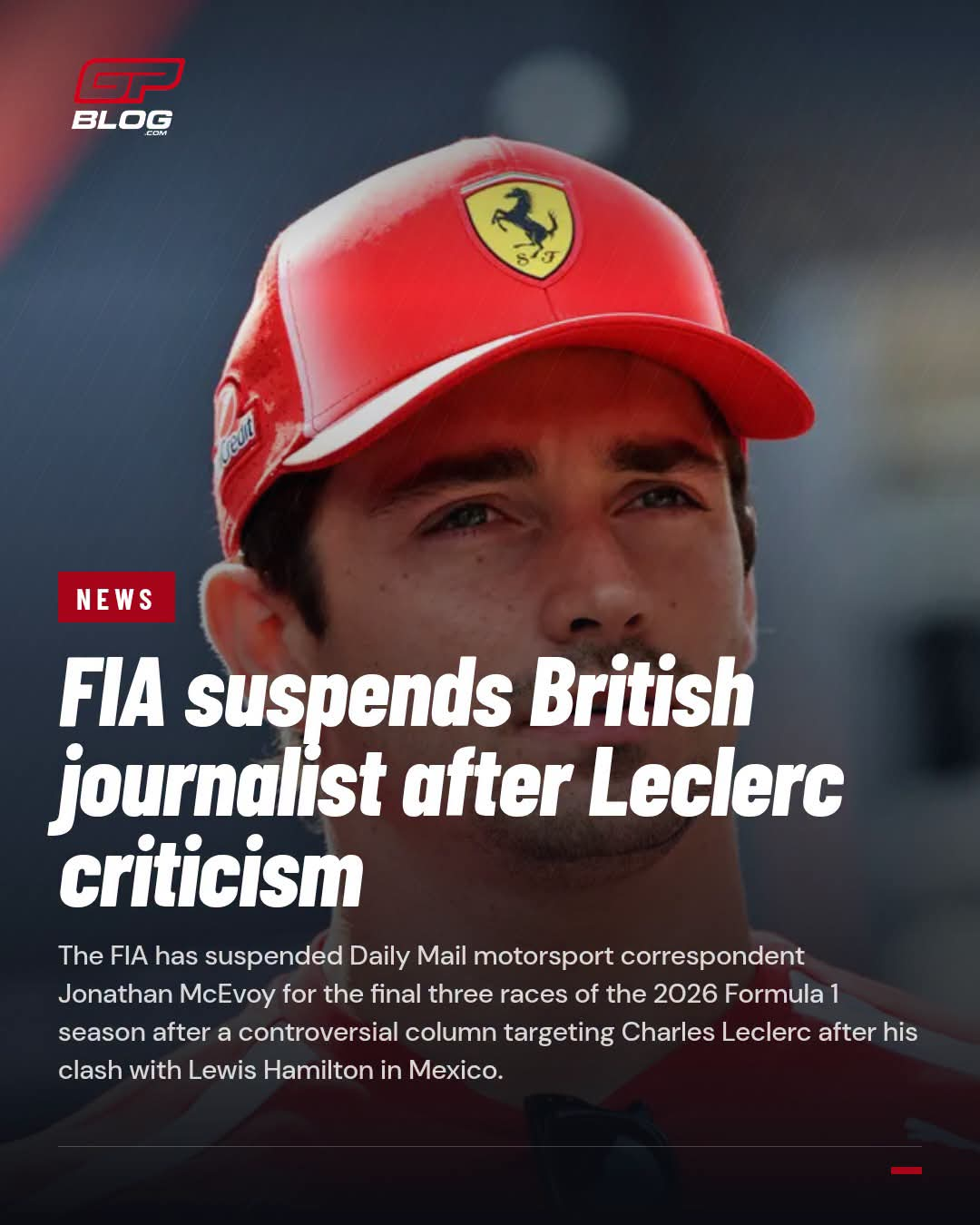
Formula 1 has been rocked by another controversial off-track development after the FIA reportedly revoked the media accreditation of British journalist Jonathan McEvoy following an explosive article targeting Ferrari driver Charles Leclerc.
The decision means McEvoy, the Daily Mail’s long-serving Formula 1 correspondent, will be unable to access the F1 paddock for the remainder of the 2026 season. The punishment has immediately sparked debate about journalistic freedom, professional standards and the growing tension between motorsport’s governing body and members of the media.
At the centre of the controversy is an opinion piece in which McEvoy used an extremely offensive description of Leclerc while discussing the Ferrari driver’s conduct following the Mexican Grand Prix.
However, what initially appeared to be another heated exchange surrounding Ferrari has quickly developed into a much bigger discussion about how far the FIA should go when regulating journalists covering the championship.
WHAT HAPPENED BETWEEN THE FIA AND JONATHAN MCEVOY?
According to reports, the FIA withdrew McEvoy’s media accreditation after taking issue with the language used in his article about Charles Leclerc.
The controversy originated from the Mexican Grand Prix, where Leclerc and his Ferrari teammate Lewis Hamilton were involved in an on-track confrontation.
The incident generated considerable discussion, particularly after Hamilton questioned aspects of Leclerc’s approach following their clash.
McEvoy subsequently published an opinion piece examining the relationship between the two Ferrari drivers and the atmosphere within the team.
However, his description of Leclerc as a “sneaky little bastard” proved particularly controversial.
The FIA reportedly concluded that the language fell below the professional standards expected of journalists accredited to cover the Formula 1 World Championship.
In a letter signed by FIA general manager Alberto Villarreal, the governing body explained that it had decided to withdraw McEvoy’s accreditation under its 2026 media accreditation guidelines.
The decision took immediate effect and covers the remainder of the season.
DAILY MAIL HITS BACK AT THE FIA
The FIA’s decision has not gone down well with McEvoy’s employer.
Chris Dean, the Daily Mail’s head of sport, strongly criticised the governing body’s approach, describing the decision as an unprecedented and outrageous attack on press freedom.
The newspaper believes the punishment is excessive and argues that journalists should be able to express strong opinions about drivers, teams and controversial sporting incidents without facing such severe professional consequences.
Former Formula 1 chief executive Bernie Ecclestone has also expressed his disagreement with the decision.
Ecclestone questioned why the FIA would take such action against an experienced journalist, describing the punishment as completely unreasonable.
His intervention adds another influential voice to a debate that could become increasingly uncomfortable for Formula 1’s governing body.
After all, journalists play an essential role in the championship. They investigate controversies, question decisions, report disagreements and provide fans with information that might otherwise remain behind closed doors.
Removing a journalist’s paddock access is therefore not simply an administrative decision. It can significantly affect their ability to perform their professional responsibilities.
WHY CHARLES LECLERC AND FERRARI ARE AT THE CENTRE OF THE CONTROVERSY
Although the FIA’s decision concerns journalistic conduct, the situation cannot be separated from the growing attention surrounding Ferrari’s internal dynamics.
Leclerc and Hamilton represent two generations of Formula 1 talent.
Leclerc has spent several seasons establishing himself as Ferrari’s leading figure, while Hamilton arrived with an extraordinary championship-winning reputation and enormous expectations.
Whenever two highly competitive drivers share a garage, disagreements are almost inevitable.
Both want to win races, secure strong championship positions and establish themselves as the team’s most successful driver.
The Mexican Grand Prix incident highlighted the potential difficulties Ferrari faces when managing two drivers with such ambitions.
However, there is an important distinction between criticising a driver’s actions and directing personal insults towards them.
Journalists should be free to question Leclerc’s decisions, analyse his driving and challenge Ferrari’s management. Equally, professional commentary should maintain a reasonable standard of language.
That distinction is central to the current controversy.
PRESS FREEDOM VERSUS PROFESSIONAL RESPONSIBILITY
Perhaps the biggest question emerging from this situation is whether the FIA’s punishment was proportionate.
The governing body has a legitimate responsibility to establish standards for individuals receiving official media accreditation.
The Formula 1 paddock is a controlled professional environment involving drivers, engineers, team executives, sponsors and international media organisations.
Accreditation is a privilege that comes with responsibilities.
However, there is a difference between addressing genuinely unprofessional conduct and restricting access because an organisation disagrees with the tone of an opinion article.
This is where the FIA could face difficult questions.
If journalists believe that strong criticism of drivers or teams could result in losing their accreditation, some may become increasingly cautious when reporting controversial subjects.
That would not necessarily benefit Formula 1.
The championship depends on independent journalism to maintain public interest, investigate important developments and hold influential figures accountable.
The FIA must therefore ensure that its accreditation policies are applied consistently and transparently.
A SIGNIFICANT BLOW TO AN EXPERIENCED FORMULA 1 CORRESPONDENT
McEvoy is not a newcomer attempting to establish himself in the Formula 1 media environment.
He has covered the championship for more than two decades, reportedly attending almost 400 Grands Prix during his career with the Daily Mail.
His experience has allowed him to build relationships with some of the sport’s most influential personalities.
Losing paddock access for the remainder of the season represents a considerable disruption to his work.
Modern Formula 1 journalism involves much more than watching races and reporting the final results.
Access to team personnel, post-race briefings, driver interviews and conversations around the paddock can provide valuable information that helps journalists produce detailed coverage.
Without accreditation, McEvoy will face additional obstacles when attempting to gather information directly from the championship’s participants.
Nevertheless, the decision does not prevent him from writing about Formula 1 altogether. It primarily removes his official access to the championship’s restricted media environments.
COULD THIS DAMAGE THE FIA’S RELATIONSHIP WITH THE MEDIA?
The timing of the controversy is particularly interesting because Formula 1 is enjoying enormous international attention.
The championship has invested heavily in expanding its global audience, strengthening its digital presence and attracting younger fans.
Independent journalists remain important to that growth.
They provide alternative perspectives, question official narratives and bring attention to developments that might otherwise receive limited coverage.
A difficult relationship between the FIA and the media could create unnecessary tension around the championship.
There is also the question of consistency.
If the governing body removes accreditation over inappropriate language, journalists will reasonably expect similar standards to apply across the entire media environment.
The FIA must be prepared to explain where it draws the line and why particular sanctions are considered appropriate.
Transparency will be essential if it wants to avoid accusations of selectively enforcing its rules.
WHAT HAPPENS NEXT?
With the 2026 season approaching its conclusion, the immediate question is whether the FIA will reconsider its decision.
The Daily Mail has made its opposition clear, while Ecclestone’s criticism has added further attention to the controversy.
An appeal or further discussions between the newspaper and the governing body could potentially change the situation, although no reinstatement should be assumed at this stage.
There is also a wider possibility that the incident could encourage renewed discussions about media accreditation rules and the relationship between sporting organisations and independent journalism.
For Ferrari, Leclerc and Hamilton, the controversy represents another distraction from the sporting questions surrounding the team.
For the FIA, however, the challenge is much bigger.
It must demonstrate that professional standards matter without creating the impression that critical journalism is unwelcome in Formula 1.
FINAL VERDICT: HAS THE FIA GONE TOO FAR?
The Jonathan McEvoy controversy highlights an increasingly important issue in modern Formula 1: where should the line be drawn between journalistic freedom and professional responsibility?
McEvoy’s description of Leclerc was undoubtedly provocative, and journalists should understand that their words carry professional consequences.
However, withdrawing a journalist’s accreditation for the remainder of an entire championship season is a significant punishment.
The FIA has the authority to establish accreditation standards, but exercising that authority requires transparency, consistency and proportionality.
In our view, the governing body must be careful not to create an environment where journalists become reluctant to investigate controversial subjects or challenge powerful figures.
Formula 1 needs independent voices, even when their opinions are uncomfortable.
The championship is at its best when sporting controversies can be examined openly, drivers can be questioned fairly and governing bodies can be held accountable for their decisions.
Ultimately, this story should not become another battle between the FIA and the media. It should become an opportunity to establish clearer expectations for everyone involved.
And with Ferrari’s internal tensions already attracting considerable attention, the last thing the championship needs is another unnecessary controversy overshadowing the racing.
SEO KEYWORDS: FIA, Charles Leclerc, Jonathan McEvoy, Formula 1 news, F1 journalist banned, Ferrari F1, FIA media accreditation, Lewis Hamilton, F1 paddock controversy, 2026 Formula 1 season.
META DESCRIPTION: The FIA has revoked British journalist Jonathan McEvoy’s F1 paddock accreditation until the end of 2026 following an offensive remark about Ferrari star Charles Leclerc. Here’s why the decision has sparked a press freedom debate.Editorial accuracy note: The reported accreditation withdrawal is attributed to the FIA’s decision, while the press-freedom criticism comes from the Daily Mail and Bernie Ecclestone. The FIA’s official media accreditation information is available through its [FIA Media Centre](https://api.fia.com/media-center/media_accreditation?utm_source=chatgpt.com).