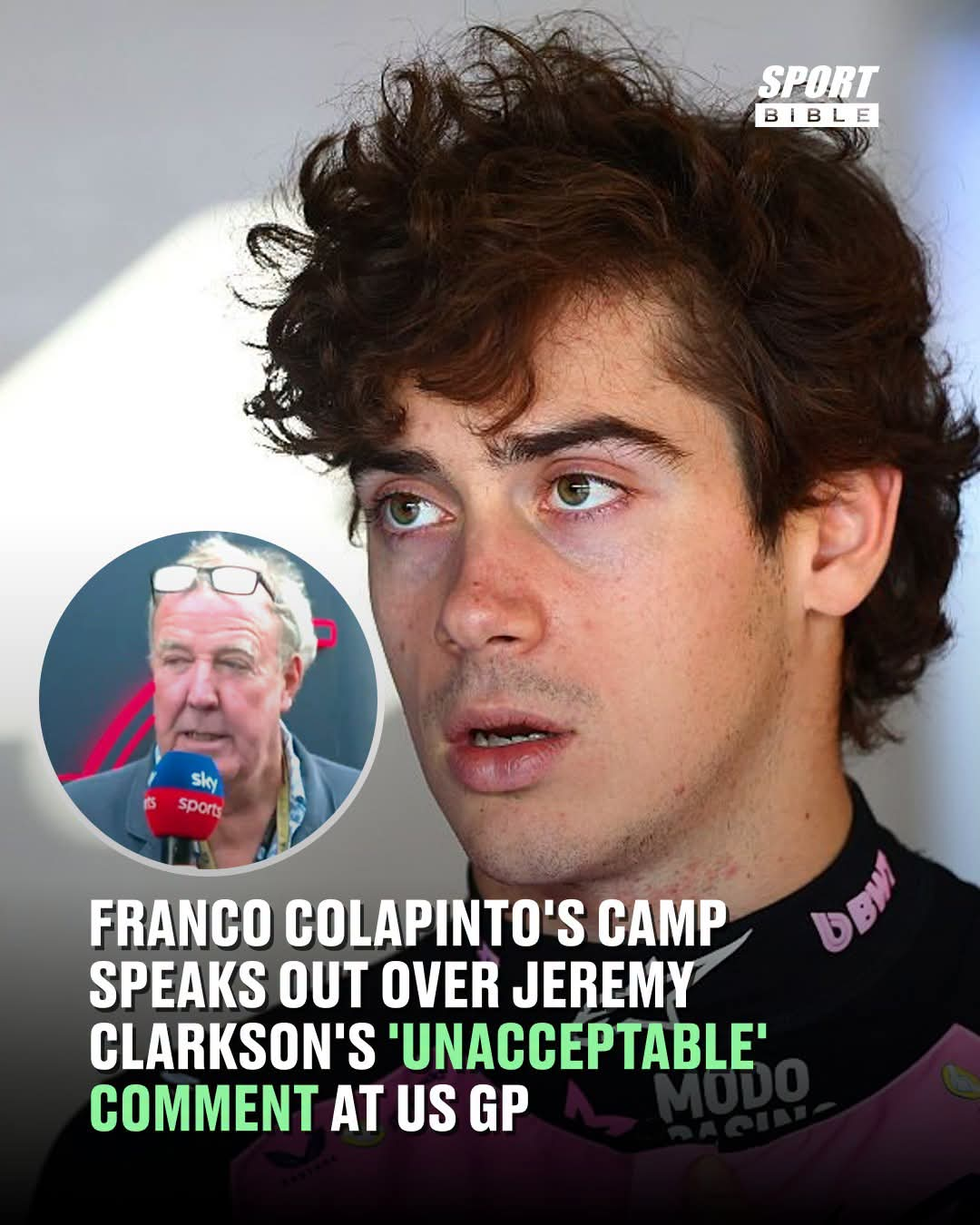
Jeremy Clarkson has found himself at the centre of a Formula 1 controversy after making a controversial remark about Alpine driver Franco Colapinto’s Argentine nationality. The comment, delivered during a Sky Sports interview ahead of the United States Grand Prix, prompted a strong response from Colapinto’s manager, who described the remark as completely unacceptable and called for greater respect within the sport.
CLARKSON’S REMARKS TRIGGER BACKLASH
The controversy erupted after Colapinto qualified 14th for the United States Grand Prix at the Circuit of the Americas in Austin, Texas. However, a 10-place grid penalty for exceeding the permitted allocation of power unit components dropped the Alpine driver to 21st on the starting grid.
Speaking to Sky Sports, Clarkson, who was attending the event as an Alpine guest, made a remark linking the penalty to Colapinto’s nationality.
“Franco’s got a grid penalty for being Argentinian. Probably. Well, I’d give him one for that,” Clarkson said, before referring to a previous incident involving Argentina.
Although the comment appeared to be delivered as a joke, it quickly became a source of controversy, particularly because it singled out the driver’s nationality rather than focusing on the technical circumstances behind his penalty.
COLAPINTO’S MANAGER DELIVERS A STRONG RESPONSE
Jamie Campbell-Walter, founder of Bullet Sports Management, which represents Colapinto, responded publicly on social media. He criticised Clarkson’s remarks and argued that prominent figures visiting Formula 1 should be held to the same standards of respect expected from everyone else in the paddock.
Campbell-Walter wrote that the comments were “completely unacceptable” and insisted there was no place for remarks of that nature in Formula 1, regardless of whether they were intended as humour.
He also highlighted the efforts made by drivers, teams and others in the sport to promote respectful behaviour and reduce hostility and abuse. According to the manager, that progress could be undermined if influential personalities were allowed to make comments that singled out drivers because of their nationality.
His response made clear that the issue was not simply about whether Clarkson intended to offend Colapinto. It was also about the standards of conduct expected from people given a public platform within the sport.
THE HISTORY BEHIND CLARKSON’S ARGENTINA REFERENCE
Clarkson’s reference to Argentina carries historical context. During a Top Gear special filmed in Argentina in 2014, the production team encountered serious hostility after controversy erupted over the registration plate on a car driven by Clarkson. Some interpreted the plate as a reference to the Falklands War.
Clarkson and the BBC maintained that the registration was coincidental and that the plate had been on the car since the 1990s. The production team eventually left the country amid escalating tensions.
The history helps explain why references to Argentina can carry additional meaning when made by Clarkson. However, it does not establish that his latest comment was intended as a deliberate insult, and his precise intention remains a matter of interpretation.
WHAT THIS MEANS FOR COLAPINTO AND ALPINE
For Colapinto, the controversy comes at a time when his attention should be focused on improving his results and helping Alpine compete in Formula 1. Starting from 21st after qualifying 14th already placed him at a disadvantage, making the weekend challenging before the public dispute emerged.
The incident also highlights how quickly off-track comments can become major talking points in modern Formula 1. Drivers operate under intense scrutiny, and remarks from celebrities, team guests and influential figures can generate debates that extend well beyond the race itself.
For Alpine, the situation presents an additional communications challenge. The team must manage its relationship with high-profile guests while ensuring that attention remains on its drivers and competitive objectives.
Clarkson’s remarks have now prompted a public response from Colapinto’s management, putting the issue of respect and nationality firmly in the spotlight. Whether Clarkson responds further remains to be seen, but the controversy demonstrates that even a brief comment at a Grand Prix can develop into a wider debate about accountability and conduct in Formula 1.