George Russell’s sensational pole position for the Austrian Grand Prix has become one of the most controversial qualifying results of the 2026 Formula 1 season. Moments after the Mercedes driver secured the fastest lap at the Red Bull Ring, attention shifted away from his impressive performance and toward whether the lap should have counted at all.
The controversy erupted after Max Verstappen crashed late in Q3, bringing out yellow flags in the final sector. Russell still managed to complete his lap and beat Ferrari’s Charles Leclerc to pole position, immediately triggering questions from rival teams, fans, and commentators about whether he had respected the yellow flag regulations. Although the FIA ultimately cleared Russell of any wrongdoing, the debate has only intensified.
VERSTAPPEN’S CRASH CREATED A DRAMATIC END TO QUALIFYING
Qualifying was building toward an exciting finish before Verstappen lost control of his Red Bull and hit the barriers in the closing stages of Q3. His accident immediately activated yellow flag procedures, forcing every driver still on a flying lap to react.
While several competitors abandoned their laps or slowed significantly, Russell continued his final attempt. His lap was quick enough to secure pole position, but within seconds the result came under investigation as officials reviewed whether he had complied with the sporting regulations.
The incident instantly overshadowed what had otherwise been an outstanding qualifying performance by Mercedes.
WHY THE FIA ALLOWED RUSSELL TO KEEP POLE
According to FIA data, Russell lifted off the throttle well before reaching the incident, reducing his speed by roughly the equivalent of 96 metres earlier than he had on his previous qualifying lap.
Telemetry reportedly showed that although he accelerated again after passing the most dangerous section, the initial reduction in speed satisfied the requirement for a single yellow flag. Under Formula 1 regulations, drivers must clearly reduce speed under a single yellow, but they are not required to abandon the lap entirely as they would under double yellow conditions.
After reviewing telemetry, onboard footage and race control data, the stewards concluded that Russell had complied with the rules. No penalty was issued, allowing him to retain pole position.
THE DIFFERENCE BETWEEN RUSSELL AND ANTONELLI FUELED THE DEBATE
Much of the controversy stems from what happened to Russell’s Mercedes teammate Andrea Kimi Antonelli.
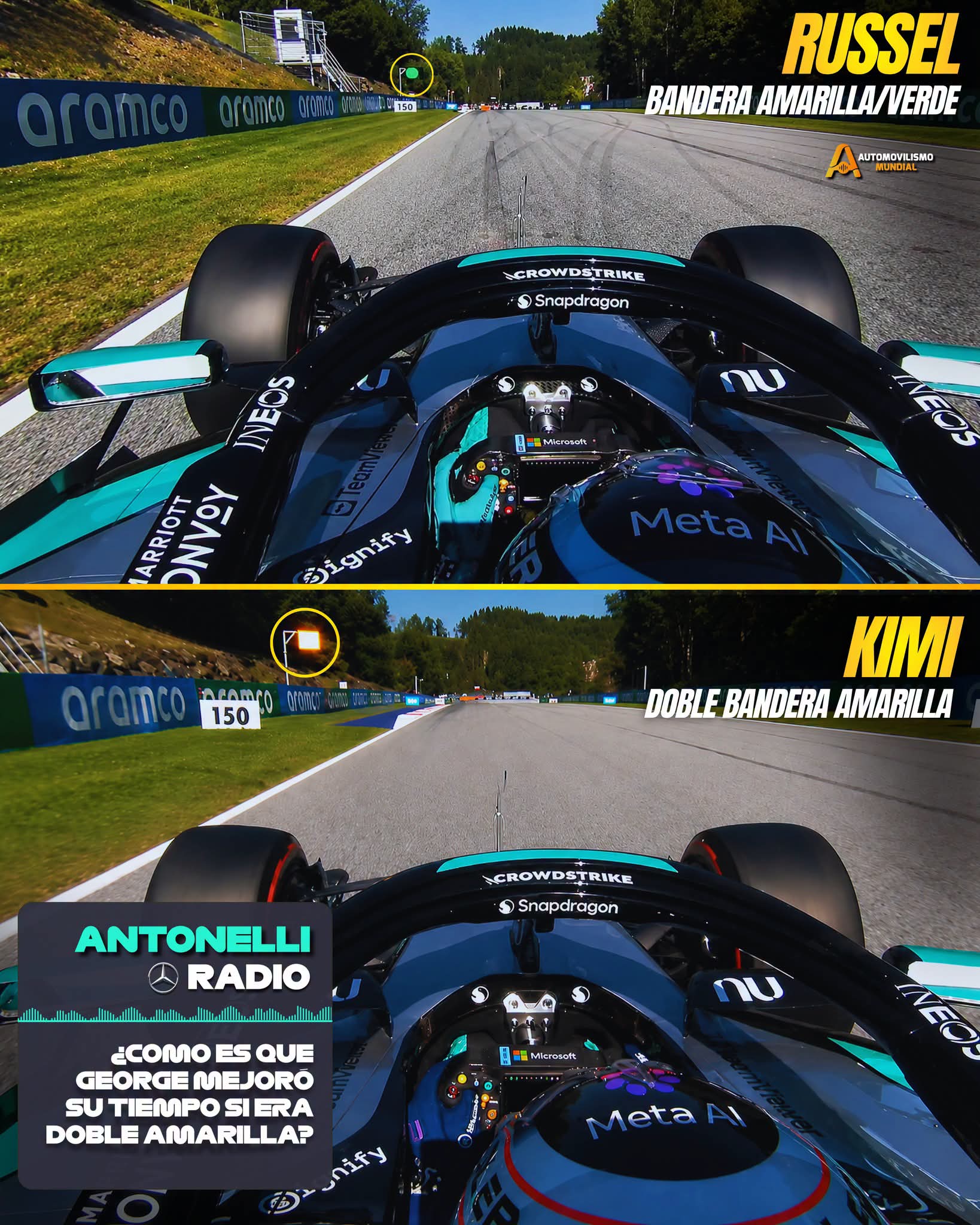
Antonelli encountered what appeared to be a double yellow flag and immediately backed off, effectively sacrificing his qualifying lap. Russell, meanwhile, was dealing with a different sequence of flag signals and reacted accordingly.
That contrast has left many fans questioning how two teammates arriving in the same sector could experience different circumstances.
The explanation lies in how quickly race control updates marshaling signals. Even a difference of a few seconds can determine whether a driver encounters a single yellow, double yellow or a green flag after marshals assess the situation.
FERRARI LEFT WITH QUESTIONS BUT LITTLE EVIDENCE
Ferrari Team Principal Fred Vasseur acknowledged that his team had no access to the FIA’s complete telemetry data while discussing the incident after qualifying.
Without that detailed information, rival teams are unable to independently verify precisely how much Russell slowed or where he accelerated again. That has inevitably allowed speculation to continue despite the FIA’s official verdict.
However, Formula 1 investigations rely heavily on telemetry, timing loops and race control data rather than visual impressions alone. Those measurements ultimately convinced the stewards that Russell’s actions complied with the regulations.
WHY THIS DECISION MATTERS FOR THE CHAMPIONSHIP
This pole position could prove enormously significant in both championship battles.
Mercedes entered the Austrian Grand Prix weekend as the benchmark team under the current regulations, with Andrea Kimi Antonelli leading the Drivers’ Championship and the Silver Arrows holding a healthy advantage in the Constructors’ standings. Russell starting from pole gives Mercedes another opportunity to maximize points and strengthen its position.
For Verstappen, the situation is even more frustrating. Instead of challenging for pole, the Red Bull driver crashed out during the decisive phase of qualifying, adding another setback to what has already been a difficult campaign.
Had Russell received a penalty, Ferrari would have inherited pole position, dramatically changing the strategic outlook for Sunday’s race.
THE FIA’S DECISION IS UNLIKELY TO END THE ARGUMENT
Although the investigation has officially been closed, discussions surrounding the incident are unlikely to disappear anytime soon.
Formula 1 has always produced heated debates whenever qualifying laps intersect with yellow flag incidents. Fans naturally compare visual footage with the final decisions, while teams often rely on telemetry that is unavailable to the public.
From the FIA’s perspective, the regulations were applied correctly because Russell demonstrated a measurable reduction in speed under a single yellow flag. For many fans, however, seeing a driver improve his lap after passing an accident scene will continue to raise questions.
SUNDAY’S RACE NOW BECOMES EVEN MORE IMPORTANT
With the controversy behind him, Russell now has the perfect opportunity to silence the criticism on track.
A victory from pole would reinforce Mercedes’ growing dominance in 2026 and further strengthen Russell’s position within the championship fight. It would also validate the FIA’s decision by ensuring the fastest qualifying driver converts his advantage into race success.
Meanwhile, Verstappen faces another recovery drive after his qualifying crash, adding even more pressure to Red Bull as questions continue surrounding both the RB22’s competitiveness and the Dutchman’s long-term future.
Whether fans agree with the stewards or not, one thing is certain: George Russell’s Austrian Grand Prix pole position has become one of the defining talking points of the 2026 Formula 1 season.