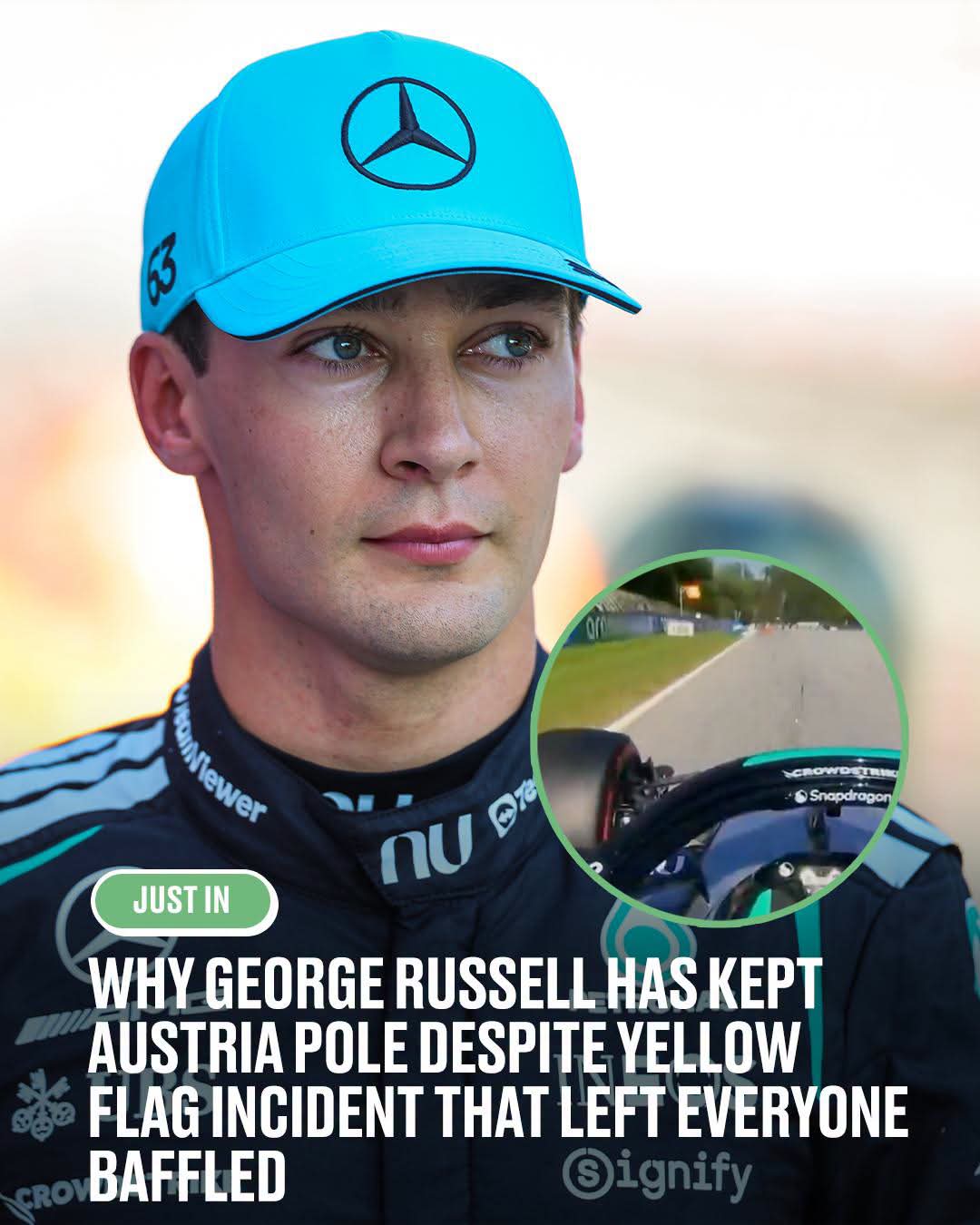
George Russell will start the Austrian Grand Prix from pole position after the FIA ruled that the Mercedes driver did not commit a yellow flag infringement during a dramatic qualifying session at the Red Bull Ring. The decision ended immediate speculation that Russell could lose his fastest lap after setting pole just moments after Max Verstappen crashed in the final stages of Q3.
The incident quickly became one of the biggest talking points of qualifying, with fans, teams and even rival drivers questioning whether Russell had complied with Formula 1’s strict yellow flag regulations. After reviewing the data, however, the stewards concluded that the Briton had acted within the rules, allowing him to retain pole ahead of Ferrari’s Charles Leclerc and Lewis Hamilton.
VERSTAPPEN’S CRASH CREATED QUALIFYING CHAOS
The closing moments of qualifying took a dramatic turn when Verstappen lost control of his Red Bull and slammed into the barriers. His accident immediately triggered yellow flags around the final sector, forcing every driver still on a flying lap to react instantly.
While several drivers abandoned their attempts altogether, Russell chose a different approach. Rather than backing out completely, he visibly lifted off the throttle through the affected sector before completing his lap. That effort ultimately proved fast enough to secure the quickest time of the session.
The decision instantly placed Russell under investigation as officials examined whether he had slowed sufficiently while passing the incident.
WHY RUSSELL WAS NOT PENALIZED
The FIA’s review focused on one critical detail: the type of yellow flag displayed when Russell approached the accident scene.
Data and race control records confirmed that Russell encountered only a single yellow flag, not a double yellow, during his flying lap.
Under Formula 1 sporting regulations, drivers facing a single yellow are required to reduce speed significantly enough to demonstrate caution while remaining prepared to change direction if necessary. They are not automatically required to abandon their laps.
Telemetry showed Russell lifted substantially entering the penultimate corner, reducing his speed by approximately 25 km/h compared to previous qualifying laps. That reduction satisfied the FIA’s requirements, resulting in no further action.
THE DIFFERENCE BETWEEN SINGLE AND DOUBLE YELLOW FLAGS
Understanding why Russell escaped a penalty requires knowing the distinction between Formula 1’s two yellow flag scenarios.
A single yellow flag warns drivers that danger exists ahead. Competitors must slow down, remain alert and be prepared to alter their line if necessary. However, provided they clearly reduce speed, they may continue their laps.
A double yellow flag is considerably more restrictive. Drivers must slow dramatically and be prepared to stop completely because marshals, damaged cars or other hazards may be directly on the racing line.
Had Russell passed Verstappen’s accident under double yellow conditions while continuing to push, losing pole position would have been almost inevitable.
ANTONELLI’S REACTION SPARKED EVEN MORE QUESTIONS
Mercedes teammate Andrea Kimi Antonelli immediately questioned how Russell had managed to produce a pole-winning lap while yellow flags were active.
Antonelli had already backed out of his own attempt after believing stronger caution signals were being displayed.
Mercedes Team Principal Toto Wolff later explained that Antonelli appeared to interpret the situation as a double yellow flag, while Russell correctly reacted to a single yellow signal. That difference in interpretation effectively ended Antonelli’s qualifying challenge but allowed Russell to continue within the regulations.
The contrasting reactions from the two Mercedes drivers highlighted just how confusing rapidly changing flag situations can become during high-pressure qualifying sessions.
MERCEDES EXECUTED UNDER PRESSURE
Beyond the controversy, Mercedes deserve significant credit for delivering another outstanding qualifying performance.
Russell remained calm despite encountering one of the most difficult scenarios any driver can face—a yellow flag appearing during a decisive final lap. Rather than panicking or making an instinctive mistake, he trusted the regulations, lifted appropriately and completed an excellent lap.
The result also reinforces Mercedes’ impressive resurgence throughout the 2026 season. With Antonelli leading the Drivers’ Championship and Russell consistently fighting near the front, the Silver Arrows continue to establish themselves as the benchmark team under Formula 1’s latest regulations.
WHAT THIS MEANS FOR THE AUSTRIAN GRAND PRIX
Keeping pole position gives Russell a major opportunity to strengthen Mercedes’ position in both championships.
Starting ahead of both Ferraris places him in an excellent position to control the race, especially if Mercedes can convert its strong qualifying pace into consistent race speed.
For Verstappen, however, the story is very different. His qualifying crash leaves Red Bull facing another difficult recovery drive on home soil, increasing pressure on both the team and the Dutch champion during a season that has already produced several frustrating weekends.
THE CHAMPIONSHIP BATTLE CONTINUES TO INTENSIFY
The qualifying controversy may now be over, but its championship implications remain significant.
Every point matters in what has become one of Formula 1’s most competitive seasons in recent years. Russell’s pole position could translate into a crucial victory, while Verstappen’s accident may further damage his already difficult title campaign.
The FIA’s swift explanation also reinforces an important message: qualifying incidents will always be judged based on precise telemetry, race control data and the exact flag conditions—not simply on appearances or public opinion.
As Sunday’s Austrian Grand Prix approaches, Russell has retained both his pole position and a golden opportunity to deliver another statement victory for Mercedes.