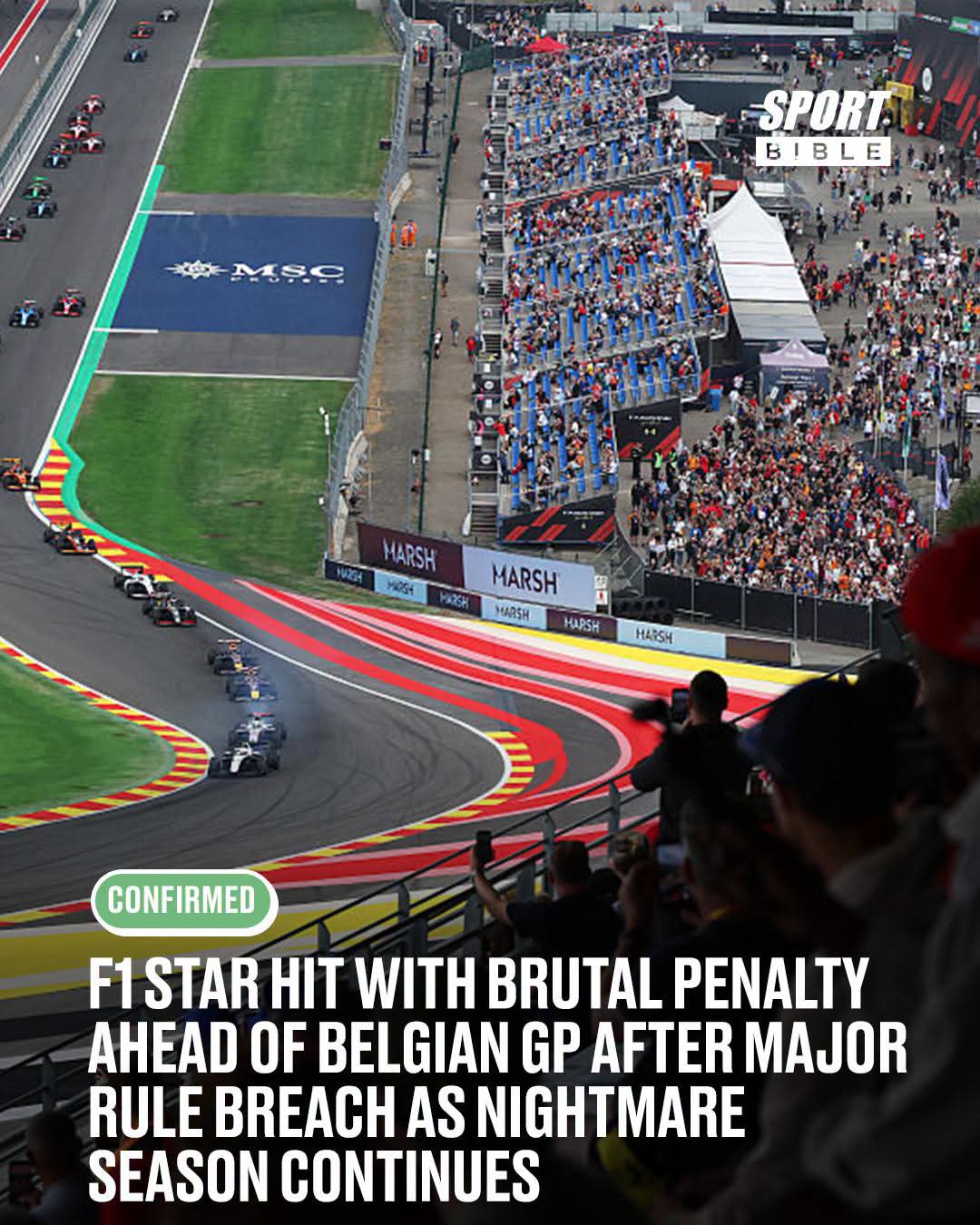
Fernando Alonso’s difficult 2026 Formula 1 season has taken another painful turn after the FIA confirmed the Aston Martin driver will start from the back of the grid for the Belgian Grand Prix following multiple power unit component changes. The two-time world champion has become the latest high-profile casualty of Formula 1’s strict engine allocation rules, joining a growing list of drivers forced to accept heavy penalties as reliability concerns continue to shape the championship.
For Alonso, the punishment could not have come at a worse time. Already enduring one of the toughest campaigns of his Formula 1 career, the Spanish veteran now faces an uphill battle at Spa-Francorchamps, where every championship point is becoming increasingly valuable.
FIA CONFIRMS BACK-OF-THE-GRID START FOR ALONSO
The FIA ruled that Aston Martin exceeded the permitted seasonal allocation by installing a new Energy Store (ES), Control Electronics (PU-CE), and Ancillary Component (PU-ANC) on Alonso’s car before the Belgian Grand Prix.
Formula 1 regulations automatically impose grid penalties whenever teams exceed their allocation of power unit components. Because Alonso’s combined penalties exceeded the 15-place threshold, the regulations require him to start Sunday’s race from the very back of the field regardless of his qualifying result.
The decision officially removes any realistic opportunity for Alonso to fight near the front at the start of the race, leaving Aston Martin to focus on damage limitation.
WHY ENGINE PENALTIES HAVE BECOME A MAJOR STORY IN 2026
Alonso is far from the only driver affected by Formula 1’s engine regulations this season.
Lando Norris recently accepted a 10-place grid penalty after McLaren introduced updated power electronics to improve reliability. Lance Stroll also received a similar sanction, while Isaac Hadjar was handed an even more severe punishment after multiple Red Bull power unit changes triggered a back-of-the-grid start.
The growing number of penalties highlights one of the biggest challenges under Formula 1’s current regulations: balancing performance, reliability, and limited component allocations across a demanding calendar.
Teams often face a difficult strategic decision between risking unreliable parts or accepting penalties in exchange for fresh components capable of lasting the remainder of the season.
ASTON MARTIN’S NIGHTMARE CAMPAIGN CONTINUES
The penalty compounds what has already been a frustrating year for Aston Martin.
Alonso has retired from four races this season and has managed to score the team’s only championship point with a tenth-place finish in Monaco. Meanwhile, teammate Lance Stroll has yet to register a point, underlining just how difficult the AMR26 has been to extract performance from throughout 2026.
Aston Martin entered the campaign hoping to build on previous progress, but instead has found itself battling reliability problems and inconsistent pace while rivals continue making steady gains.
The latest power unit changes suggest the team is prioritizing long-term reliability, even if it comes at the cost of immediate results.
CAN ALONSO STILL FIGHT BACK AT SPA?
Although starting from the back is a significant disadvantage, Spa-Francorchamps remains one of the few circuits where recovery drives are genuinely possible.
Its long straights, multiple overtaking zones, and unpredictable weather frequently create opportunities for drivers to climb through the field. Safety Cars, mixed conditions, and varying tyre strategies have historically transformed Belgian Grand Prix races into unpredictable contests.
Alonso’s racecraft has long been considered among the best in Formula 1, and his ability to manage tyres while making calculated overtakes could allow him to recover positions despite the difficult starting spot.
However, reaching the points will still require both a flawless performance and favorable race circumstances.
WHAT THIS MEANS FOR THE CHAMPIONSHIP
For Alonso personally, the championship picture has already become increasingly difficult, and another likely points-less weekend would further reduce his chances of climbing the Drivers’ Championship standings.
For Aston Martin, the situation is equally concerning. Constructors’ Championship points are crucial not only for prestige but also for the financial rewards distributed at the end of the season. Falling behind direct midfield rivals could have long-term consequences beyond 2026.
The team must therefore ensure these fresh power unit components deliver improved reliability over the remaining races to justify sacrificing grid position this weekend.
ALONSO’S EXPERIENCE WILL BE PUT TO THE ULTIMATE TEST
Few drivers on the Formula 1 grid possess the experience Fernando Alonso brings to challenging race situations.
The Spaniard has repeatedly demonstrated an ability to maximize opportunities when circumstances appear stacked against him. Starting last will undoubtedly make the Belgian Grand Prix one of his toughest races of the season, but it also offers another chance to showcase the racecraft that has defined his remarkable Formula 1 career.
Whether Alonso can transform adversity into another memorable recovery remains to be seen. What is already certain, however, is that Aston Martin’s reliability gamble has made the Belgian Grand Prix one of the most important weekends of its season.
If the new power unit package performs as intended, the short-term pain of a back-of-the-grid start could ultimately provide the platform for a stronger finish to the 2026 Formula 1 campaign.