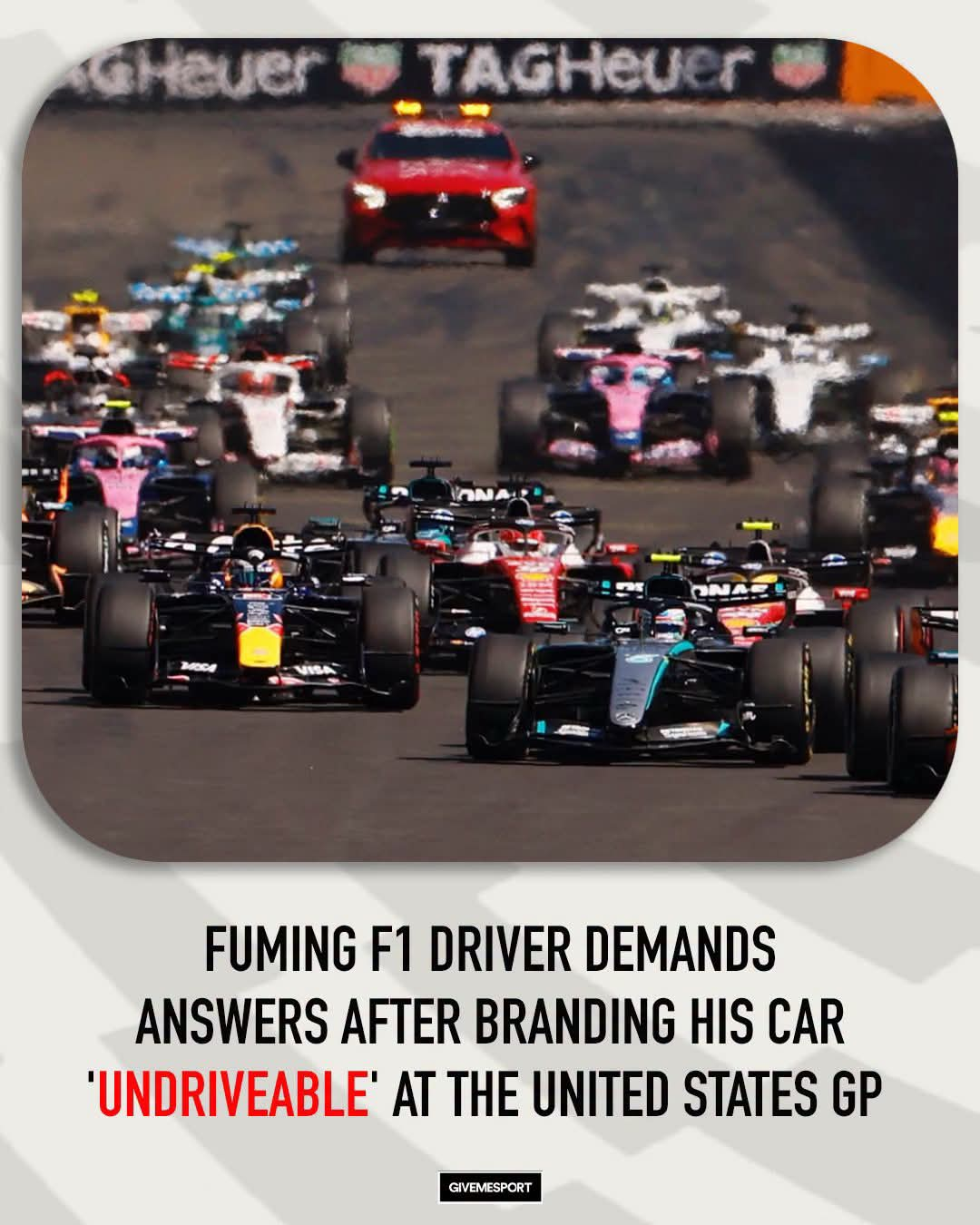
Isack Hadjar has demanded answers from Red Bull after a frustrating Friday at the 2026 United States Grand Prix, describing his RB22 as “undriveable” following a dramatic loss of performance on the soft tyres. The French-Algerian driver struggled to find consistency at the Circuit of the Americas, raising questions about Red Bull’s car setup and its ability to deliver predictable performance across different tyre compounds.
Hadjar finished 14th in the opening practice session before improving to ninth in FP2. However, his position on the timing screens did little to hide his frustration. After making several changes to the car between sessions, the Racing Bulls graduate found himself battling a machine that became increasingly difficult to control, particularly through the circuit’s demanding high-speed corners.
HADJAR LEFT FUMING AFTER RED BULL SETUP CHANGES
Hadjar initially believed the adjustments made after FP1 would move him in the right direction. Instead, the changes introduced fresh problems, leaving him struggling to extract performance from the soft tyres.
Speaking after the session, he explained that the car felt reasonably manageable on the medium compound but became dramatically worse when he switched to the softer rubber. He reported severe front-end instability and excessive tyre degradation, which prevented him from maintaining competitive lap times throughout the circuit.
His description of the RB22 as “undriveable” highlighted the scale of the problem. At a track like Austin, where drivers must attack a mixture of fast corners, heavy braking zones and technical sections, a lack of front-end grip can compromise an entire lap.
WHY THE TYRE PROBLEM COULD BECOME A MAJOR CONCERN
Hadjar’s biggest concern was not simply his position in FP2 but the apparent difference in performance between the medium and soft tyres.
The soft compound is generally expected to provide greater grip over a qualifying lap, although it can also be more sensitive to temperature and degradation. If a car overheats its front tyres or struggles to maintain the correct operating window, the expected performance advantage can disappear quickly.
Hadjar reported that his front tyres were effectively losing their effectiveness in high-speed corners. That would make it difficult to carry speed through the opening sector and could force him to compensate elsewhere, costing valuable lap time.
For Red Bull, identifying the cause is essential. The issue could involve setup changes, tyre preparation, aerodynamic balance or the interaction between the car and the circuit. Without further technical information, it would be premature to blame a single component.
RED BULL RESPONDS AS HADJAR MAKES A QUALIFYING RECOVERY
Despite the difficult practice sessions, Red Bull’s response appeared to pay off when qualifying arrived. Hadjar secured third place on the grid, a significant improvement that suggested the team had found a more effective direction with the car.
That turnaround is important because it demonstrates how quickly performance can change when engineers identify the right setup compromise. It also suggests that Hadjar’s complaints provided useful feedback rather than simply reflecting a lack of confidence behind the wheel.
Nevertheless, qualifying pace does not automatically guarantee race-day performance. A car that performs well over one lap can still struggle with tyre management, balance and consistency over a full Grand Prix distance.
MAX VERSTAPPEN’S PERFORMANCE ADDS ANOTHER DIMENSION
While Hadjar struggled in Friday practice, teammate Max Verstappen remained competitive, finishing second in FP1 and third in FP2 after Charles Leclerc topped both sessions.
The difference between the two Red Bull drivers raises an important question: was Hadjar dealing with an isolated setup problem, or was he experiencing a broader weakness that Verstappen managed more effectively?
Different driving styles, setup preferences and tyre preparation can produce significantly different results from the same car. Hadjar’s difficulties should therefore be assessed alongside the team’s technical data rather than treated as proof that the RB22 was fundamentally flawed.
For Red Bull, the objective will be to ensure both drivers have a car capable of delivering consistent performance, especially as the championship enters another demanding stretch of races.
WHAT HADJAR’S FRUSTRATION MEANS FOR SUNDAY’S RACE
Hadjar’s third-place qualifying result puts him in a strong position to challenge for a major result, provided the car remains stable over longer runs. The crucial test will be whether Red Bull has resolved the front-end grip and tyre degradation issues he identified in practice.
If those problems return, Hadjar could struggle to maintain his position against rivals with better tyre management. If the improvements hold, however, he has a genuine opportunity to convert his qualifying performance into valuable championship points.
The United States Grand Prix could therefore become an important test of Red Bull’s development work and Hadjar’s ability to manage pressure when the car is not behaving as expected.
One thing is clear: his blunt assessment has placed the RB22 under the spotlight. Red Bull’s next challenge is to prove that the problems experienced in practice have been properly addressed, rather than merely hidden by a stronger qualifying performance.