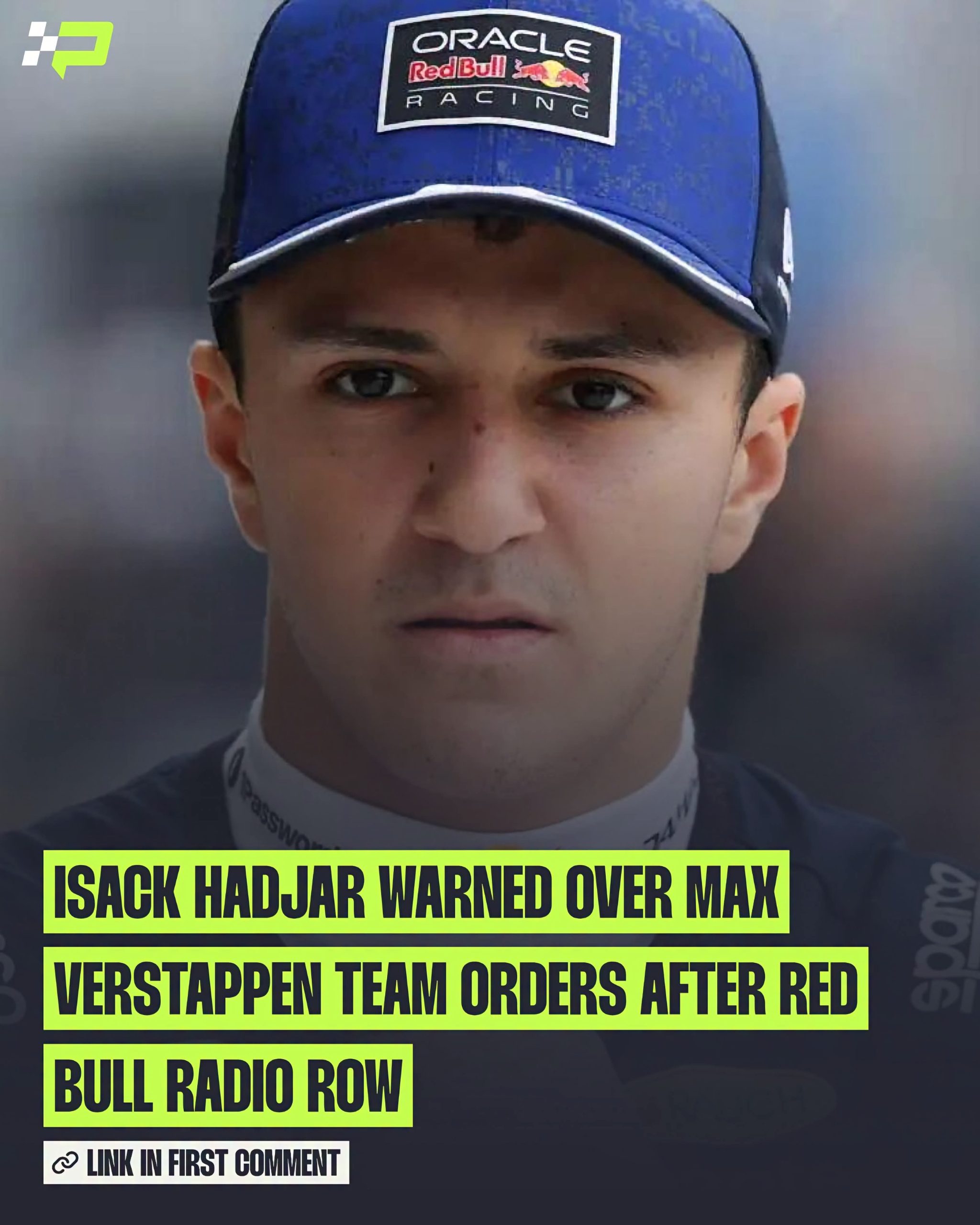
Isack Hadjar could face a stern conversation with Red Bull after initially resisting a team order to let Max Verstappen through during the United States Grand Prix. The Frenchman eventually obeyed instructions, but his hesitation has sparked fresh debate about team hierarchy, driver independence and the expectations placed on anyone sharing a garage with the four-time world champion.
The incident unfolded at the Circuit of the Americas, where Hadjar started third but lost positions after a difficult getaway. Red Bull subsequently placed its drivers on different strategies, leaving Verstappen chasing the drivers ahead after making an early pit stop on Lap 13. When the Dutchman caught Hadjar, the team instructed the rookie to move aside at Turn 12.
Hadjar initially objected because he feared the manoeuvre would cost him valuable race time. His race engineer, Richard Wood, reiterated that the decision had already been made, telling him: “No, mate, this is what we’re doing.” Hadjar eventually yielded, allowing Verstappen to pass at Turn 15.
Verstappen went on to finish third, while Hadjar crossed the line in sixth. Although the Frenchman still secured a respectable result, the radio exchange quickly became one of the most discussed moments of Red Bull’s weekend.
DAVID COULTHARD WARNS HADJAR ABOUT RED BULL’S EXPECTATIONS
Former Formula 1 driver David Coulthard believes Hadjar could receive a telling-off for initially refusing to follow the instruction. Commentating on F1TV, the Scot suggested that Red Bull’s decision was understandable given Verstappen’s record and experience.
Coulthard acknowledged that the situation might appear harsh, particularly because Hadjar was enjoying a strong weekend himself. However, he argued that Verstappen’s status as a proven race winner meant Red Bull had good reason to prioritise the Dutchman’s strategy when the team believed it was the best course of action.
Coulthard also suggested that Hadjar would be unlikely to challenge a similar instruction again after this experience. His comments underline the difficult position facing a young driver who wants to establish himself while competing alongside one of the most successful racers of his generation.
For Hadjar, the challenge is not simply about accepting team orders. It is about understanding when a decision serves the team’s overall objectives and communicating his concerns without creating unnecessary confusion during a race.
WHY HADJAR QUESTIONED THE TEAM ORDER
Hadjar later explained that the situation was confusing for both drivers. Verstappen was approaching quickly, but the timing of the instruction meant the Frenchman believed the manoeuvre could cost both cars time.
Speaking after the race, Hadjar explained that Verstappen was coming through “like a bullet” and that he was losing time by allowing his teammate past while also affecting Verstappen’s progress through the dirty air behind his car.
His concern was therefore rooted in race performance rather than an outright refusal to cooperate. Hadjar believed the team could have anticipated the situation more effectively and avoided an awkward exchange on the radio.
That argument highlights a wider challenge in Formula 1. Team orders can be strategically important, but their effectiveness depends on clear communication, timing and a shared understanding of the race plan. If a driver does not immediately understand the reasoning behind an instruction, even a brief disagreement can create complications.
Red Bull’s decision to place its drivers on different strategies made coordination particularly important. Once Verstappen caught Hadjar, the team had to decide whether allowing the faster-moving driver through would improve its chances of securing the strongest possible result.
VERSTAPPEN’S STATUS CREATES A DIFFICULT CHALLENGE FOR HADJAR
Verstappen’s standing within Red Bull inevitably adds another dimension to the incident. The Dutchman has delivered multiple championships and remains the team’s most established race-winning driver. Hadjar, meanwhile, is still building his reputation at the highest level of motorsport.
That difference does not automatically mean Hadjar must surrender every position to Verstappen. Team orders are usually dependent on circumstances, including strategy, pace, tyre condition and the team’s competitive objectives. However, when a team believes one driver has a stronger opportunity to achieve its immediate target, it may instruct the other to cooperate.
The important question is whether Red Bull communicated its reasoning clearly enough before the situation developed. Hadjar’s post-race explanation suggests he felt the team could have anticipated the encounter, potentially preventing both drivers from losing time.
If Red Bull wants to avoid similar incidents, it will need to ensure its drivers understand the strategic priorities before they find themselves competing for position on track.
HADJAR’S STRONG SEASON CONTINUES DESPITE THE CONTROVERSY
Despite the radio disagreement, Hadjar’s sixth-place finish represented another useful result in a season that has included significant challenges. He missed three Grand Prix weekends after suffering a wrist fracture, yet has continued working to establish himself in Formula 1.
According to the report, Hadjar sits seventh in the Drivers’ Championship with 105 points, while Verstappen is fourth with 236 points. The 131-point gap reflects the difference in their championship campaigns, although the Frenchman is still developing his experience and consistency.
Hadjar’s willingness to defend his position also demonstrates the competitive instinct that teams expect from their drivers. The difficulty is knowing when that instinct should take priority and when cooperation offers a better opportunity for the team.
His performance in the United States suggests he has the speed to remain competitive, but the incident provides a reminder that Formula 1 success also depends on communication, judgement and understanding the wider strategy.
WILL RED BULL TAKE FURTHER ACTION?
Coulthard believes Hadjar could receive a private reprimand, but the supplied report does not confirm that Red Bull has formally disciplined him. Any claim that the team has already imposed punishment would therefore be premature.
The episode is nevertheless likely to prompt internal discussions about how team orders are communicated and followed. Red Bull must balance Verstappen’s championship ambitions with its responsibility to develop Hadjar and give him the opportunity to demonstrate his own potential.
For Hadjar, the best response will be to learn from the incident while continuing to deliver strong performances. Challenging decisions is not necessarily a problem in itself, but disagreements must be handled in a way that does not compromise the team’s race.
The United States Grand Prix has exposed a potential flashpoint inside Red Bull, even though the drivers ultimately finished with respectable results. Whether it becomes a recurring issue will depend on how the team manages its strategy and how Hadjar adapts to the demands of racing alongside Verstappen.
Hadjar has shown that he is not afraid to defend his position, but Red Bull will expect him to recognise when the team’s bigger objectives must come first.