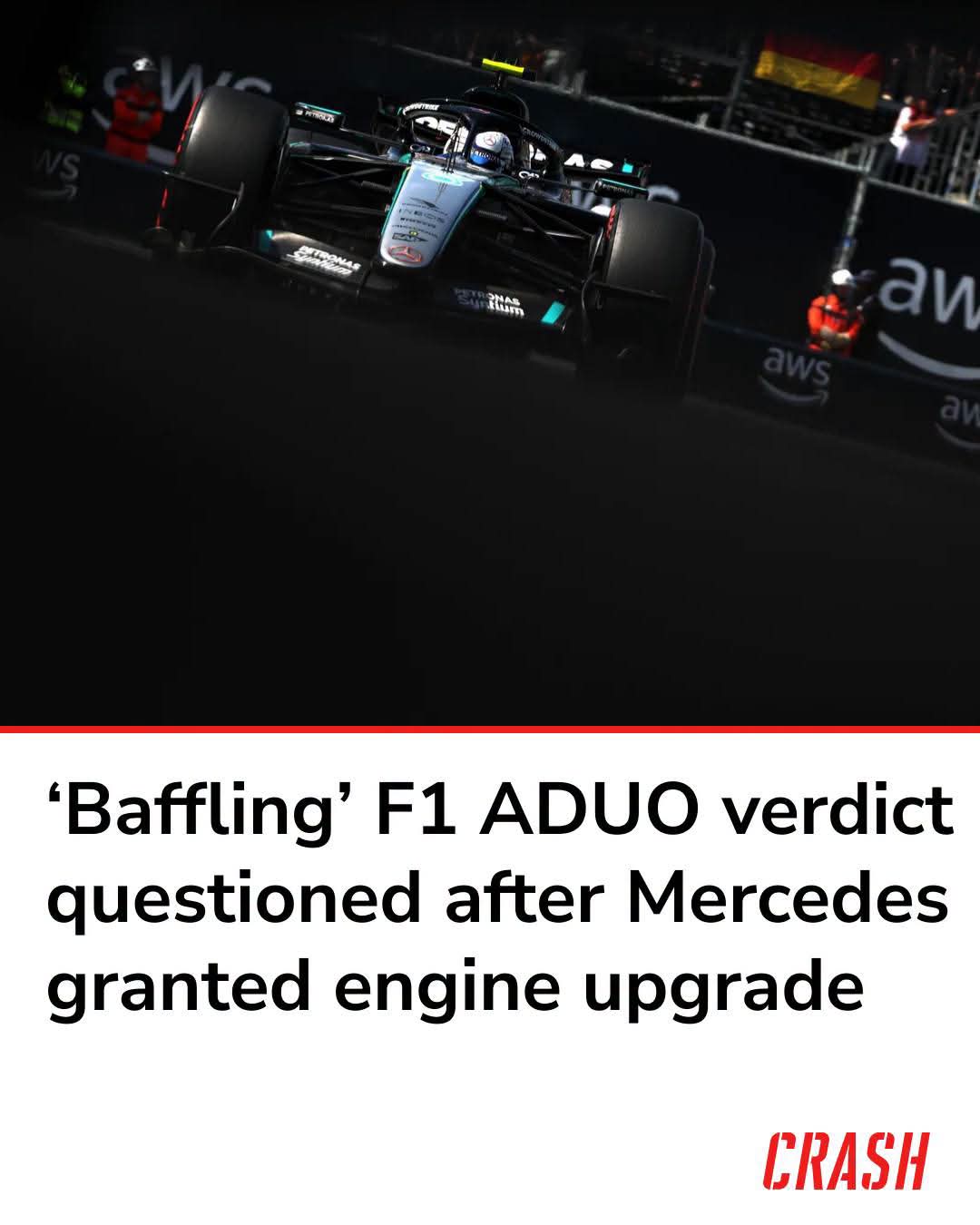
Formula 1 has found itself at the center of a growing technical controversy after the FIA’s Additional Development and Upgrade Opportunities (ADUO) ruling produced one of the most surprising outcomes of the 2026 season. Despite Mercedes winning every Grand Prix so far this year, the German manufacturer has reportedly been granted engine upgrade opportunities, while Red Bull has been classified as the benchmark power-unit supplier and therefore receives no additional assistance.
The decision has triggered confusion across the paddock, criticism from respected commentators, and growing concerns that the system designed to create parity could actually distort the competitive balance it was intended to protect.
With teams already preparing for the next phase of Formula 1’s new engine era, the debate surrounding the FIA’s findings is becoming one of the most significant stories of the season.
WHY THE FIA’S ADUO SYSTEM EXISTS
The ADUO mechanism was introduced as part of Formula 1’s effort to prevent engine manufacturers from becoming permanently stuck behind a dominant rival under the sport’s tightly controlled development regulations.
Unlike previous generations of Formula 1, where manufacturers could spend aggressively to close performance gaps, the modern era includes cost caps and restrictions that make recovery far more difficult. The FIA’s solution was to create a structured catch-up system that rewards underperforming manufacturers with additional upgrade opportunities and development resources.
In theory, the concept is sensible. If one engine supplier falls significantly behind, the system provides a pathway to regain competitiveness without waiting years for a regulation reset.
The problem arises when the rankings themselves appear to contradict what fans, teams, and even rival manufacturers are seeing on track.
THE DECISION THAT LEFT THE PADDOCK STUNNED
According to the FIA’s analysis, Red Bull currently possesses Formula 1’s strongest internal combustion engine. That classification means the team does not qualify for additional development opportunities under the ADUO framework.
Meanwhile, Mercedes, despite its flawless start to the season and dominance across multiple circuits, has reportedly been deemed sufficiently behind Red Bull’s combustion engine performance to receive upgrade allowances.
Ferrari, Audi, Honda, and other manufacturers are also expected to benefit from the system.
The outcome immediately raised eyebrows throughout Formula 1.
Mercedes has established itself as the team to beat in 2026, with its cars demonstrating exceptional pace, consistency, and efficiency. Naturally, many observers assumed the power unit was a major factor behind that success.
Instead, the FIA’s findings suggest a very different picture.
WHY MANY BELIEVE THE VERDICT DOESN’T ADD UP
One of the strongest criticisms of the ruling centers around the distinction between a combustion engine and a complete power unit.
Modern Formula 1 engines are no longer judged solely by raw combustion performance. Hybrid deployment, battery efficiency, energy recovery systems, software management, and electrical power delivery all contribute significantly to lap time.
The FIA’s rankings focus specifically on internal combustion engine output rather than the total performance package.
That distinction is critical.
A manufacturer may have the strongest combustion engine while still trailing rivals in hybrid efficiency. Conversely, another team could possess a slightly weaker combustion engine but compensate through superior electrical deployment and energy recovery systems.
Critics argue that focusing on only one aspect of the power unit risks creating misleading conclusions about overall competitiveness.
DAVID CROFT’S CRITICISM REFLECTS A WIDER CONCERN
The controversy intensified after prominent Formula 1 voices questioned the logic behind the system.
Many observers are struggling to understand how a team that has won every race can receive additional development assistance while another team that appears to be chasing the leaders is effectively blocked from further improvements.
The criticism isn’t necessarily aimed at Mercedes, which has simply operated within the regulations. Instead, it focuses on whether the system itself accurately measures competitive reality.
If the goal is to create parity, critics argue that rewarding the dominant team while limiting opportunities for challengers could produce the opposite effect.
That concern has become increasingly common throughout the paddock since the findings emerged.
RED BULL’S FRUSTRATION IS UNDERSTANDABLE
Perhaps the most fascinating aspect of the controversy is that Red Bull reportedly did not expect to be classified as Formula 1’s benchmark engine supplier.
Throughout the season, senior team figures have openly acknowledged Mercedes’ apparent advantage. Internal estimates reportedly suggested Red Bull remained behind the Silver Arrows in overall power-unit performance.
As a result, the FIA’s findings appear to conflict not only with public perception but also with Red Bull’s own analysis.
The situation becomes even more frustrating when viewed through a competitive lens. Red Bull believed the ADUO system would provide an avenue to close the gap to Mercedes. Instead, the team now finds itself excluded from receiving the very assistance it expected to utilize.
For a team trying to keep Max Verstappen competitive in a rapidly evolving championship battle, that could prove significant.
WHAT THIS MEANS FOR THE CHAMPIONSHIP FIGHT
The implications extend far beyond a technical argument.
Engine development plays a crucial role in Formula 1’s long-term competitive order. Manufacturers that gain additional upgrade opportunities today could enjoy substantial advantages next season and beyond.
Mercedes already sits at the top of the standings. If the team can improve further through ADUO-assisted development, rivals may find it even harder to challenge for victories.
For Red Bull, Ferrari, Audi, Honda, and the rest of the field, the next few months could shape the future of the championship landscape.
The controversy also arrives during a period when Formula 1 is already adjusting its engine regulations following criticism of excessive energy management and power deployment limitations. Questions about engine parity are now colliding with broader concerns about the direction of the sport’s technical rules.
COULD THE FIA BE FORCED TO REASSESS ITS APPROACH?
As pressure mounts, attention is shifting toward the FIA’s methodology.
Even if the governing body stands by its original findings, the debate has exposed a potential weakness in how performance is evaluated. Measuring only combustion output may no longer be sufficient in an era where hybrid technology often determines race-winning performance.
Future revisions to the ADUO system may need to incorporate a broader assessment of complete power-unit effectiveness rather than focusing on individual components.
That conversation is likely to continue well beyond the current season.
PREDICTION: THIS ENGINE DISPUTE IS ONLY JUST BEGINNING
The FIA’s ruling may have been intended as a technical assessment, but it has quickly evolved into one of Formula 1’s most politically charged stories.
If Mercedes continues its dominance while benefiting from additional development opportunities, scrutiny of the system will intensify. If Red Bull remains excluded from upgrades despite struggling to match the championship leaders, calls for reform will grow louder.
The controversy also places enormous importance on future ADUO reviews later this season. Any change in the rankings could dramatically alter the narrative and potentially reshape development plans across the grid.
For now, one thing is certain: a system designed to create fairness has instead created one of the biggest debates in Formula 1. And until the FIA provides greater clarity, questions about who truly has the best engine in Formula 1 will continue to dominate the paddock.