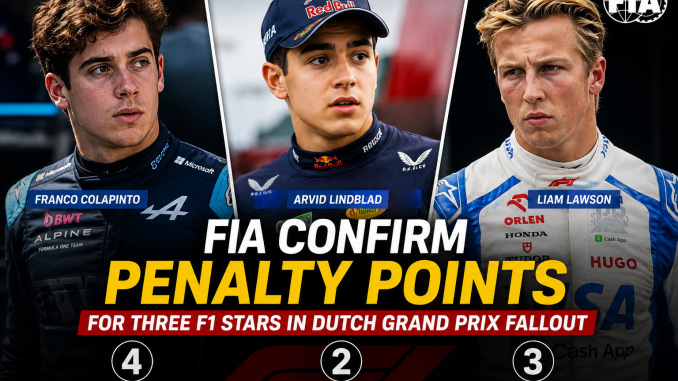
The FIA has added another layer of tension to the aftermath of the Dutch Grand Prix, with Franco Colapinto, Arvid Lindblad and Liam Lawson all receiving penalty points for separate yellow-flag infringements at Zandvoort.
The decisions could become increasingly important as the 2026 Formula 1 season enters its decisive phase. While none of the three drivers is immediately close to an automatic race ban, further mistakes could put their superlicence records under significant pressure.
COLAPINTO TAKES THE BIGGEST HIT
Franco Colapinto emerged from the weekend with the most severe penalty of the trio, collecting three penalty points and taking his 12-month total to four.
Two points were awarded after the Alpine driver overtook another competitor while yellow flags were being displayed following Max Verstappen’s opening-lap incident. Colapinto was then punished again after stewards concluded that he had failed to slow sufficiently when yellow flags were active.
The combined penalties underline how seriously the FIA is treating driver behaviour around incidents. Yellow flags are not simply informational signals; they require drivers to demonstrate a clear reduction in speed and heightened caution.
LINDBLAD ALSO CAUGHT IN OPENING-LAP INCIDENT
Arvid Lindblad was involved in the same opening-lap sequence and received two penalty points for overtaking under double-waved yellow flags.
The Racing Bulls driver also received a drive-through penalty, making the incident particularly costly. More importantly, the two points represent his first penalty points in Formula 1.
For a young driver building his career, accumulating points this early is something his team will want to monitor carefully. One isolated incident is unlikely to define his season, but repeated infringements can quickly create unnecessary pressure.
LAWSON ADDS ANOTHER POINT
Liam Lawson was the third driver punished after stewards found that he had not slowed appropriately for yellow flags later in the race.
The Racing Bulls driver received one penalty point, taking his total to three over the relevant 12-month period. He was also handed a 10-second race penalty.
Lawson therefore leaves Zandvoort with considerably less room for error than before. Another penalty-point offence would push his tally higher and make subsequent incidents increasingly consequential.
THE 12-POINT RULE MAKES EVERY FUTURE MISTAKE MATTER
Under the FIA’s current penalty-point system, a driver who accumulates 12 points within a 12-month period is automatically suspended for one race. Points then expire individually after 12 months.
That means Colapinto’s four points are particularly noteworthy. He is now only eight points away from the suspension threshold, while Lawson sits on three and Lindblad on two.
The situation also illustrates why penalty points can become a season-long subplot. Drivers aren’t merely fighting for championship positions; they must simultaneously avoid incidents that could compromise their availability for future races.
ZANDVOORT HAS CREATED ANOTHER F1 PRESSURE POINT
The Dutch Grand Prix has therefore left Colapinto, Lindblad and Lawson with something else to think about when the grid forms for the next round.
For Colapinto, the priority is obvious: avoid another avoidable infringement. Lawson faces a similar challenge, while Lindblad will be keen to ensure his first penalty points do not become the beginning of a pattern.
With the championship battle intensifying and the remaining races carrying greater significance, disciplined driving could prove just as important as outright pace. A driver cannot score points from the garage — and reaching 12 penalty points could force them there for an entire Grand Prix.