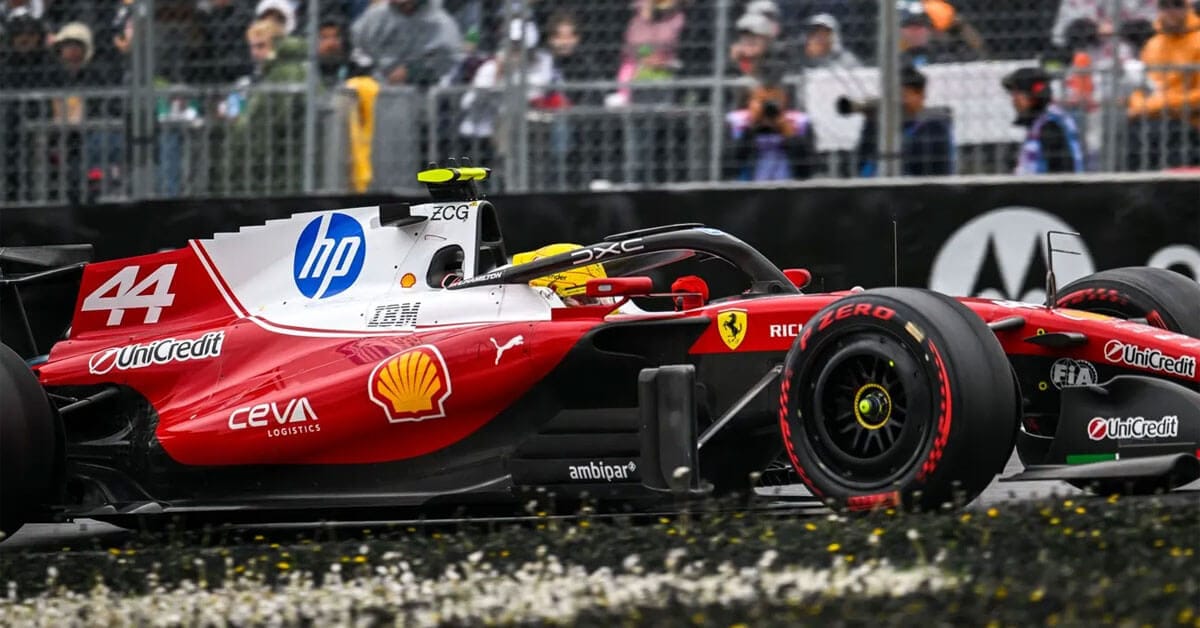
Ferrari’s recent breakthrough in rear wheel technology has quietly emerged as one of the most important performance factors behind Lewis Hamilton’s standout victory at the Spanish Grand Prix. While much of the attention has focused on the SF-26 aerodynamic upgrade package, a less visible innovation played a decisive role in Ferrari’s race-winning performance.
The Scuderia’s new rear wheel rim design, developed in collaboration with BBS Japan, has delivered a significant improvement in tyre temperature control and long-run consistency, helping Ferrari unlock stronger race pace in extreme conditions at Barcelona.
A HIDDEN PERFORMANCE BREAKTHROUGH BEHIND FERRARI’S SPAIN SUCCESS
Modern Formula 1 is often decided by fine margins, and Ferrari’s victory in Spain is a clear example of how small technical innovations can translate into major on-track gains.
While the SF-26 upgrade package improved overall aerodynamic efficiency, Ferrari also introduced a revised rear wheel rim concept designed specifically to manage heat transfer between the brakes and tyres.
This detail became particularly important at the Circuit de Barcelona-Catalunya, where high ambient temperatures and severe track heat typically create extreme tyre degradation challenges.
By improving how heat is controlled at the wheel level, Ferrari effectively gave Lewis Hamilton a more stable platform to manage tyre wear throughout the race.
WHY TYRE MANAGEMENT DECIDED THE SPANISH GRAND PRIX
The Spanish Grand Prix is widely regarded as one of the most demanding circuits on the calendar when it comes to tyre degradation.
In Barcelona, track temperatures climbed to over 50°C, turning tyre strategy into a critical performance factor. Pirelli also brought softer compounds compared to previous seasons, further increasing degradation sensitivity.
In these conditions, race pace is no longer just about outright speed. It becomes a strategic balance of:
Controlling tyre temperature over long stints
Preventing overheating on rear axle traction zones
Maintaining consistent lap times under pressure
Managing brake-induced heat transfer
Ferrari’s ability to control these variables gave them a decisive advantage over rivals during the race.
THE TECHNICAL IDEA BEHIND FERRARI’S REAR WHEEL INNOVATION
At the core of Ferrari’s development is a renewed focus on thermal management at the wheel assembly level.
With Formula 1 regulations allowing more freedom in wheel design, teams have begun treating rims as active aerodynamic and thermal components rather than passive parts.
Ferrari’s solution, developed with BBS Japan, focuses on reducing unwanted heat transfer from the braking system into the tyres.
Key elements of the concept include:
Advanced carbon brake drum architecture that isolates heat flow
A controlled air gap between structural layers to reduce thermal transfer
Optimized airflow channels independent from traditional brake cooling ducts
Magnesium wheel rim design tailored to dissipate excess heat away from the tyre surface
The result is a system that helps maintain more stable tyre pressures and prevents overheating during long race stints.
WHY THIS APPROACH GIVES FERRARI AN EDGE IN HOT RACES
Ferrari’s innovation is particularly effective in high-temperature races like Barcelona, where tyre overheating is often the limiting factor rather than grip.
By preventing excessive heat from reaching the tyre surface, the team can:
Extend the performance window of soft and medium compounds
Reduce sudden degradation spikes
Maintain more consistent rear-end stability
Improve overall race strategy flexibility
This is especially important in modern Formula 1, where tyre management often determines whether a team can fight for wins or simply defend positions.
HOW LEWIS HAMILTON BENEFITED IN HIS FIRST FERRARI VICTORY
Lewis Hamilton’s victory in Spain was not only a milestone moment in his Ferrari career but also a demonstration of how technical innovation translates into driver performance.
Although he narrowly missed pole position in qualifying by just 0.064 seconds, Hamilton’s race pace stood out as one of the strongest on the grid.
The improved tyre stability allowed him to:
Push harder in key race phases without overheating the tyres
Execute a more aggressive yet controlled race strategy
Maintain consistent lap times in high-temperature conditions
Capitalize on Ferrari’s strong long-run performance window
This synergy between driver skill and technical development proved decisive in converting race pace into victory.
THE ROLE OF LOIC SERRA AND FERRARI’S TYRE PHILOSOPHY SHIFT
Ferrari’s technical progress in tyre management is also linked to the influence of Loïc Serra, whose background in tyre engineering has helped reshape the team’s development direction.
Having worked extensively in tyre dynamics during his career, Serra has brought a more integrated approach to how Ferrari designs its car around tyre behavior rather than treating tyres as an external limitation.
This philosophy is now visible in developments like:
Integrated aerodynamic and thermal design thinking
Greater focus on stint consistency rather than peak qualifying pace
Improved collaboration with tyre supplier data insights
The rear wheel innovation is a clear example of this broader shift in engineering strategy.
WHAT THIS MEANS FOR THE REST OF THE SEASON
Ferrari’s success in Spain suggests that the team may have unlocked a competitive advantage in hot-weather and high-degradation circuits.
If this development proves consistent across multiple tracks, Ferrari could become a serious threat in the championship battle, especially on circuits where tyre management plays a central role.
However, questions remain:
Will the rear wheel concept perform equally well in cooler conditions?
Can rival teams quickly copy or counter this approach?
Is Ferrari now more balanced across qualifying and race performance?
If the answers are positive, Ferrari may have added a crucial weapon to their 2026 title challenge.
FINAL THOUGHTS
Ferrari’s rear wheel innovation may not grab headlines like major aerodynamic upgrades, but its impact in Spain shows how Formula 1 success is often built on hidden technical details.
By improving tyre temperature control, Ferrari gave Lewis Hamilton the tools to deliver a controlled, strategic, and ultimately winning performance.
In a sport defined by fractions of a second, this kind of engineering precision could prove decisive as the season unfolds.