Ferrari has arrived at the Barcelona Grand Prix with one of its most significant technical updates of the 2026 Formula 1 season so far, introducing an eight-part upgrade package aimed at closing the gap to its main championship rivals.
But beyond the sheer scale of the upgrade, what has caught attention is a subtle but potentially important front wing design detail that could hint at Ferrari’s deeper aerodynamic direction for the rest of the season.
For a team under pressure to deliver consistent race-winning performance, Barcelona may become a defining weekend.
WHY THE BARCELONA GP IS A CRITICAL TEST FOR UPGRADES
The Spanish Grand Prix at Barcelona is traditionally seen as the ultimate “truth circuit” in Formula 1.
Its mix of high-speed corners, long-duration bends, and heavy aerodynamic load makes it one of the best tracks to evaluate whether an upgrade package genuinely works or simply looks good on paper.
For Ferrari, this makes the timing of the eight-part upgrade package especially significant.
Unlike street circuits or low-speed layouts, Barcelona exposes weaknesses in:
High-speed aerodynamic stability
Tyre degradation under load
Cornering balance through medium-speed sections
Overall efficiency of airflow management
If Ferrari’s updates work here, they are likely to work almost everywhere.
INSIDE FERRARI’S EIGHT-PART UPGRADE PACKAGE
Ferrari’s latest development push is not a single headline upgrade but a collection of refinements across multiple areas of the car.
While full technical details are always carefully guarded, the package is understood to include improvements across:
Front wing structure and airflow conditioning
Floor edge and underbody efficiency
Rear aerodynamic stability
Cooling refinements
Suspension and mechanical balance adjustments
Minor bodywork reshaping for drag reduction
This type of “multi-layered” upgrade approach is increasingly common in modern Formula 1, where performance gains often come from the interaction of multiple small improvements rather than one major change.
Ferrari’s goal is not just more downforce, but more usable downforce across a wider range of corners.
THE INTRIGUING FRONT WING DESIGN DETAIL EXPLAINED
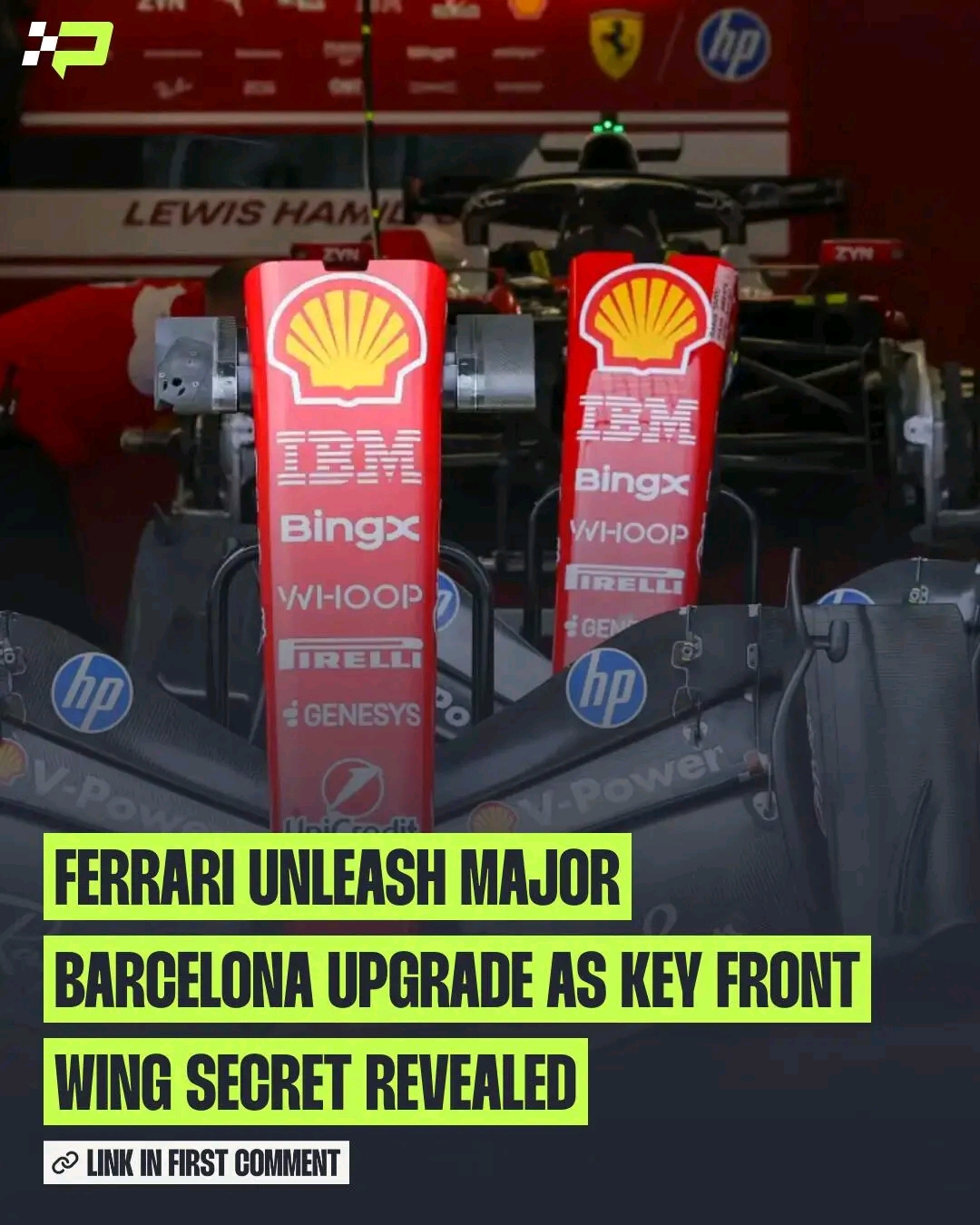
The most closely watched element of Ferrari’s upgrade package is the revised front wing concept.
According to technical analysis highlighted by PlanetF1’s Dr Obbs, Ferrari appears to be experimenting with a more refined airflow management structure around the front wing edges.
In simple terms, the front wing is responsible for:
Directing airflow around the car
Feeding the floor for ground effect performance
Controlling balance between front and rear grip
Even a small change here can significantly alter the car’s behavior.
The intriguing aspect is that Ferrari’s design suggests a shift toward:
More controlled airflow separation
Improved consistency through high-speed corners
Better synergy with the floor aerodynamics
If successful, this could reduce one of Ferrari’s recurring issues in recent seasons: inconsistency between qualifying pace and race stability.
WHY THIS UPGRADE MATTERS FOR FERRARI’S TITLE HOPES
Ferrari’s 2026 campaign has been defined by flashes of competitiveness, but not sustained dominance.
At their best, the Scuderia can challenge for podiums and occasional wins. At their worst, they struggle with tyre degradation and balance shifts during long stints.
This Barcelona upgrade is important because it directly targets those weaknesses.
If the package works, Ferrari could:
Improve race pace consistency
Reduce tyre overheating issues
Increase qualifying-to-race performance conversion
Strengthen its position in the Constructors’ Championship fight
In a tightly packed midfield-to-front grid, even a small gain of two to three tenths per lap can dramatically change race outcomes.
IMPACT ON LEWIS HAMILTON AND CHARLES LECLERC
For Ferrari’s driver lineup, the upgrade package is especially significant.
Lewis Hamilton will be closely evaluating how the new front wing affects confidence in high-speed corner entry, an area that becomes crucial at Barcelona’s fast sweeps.
Meanwhile, Charles Leclerc is expected to push the package to its limits in qualifying, where Ferrari often needs to extract maximum performance to stay competitive with Red Bull and McLaren.
Both drivers have different driving styles, which makes this upgrade an important internal benchmark: if it works for both, Ferrari has likely unlocked a more universal solution rather than a driver-specific setup fix.
COMPETITIVE IMPLICATIONS IN THE 2026 CHAMPIONSHIP
Ferrari’s timing could not be more critical.
The 2026 season is shaping up to be one of the most tightly contested in recent years, with multiple teams capable of podium finishes depending on circuit characteristics.
If Ferrari’s Barcelona upgrade delivers real performance gains, it could:
Tighten the Constructors’ Championship battle
Put pressure on Red Bull’s development trajectory
Force McLaren and Mercedes to respond quickly with upgrades of their own
However, if the upgrade underperforms, Ferrari risks falling further behind in development momentum, which is often harder to recover from than outright pace deficits.
LONG-TERM DEVELOPMENT SIGNAL FROM FERRARI
Beyond immediate performance, Ferrari’s eight-part package signals something more important: a shift toward layered aerodynamic evolution.
Instead of relying on isolated major upgrades, the team appears to be refining multiple systems simultaneously, which is more aligned with modern ground-effect Formula 1 philosophy.
This approach suggests Ferrari is thinking beyond Barcelona — possibly shaping a foundation for sustained competitiveness in the second half of the season.
FINAL THOUGHTS: A DEFINING WEEKEND FOR FERRARI’S SEASON
Barcelona has always been a proving ground in Formula 1, and Ferrari arrives with more than just hope — it arrives with answers it needs to validate.
The eight-part upgrade package, especially the refined front wing concept, represents one of the team’s clearest attempts yet to solve its consistency problem.
If it works, Ferrari’s 2026 season could take a meaningful step forward.
If it doesn’t, the championship gap may become harder to close as rivals continue evolving.
Either way, Barcelona will reveal far more than just lap times — it will reveal Ferrari’s true trajectory for the rest of the year.