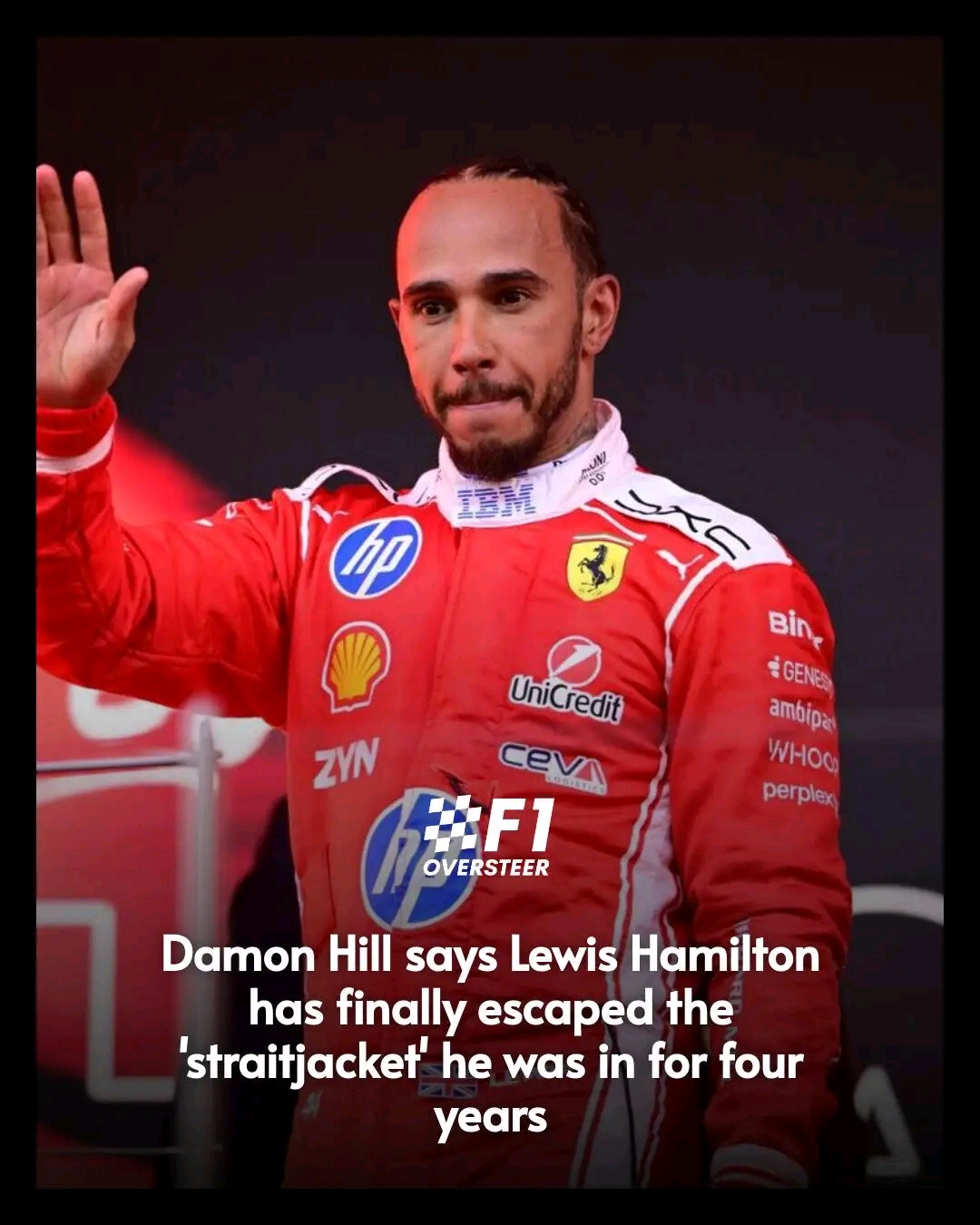
Lewis Hamilton’s recent upturn in performance has sparked fresh debate in the Formula 1 paddock, with 1996 World Champion Damon Hill suggesting the Ferrari driver has finally broken free from what he described as a “straitjacket” period in his career. The comments have reignited discussion about whether Hamilton is truly returning to his peak form, or simply benefiting from improved circumstances around him.
With Hamilton now regularly fighting at the front again and showing sharper race execution, the narrative around his career trajectory has shifted dramatically. But what does this resurgence actually mean for Ferrari, the championship fight, and Hamilton’s long-term legacy in F1?
Here is a deeper look at why this story matters beyond the headlines.
WHAT DAMON HILL ACTUALLY MEANT BY THE “STRAITJACKET” COMMENT
Damon Hill’s remarks were not about talent fading, but about constraint.
The former world champion believes Hamilton spent recent seasons operating under limitations that prevented him from fully expressing his driving style. That could include car performance inconsistency, strategic rigidity, and the psychological weight of repeated setbacks.
In essence, Hill’s argument is that elite drivers don’t suddenly lose ability. Instead, they can become trapped in systems that dull their natural strengths.
Hamilton’s current form suggests that those limitations are easing.
WHY HAMILTON LOOKS SHARPER AGAIN IN 2026
Hamilton’s recent performances have shown three key changes that have not gone unnoticed in the paddock:
First, his race management has become more aggressive again. He is taking risks in wheel-to-wheel battles instead of settling for points-heavy conservatism.
Second, his qualifying pace appears more stable, giving him better track position and reducing recovery drives.
Third, his in-race communication and strategy adaptation looks more decisive, suggesting stronger alignment with his engineering team.
These small but crucial improvements often define whether a driver is fighting for podiums or merely surviving a season.
Recent race data also reflects this shift, with stronger podium consistency and more direct battles against top rivals like Kimi Antonelli, who currently leads the championship picture after his Monaco victory. �
The Guardian
WHY THIS MATTERS FOR FERRARI’S TITLE AMBITIONS
For Ferrari, Hamilton’s resurgence is more than symbolic.
The team has spent years trying to rebuild into a consistent title contender, but often struggled with execution under pressure. A fully firing Hamilton changes that dynamic immediately.
A driver in peak form brings:
Faster development feedback
More aggressive race-day strategy calls
Higher qualifying consistency
Stronger points conversion from imperfect weekends
If Hamilton maintains this level, Ferrari becomes a far more dangerous factor in both the Drivers’ and Constructors’ Championships.
However, the pressure also rises. Ferrari does not tolerate inconsistency for long, and internal competition within the team could still shape race strategies.
THE CHAMPIONSHIP IMPACT: A THREE-WAY PRESSURE SYSTEM
The 2026 season is shaping into a multi-layered battle rather than a simple two-driver duel.
At the front, Kimi Antonelli’s rise has changed the competitive structure entirely, with Mercedes now controlling race pace more consistently than expected. His Monaco win under pressure reinforced his status as a title leader. �
The Guardian
Behind him, Hamilton’s resurgence adds another serious threat, especially on circuits that reward experience and tyre management.
Then there is the wider Red Bull and McLaren challenge, which continues to fluctuate depending on upgrades and race conditions.
The result is a championship environment where momentum swings matter more than raw speed alone.
IS THIS REALLY “THE OLD HAMILTON”?
The phrase “old Hamilton” is misleading.
Modern Hamilton is not the same driver who dominated early hybrid-era Formula 1. Instead, he is a more refined version built on experience, race intelligence, and adaptability.
What fans are now seeing is not a return to the past, but a recalibration of strengths:
Less dependency on outright qualifying dominance
More emphasis on race execution and tyre strategy
Improved patience in long stints
Better risk management in championship context
That combination can be just as dangerous as peak qualifying form.
WHAT COMES NEXT FOR HAMILTON AND FERRARI
The key question now is sustainability.
One strong run of form is not enough to define a season. Ferrari will need Hamilton to maintain consistency across different circuits, especially high-degradation tracks where strategy becomes decisive.
If he does, three outcomes become realistic:
A late-season title push if rivals drop points
A decisive role in Constructors’ Championship positioning
A leadership shift within Ferrari’s internal hierarchy
But if performance dips again, the “straitjacket” debate will return just as quickly as it faded.
FINAL VERDICT
Damon Hill’s comments highlight a broader truth in modern Formula 1: elite performance is rarely about talent alone.
It is about environment, confidence, and machinery aligning at the right moment.
Right now, Lewis Hamilton appears to have found a better balance of all three. Whether that continues will determine if this is a genuine career revival or just another strong phase in a long and complex F1 journey.
Either way, the championship fight just became a lot more interesting.