FICTIONAL SCENARIO — THIS IS A CREATIVE SPORTS-NEWS STORY, NOT A REPORT OF REAL-WORLD FORMULA 1 EVENTS.
Formula 1 is no stranger to technical controversy, but imagine a post-race investigation that suddenly puts George Russell and Mercedes under the FIA microscope after a remarkable Azerbaijan Grand Prix performance.
In this fictional scenario, Max Verstappen becomes the driver raising the questions.
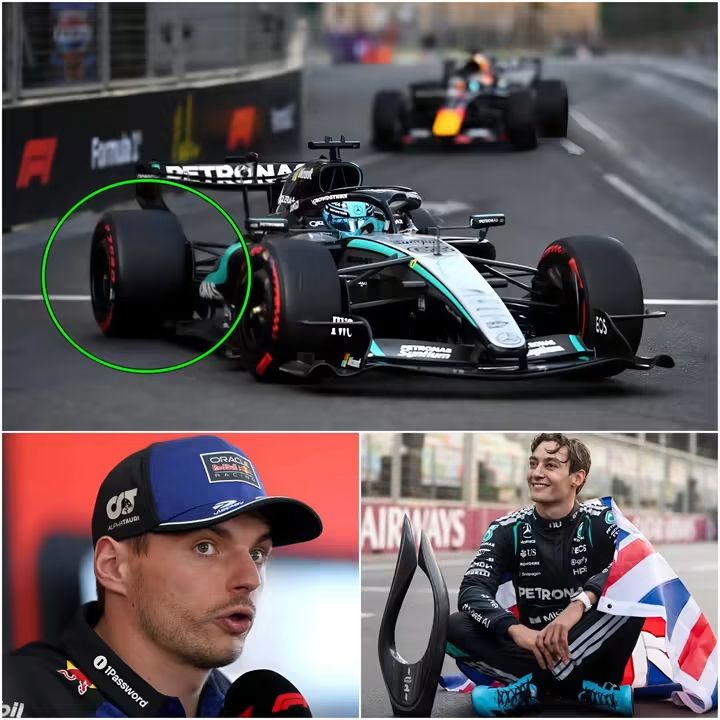
Following a dramatic race around the Baku City Circuit, Verstappen is portrayed as asking the FIA to conduct an urgent technical review of Russell’s Mercedes after allegedly obtaining video footage that appeared to show unusual behaviour from the car.
The central mystery?
A supposedly unidentified component that quickly becomes known as Mercedes’ “mystery device.”
However, what initially looks like the beginning of a major technical scandal eventually develops into something very different.
The fictional FIA investigation finds insufficient evidence of a rules violation, leaving Russell and Mercedes without a sporting penalty.
The imagined controversy offers an intriguing look at how technical disputes can develop in modern Formula 1—and why unusual performance alone is never enough to prove that a team has broken the rules.
A FICTIONAL POST-RACE CONTROVERSY ERUPTS
The fictional story begins after the Azerbaijan Grand Prix, where George Russell is portrayed as producing an especially impressive performance during the closing stages.
Baku is one of the most unusual circuits on the Formula 1 calendar.
Its layout combines extremely long straights with slow corners and narrow sections around the historic part of the city. That creates a difficult compromise for engineers: teams need aerodynamic efficiency for straight-line speed while still requiring enough downforce, traction and stability for the slower sections.
In this imagined scenario, Russell’s Mercedes appears particularly competitive.
That performance allegedly catches Verstappen’s attention.
Rather than publicly declaring that Mercedes has cheated, Verstappen is portrayed as asking the FIA to investigate whether something unusual could be contributing to the car’s performance.
That distinction becomes important.
The fictional storyline does not portray Verstappen as having definitive proof of illegal activity. Instead, the alleged footage simply raises questions that he believes deserve examination.
WHAT IS THE “MYSTERY DEVICE”?
The fictional report deliberately leaves the supposed device vague.
No confirmed technical specifications are provided, and no genuine Mercedes component is identified.
That uncertainty is actually central to the storyline.
Formula 1 cars contain thousands of components, and many of them are impossible to fully understand simply by watching television footage.
A movement seen on an onboard camera could potentially be caused by suspension behaviour, aerodynamic loading, tyre movement, bodywork flex, track characteristics or something completely unrelated to performance.
That is why the phrase “mystery device” should remain firmly within the fictional scenario.
There is no real-world evidence presented here establishing that Mercedes used such a device.
WHY VIDEO FOOTAGE ALONE WOULD NOT PROVE A RULES VIOLATION
The fictional investigation highlights one of the most complicated aspects of modern Formula 1: interpreting what viewers see.
Television cameras can reveal fascinating details.
Fans can notice bodywork movement, ride-height changes, unusual aerodynamic behaviour or differences between two cars.
But observation is not the same thing as technical proof.
An FIA technical investigation could require considerably more information, including physical inspection, measurements, technical documentation and other relevant data.
Engineers also have to consider variables such as:
– Fuel load
– Tyre condition
– Track temperature
– Aerodynamic setup
– Suspension configuration
– Brake temperatures
– Energy deployment
– Ride height
– Vehicle balance
A Mercedes appearing unusually quick on one section of the circuit does not automatically mean that an illegal component is responsible.
THE FIA STEPS INTO THE FICTIONAL STORY
In the imagined scenario, the FIA decides to examine the Mercedes rather than allowing speculation to determine the outcome.
Officials allegedly review the available footage alongside technical information and data relating to Russell’s car.
The fictional investigation focuses on a straightforward question:
Was the Mercedes configuration legal under the technical regulations governing the Azerbaijan Grand Prix?
That question is much narrower than asking whether Mercedes had discovered a revolutionary advantage.
A team can produce an unexpected performance gain without breaking any regulations.
In fact, much of Formula 1’s competitive history has been built around engineers finding legal ways to interpret complicated technical rules.
BAKU IS THE PERFECT SETTING FOR TECHNICAL SPECULATION
The Baku City Circuit makes the fictional storyline particularly believable as a creative F1 scenario.
The track demands compromises.
Teams need low enough drag to maximise speed along the enormous straight, but they cannot completely sacrifice performance through the slower corners.
That means two cars can look dramatically different depending on where they are being compared.
One might gain several tenths on the straight.
Another could recover time through the corners.
Tyre degradation can then change the picture again during the final stages of the race.
Energy deployment also becomes important because modern F1 cars can produce significant differences in acceleration depending on how electrical energy is managed.
Therefore, a particularly strong Mercedes performance could easily attract technical curiosity without necessarily indicating anything illegal.
THE FICTIONAL FIA FINDING CHANGES EVERYTHING
After examining the evidence, the fictional FIA investigation reaches an anticlimactic conclusion.
No sufficient evidence establishes a technical infringement.
The alleged mystery device does not become the illegal breakthrough that the original headline suggested.
Instead, the component or behaviour at the centre of the fictional controversy is portrayed as either compliant with the regulations or unrelated to the performance advantage that initially raised questions.
No sporting penalty is issued.
No result is overturned.
And Mercedes is allowed to continue its championship campaign.
For Russell, the fictional outcome provides confirmation that the performance in question did not result in an established technical violation.
VERSTAPPEN’S FICTIONAL PROTEST DOES NOT MAKE HIM THE VILLAIN
An interesting aspect of the imagined story is that Verstappen is not portrayed as doing anything improper by asking questions.
Formula 1 teams constantly monitor competitors.
Engineers study rival cars, compare performance and look for technical innovations. If a team genuinely believes that another competitor may be operating outside the regulations, bringing the concern to the governing body is part of the competitive environment.
The important issue is what happens afterward.
A request for an investigation is not proof of guilt.
Likewise, unusual footage is not automatically proof of an illegal device.
The fictional storyline ultimately reinforces that distinction.
WHY MERCEDES WOULD HAVE REASON TO BE CONFIDENT
From Mercedes’ perspective, the fictional FIA conclusion would be significant.
Technical investigations can create enormous pressure because even the suggestion of an illegal advantage can dominate the conversation around a team.
But if the governing body examines the relevant evidence and finds no violation, the team can return its attention to development and performance.
That would also allow Russell’s result to remain intact.
The fictional episode therefore demonstrates why official technical inspections matter.
Without them, the paddock could become dominated by speculation, social-media theories and competing interpretations of video footage.
FORMULA 1 HAS ALWAYS LIVED ON THE EDGE OF TECHNICAL INTERPRETATION
The fictional controversy also reflects something very real about Formula 1’s history: technical regulations are often just as important as driving ability.
Teams spend enormous amounts of money searching for small advantages.
A fraction of a millimetre in the wrong place can become a major engineering discussion.
Aerodynamic surfaces, suspension systems, floors, cooling arrangements and bodywork are all developed under strict regulatory limitations.
The challenge for teams is not simply finding performance.
It is finding performance within the rules.
That is why the FIA’s technical department plays such an important role in the championship.
THE DANGER OF CALLING SOMETHING “ILLEGAL” TOO EARLY
Perhaps the biggest lesson from this fictional scenario concerns the language used around technical controversies.
Words such as “cheating,” “secret device,” “illegal technology” and “hidden advantage” can spread rapidly online.
But those descriptions can become misleading if they appear before an investigation has established the facts.
A responsible Formula 1 report should separate three things:
WHAT IS SUSPECTED:
A competitor believes something unusual may be happening.
WHAT IS BEING INVESTIGATED:
The FIA examines the relevant car, footage and technical evidence.
WHAT HAS BEEN PROVEN:
Officials determine whether the regulations were actually breached.
In this fictional scenario, the final category produces no confirmed infringement.
That means the dramatic allegation ultimately remains just that—an allegation within a fictional storyline.
WHAT COULD THE STORY MEAN FOR RUSSELL?
Within the fictional universe, the investigation could actually strengthen Russell’s position.
Instead of leaving questions hanging over his performance, an official examination provides a clear regulatory conclusion.
If the FIA finds no breach, Mercedes can point to the result and move forward.
For Russell, that would mean his strong performance could be discussed primarily in terms of driving, setup and Mercedes’ engineering rather than an unresolved technical controversy.
WHAT COULD THE STORY MEAN FOR VERSTAPPEN?
For Verstappen, the fictional episode would demonstrate the importance of allowing the governing body to settle technical disputes.
Even if a driver strongly suspects that something unusual is happening, the driver does not determine whether a component is legal.
That responsibility belongs to the FIA.
The fictional Verstappen therefore becomes less of an accuser and more of a competitor asking for clarification.
Once the investigation is complete, the regulatory finding becomes the important part of the story.
THE BIGGER F1 LESSON
The most interesting element of this fictional scenario is not the supposed mystery device.
It is the process surrounding it.
Formula 1 is an environment where tiny technical details can create enormous competitive differences. When a rival suddenly appears faster, questions are inevitable.
But questions are not conclusions.
A car can look unusual without being illegal.
A performance advantage can appear mysterious without involving prohibited technology.
And a video can raise legitimate questions without proving a technical infringement.
That is why official inspection procedures matter so much.
FINAL VERDICT IN THE FICTIONAL STORY
In this fictional Azerbaijan Grand Prix storyline, Max Verstappen allegedly asks the FIA to examine George Russell’s Mercedes after becoming suspicious about an unusual aspect of the car’s performance.
The imagined investigation then examines the available footage, technical information and relevant regulations.
But the dramatic ending never arrives.
No illegal device is discovered.
No sporting penalty is imposed.
And Mercedes is cleared within the fictional scenario.
The story therefore ends with a useful principle for any Formula 1 technical controversy:
Suspicion can start an investigation, but only evidence and the regulations can establish a violation.
For fans, that distinction is crucial.
Because in Formula 1, the most dramatic mystery is not always a technical scandal.
Sometimes it is simply the difference between something that looks extraordinary—and something that is actually illegal.
IMPORTANT: THIS ARTICLE IS A FICTIONAL SPORTS-NEWS SCENARIO AND SHOULD NOT BE PRESENTED OR SHARED AS CONFIRMED REAL-WORLD FORMULA 1 NEWS.