LIAM LAWSON’S RED BULL EXPERIENCE MAKES ISACK HADJAR’S BAKU FREEDOM EVEN MORE INTERESTING
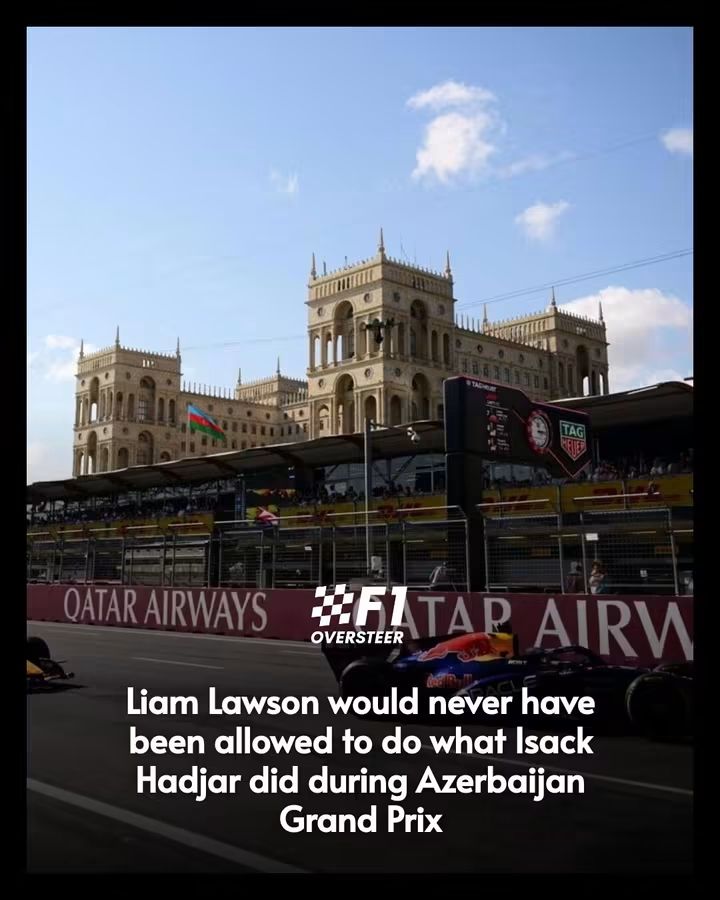
Isack Hadjar’s Azerbaijan Grand Prix comeback produced more than just another Red Bull podium.
It also raised fresh questions about how Red Bull manages its second driver alongside Max Verstappen.
Hadjar returned to Formula 1 action in Baku after missing three races with a wrist injury. He immediately delivered a statement result, qualifying fourth and finishing third behind Verstappen and race winner George Russell.
But the most interesting part of his weekend may have happened over the team radio.
At one point, Red Bull allowed Hadjar to race Verstappen within clearly defined limits. The instruction was effectively to let Verstappen through when the Dutchman’s pace made that strategically sensible—but once the positions settled, the message was not simply to freeze Hadjar behind his teammate.
Instead, the instruction was:
“Just keep it clean.”
That apparently small difference has created a fascinating contrast with Liam Lawson’s short spell alongside Verstappen earlier in the season.
HADJAR RETURNED TO RED BULL AND IMMEDIATELY DELIVERED
Hadjar’s comeback could hardly have gone much better.
After being forced to sit out the Dutch, Italian and Madrid races because of his wrist injury, he returned to his regular Red Bull seat in Baku. Lawson, who had deputised for him, moved back to Racing Bulls.
Hadjar then qualified fourth—one position ahead of Verstappen.
That was already significant.
The race was even more impressive.
Hadjar spent the opening stages close to Verstappen and was able to pressure his four-time world champion teammate. When Verstappen’s medium tyres began struggling, Hadjar’s soft tyres gave him a period of additional performance.
Formula 1’s official race report confirms that the Red Bull pair ran closely together before Verstappen eventually moved ahead and began chasing Oscar Piastri.
Hadjar ultimately finished third and secured his second podium of the 2026 season.
THE RADIO MESSAGE THAT CHANGED THE DYNAMIC
The fascinating part came when Verstappen was closing on Hadjar.
Red Bull wanted Verstappen to get through because his pace and tyre situation made him the more effective driver to send after Piastri.
Hadjar therefore did not need to defend aggressively against his teammate.
That part was clear.
But once Verstappen had passed, the situation became more complicated.
Hadjar remained close enough to Verstappen to put pressure on him, and he even communicated with the team about the pace ahead.
Eventually, when the question of whether the two Red Bulls could race arose, the message from the pit wall was essentially to keep the battle clean rather than automatically preventing Hadjar from fighting.
Juan Pablo Montoya highlighted that distinction on the Formula 1 post-race show, noting that Red Bull had not simply told Hadjar to hold position.
That is what makes the situation interesting.
RED BULL DID NOT COMPLETELY FREEZE THE TWO CARS
It would be too strong to say that Red Bull gave Hadjar unlimited freedom.
The team still had a clear strategic objective.
Verstappen was released to chase Piastri because Red Bull believed that was the fastest route to maximising its result.
And the team clearly wanted the two cars to avoid contact.
But after that, Red Bull did not appear to force Hadjar into a rigid “do not race your teammate” instruction.
That is consistent with Red Bull team principal Laurent Mekies’ explanation after the race.
Mekies said the team considered the different scenarios and chose to leave the drivers in their positions, while both drivers were disciplined about how they handled the situation.
That is a very different message from simply declaring one driver untouchable.
WHY LIAM LAWSON COMPARISONS ARE INEVITABLE
This is where Lawson’s name naturally enters the conversation.
Lawson spent three races in the Red Bull seat while Hadjar recovered from his injury.
He wasn’t a permanent replacement.
He was stepping into one of the most difficult seats in Formula 1 under extremely unusual circumstances.
Red Bull later thanked Lawson publicly for his professionalism and contribution before returning him to Racing Bulls once Hadjar was fit again.
Lawson’s situation was therefore complicated from the beginning.
But it also meant that every interaction with Verstappen was going to be heavily scrutinised.
And that makes Hadjar’s Baku experience particularly intriguing.
THE BIG DIFFERENCE IS NOT NECESSARILY “FAVOURITISM”
The headline claim that Lawson “would never have been allowed” to do what Hadjar did is an interpretation rather than something that can be proven from the Baku evidence.
There is no direct evidence establishing that Red Bull would categorically have prohibited Lawson from racing Verstappen under identical circumstances.
There are, however, obvious contextual differences.
Hadjar is Red Bull’s established 2026 driver.
Lawson was a temporary stand-in during Hadjar’s recovery.
Those situations are not equivalent.
The team’s expectations, championship objectives and driver-management considerations could therefore have been different.
That distinction matters before drawing conclusions about Red Bull’s internal hierarchy.
HADJAR ALSO MADE A VERY SMART STRATEGIC DECISION
Hadjar’s own comments make the story more interesting.
The Frenchman recognised that his soft tyres were performing well, but he also understood the bigger strategic picture.
He explained that he was comfortable remaining behind Verstappen because his primary target was Piastri.
That turned out to be an important decision.
When Verstappen eventually moved ahead, he could focus on attacking Piastri without Red Bull creating unnecessary internal conflict.
And when Piastri later made his own mistake at Turn 1, Hadjar was perfectly positioned to take advantage.
Piastri’s lock-up dropped him dramatically down the order, allowing Hadjar to inherit third place.
VERSTAPPEN WAS THE STRATEGIC PRIORITY—BUT HADJAR WAS NOT TREATED AS INVISIBLE
There is a subtle distinction here.
Red Bull clearly wanted Verstappen to have the opportunity to attack Piastri.
But that did not automatically mean Hadjar had to surrender every opportunity to race his teammate for the remainder of the Grand Prix.
That is what made the radio exchange so notable.
Hadjar was being treated as a competitor with his own race to manage, while still operating within Red Bull’s overall strategy.
The instruction to “keep it clean” effectively placed the responsibility on the drivers to race intelligently.
That is different from completely removing competition between teammates.
LAWSON’S RED BULL EXPERIENCE REMAINS PART OF THE CONVERSATION
Lawson’s earlier Red Bull spell inevitably influences how fans interpret this.
His first stint alongside Verstappen lasted only two races before he was moved back down the Red Bull system.
When he returned temporarily in 2026, the circumstances were different again.
He was given three races to stand in for an injured Hadjar before returning to Racing Bulls. During that period, he produced points-scoring performances and demonstrated that he could operate at the front of the midfield. Reuters reported that Lawson scored points in two of the three races during his temporary Red Bull spell.
Yet his Baku weekend also shows how quickly the circumstances can change.
By the time Hadjar returned, Lawson was back at Racing Bulls—and his Azerbaijan race ended with contact at the restart that damaged his car.
HADJAR’S BAKU PODIUM CHANGES THE CONVERSATION
The biggest winner from the entire episode may actually be Hadjar himself.
He returned from injury and immediately finished on the podium.
He qualified ahead of Verstappen.
He had periods of strong race pace.
He handled the internal Red Bull situation without creating unnecessary contact.
And he capitalised when Piastri made a mistake.
That is a remarkably complete weekend.
It does not prove that Red Bull will always give Hadjar greater freedom than Lawson would have received.
But it does show that Hadjar has established himself as more than a passive second driver in this particular race.
RED BULL’S APPROACH COULD BE EVOLVING
There is also a broader strategic question for Red Bull.
For years, Verstappen has been the team’s clear championship leader.
That makes perfect sense when one driver is consistently fighting for the title while the other is significantly further back.
But if the second Red Bull becomes genuinely competitive, the team has to decide how much freedom to provide.
Baku offered an interesting model.
Let Verstappen through when the strategic situation requires it.
Allow the second driver to race when there is no compelling reason to intervene.
Set a clear boundary around unnecessary contact.
Then let the drivers execute.
That approach may be easier to manage when both drivers understand the bigger picture.
THE BAKU RESULT WAS IDEAL FOR RED BULL
From the team’s perspective, the final result was extremely strong.
Verstappen finished second.
Hadjar finished third.
Red Bull secured a double podium.
And the two drivers avoided damaging each other’s cars.
Formula 1’s official classification confirms Russell won by just 0.196 seconds over Verstappen, with Hadjar another 10.704 seconds behind in third.
The only thing missing was the victory.
Verstappen had a genuine opportunity to challenge Russell in the closing stages but could not quite get close enough on the final straight.
Even so, Red Bull left Baku with a major points haul.
THE LAWSON QUESTION WILL NOT DISAPPEAR
Hadjar’s performance does not erase the questions surrounding Lawson’s treatment at Red Bull.
But it is important to separate what is documented from what is inferred.
Documented: Lawson temporarily replaced Hadjar, then returned to Racing Bulls when Hadjar recovered.
Documented: Hadjar was allowed to remain close to Verstappen during parts of the Baku race, with Red Bull ultimately choosing not to impose further team orders once the initial strategic pass had happened.
Interpretation: Some observers may see this as evidence that Hadjar has been given greater freedom than Lawson.
Not established: That Lawson would definitely have been prohibited from doing exactly the same thing under identical circumstances.
That distinction is important because Formula 1 driver-management decisions depend heavily on timing, championship position, tyre strategy and the specific race situation.
THE BIGGER PICTURE FOR RED BULL
The Baku weekend may ultimately prove more important for Hadjar than the headline suggests.
He has now demonstrated that he can return from an injury, qualify ahead of Verstappen, race aggressively without causing an internal incident and finish on the podium.
That gives Red Bull another important piece of information about its driver pairing.
For Lawson, meanwhile, the challenge is different.
He returns to Racing Bulls with more experience of driving a 2026 Red Bull and more knowledge of what it takes to operate alongside Verstappen.
And his Baku race itself contained another reminder of how chaotic the midfield can be: Lawson was caught up in contact with Racing Bulls teammate Arvid Lindblad during the restart and finished 12th.
FINAL TAKEAWAY
The most revealing part of the Azerbaijan Grand Prix was not simply that Isack Hadjar finished on the podium.
It was how Red Bull managed the relationship between its two drivers.
Verstappen remained the immediate strategic priority when the team believed he had the better opportunity to attack Piastri.
But Hadjar was not simply ordered to disappear from the fight.
He was given room to race within clear boundaries.
That is why the comparison with Liam Lawson is so compelling.
Lawson’s previous Red Bull experiences naturally make fans question whether every second driver receives the same degree of freedom around Verstappen.
Baku, however, does not provide definitive proof that Lawson would have been treated differently.
What it does provide is evidence that Red Bull was willing, in this particular race, to let Hadjar operate as a genuine competitor while still protecting the team’s strategic objective.
And after returning from injury with a third-place finish, Hadjar gave Red Bull plenty of reasons to take notice.