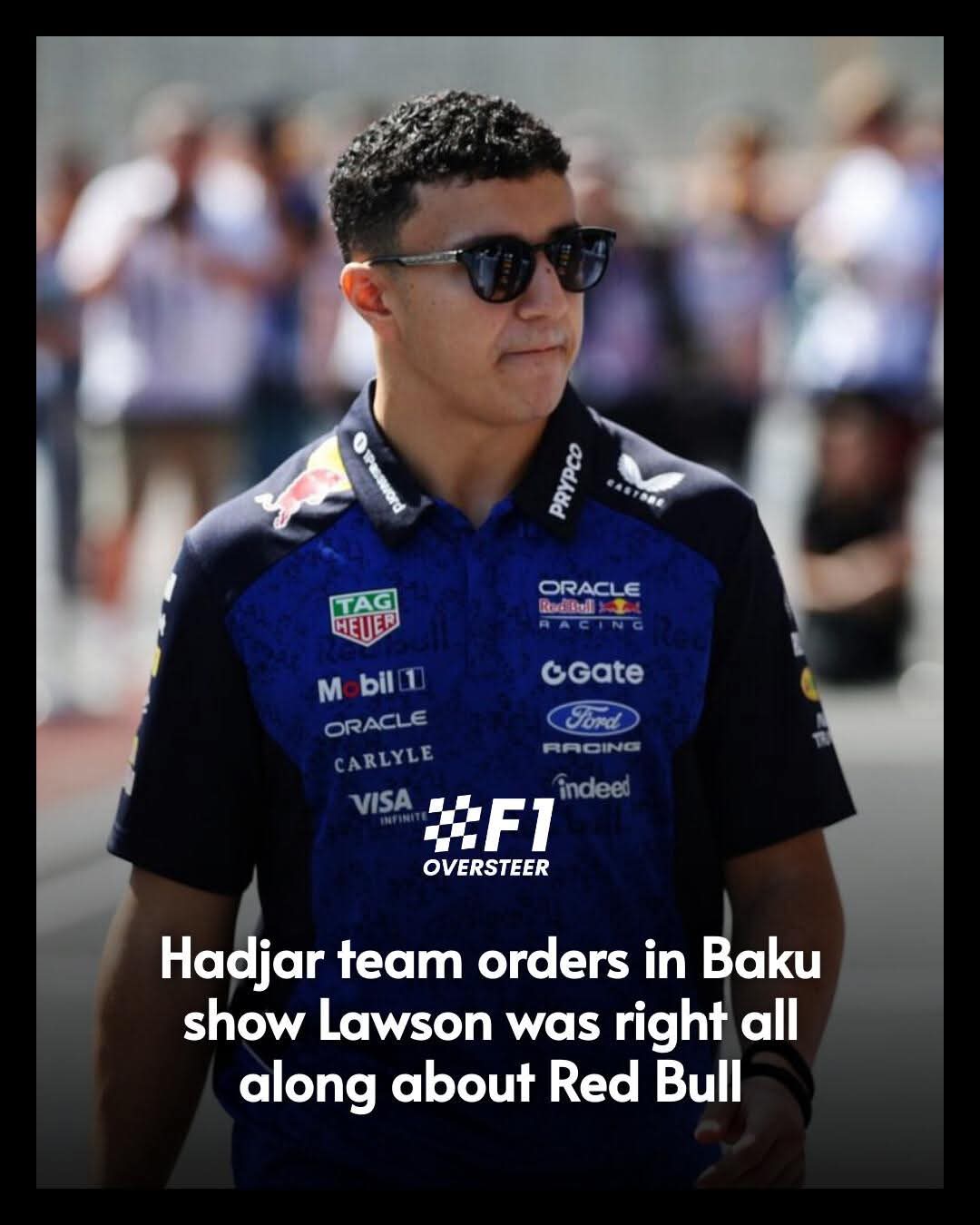
- ISACK HADJAR RED BULL TEAM ORDERS REVIVE LIAM LAWSON QUESTIONS AFTER AZERBAIJAN GPk
Red Bull produced a remarkable double podium at the 2026 Azerbaijan Grand Prix, but the team’s handling of Max Verstappen and Isack Hadjar has sparked a different conversation away from the final results.
Verstappen recovered from eighth on the grid to finish second, while Hadjar marked his return from a wrist injury with an impressive third-place finish. It was Red Bull’s first double podium in more than two years.
Yet the early stages of the race raised questions about how Red Bull manages the relationship between Verstappen and his team-mates.
Hadjar was initially asked to allow Verstappen through while the two Red Bulls were chasing Oscar Piastri. The expectation was that Verstappen would use the opportunity to attack the McLaren ahead.
The interesting part came later.
When Verstappen struggled to make immediate progress, Hadjar remained behind rather than automatically regaining the position.
That decision has inevitably brought Liam Lawson’s previous Red Bull experience back into the discussion.
RED BULL’S TEAM ORDERS CREATED AN INTERESTING SITUATION
Hadjar started fourth after an excellent qualifying performance on his return to Formula 1.
Verstappen, meanwhile, began eighth after encountering problems during qualifying, but his race pace was considerably stronger.
As the Red Bull pair moved through the field, they eventually found themselves behind Piastri.
Rather than allowing Hadjar and Verstappen to fight freely, Red Bull effectively prioritised Verstappen’s opportunity to attack the McLaren.
Hadjar complied.
The Frenchman even told the team that he was happy to remain behind Verstappen despite believing he had more pace in clean air.
According to the race account, Hadjar indicated that he had around two or three tenths of additional pace available.
That was a significant sacrifice from a driver who had qualified ahead of his team-mate.
HADJAR EVENTUALLY ASKED TO RACE VERSTAPPEN
Hadjar’s patience did not mean he had no interest in fighting his team-mate.
Later in the race, he asked whether he could “go for it” against Verstappen.
The Red Bull driver subsequently put pressure on his more experienced team-mate and even forced Verstappen to defend into Turn 1.
That moment showed just how close the two Red Bulls could be when they were allowed to race.
But the situation changed after the Safety Car period and Piastri’s costly mistake.
Verstappen eventually moved ahead of the McLaren and began pulling away from Hadjar.
The Dutchman ultimately finished second, while Hadjar secured third—giving Red Bull a double podium.
HADJAR WAS NOT SIMPLY A PASSIVE SECOND DRIVER
One of the most interesting aspects of the Baku weekend was Hadjar’s performance.
He had missed the previous three Grands Prix because of a wrist injury, with Liam Lawson stepping into the Red Bull seat during his absence.
Red Bull confirmed before Baku that Hadjar was fit to return and thanked Lawson for his work during those three races.
Despite the long absence, Hadjar immediately delivered.
He qualified fourth and converted that starting position into third place.
Formula 1 described it as his second podium of the season and highlighted how quickly he returned to competitive form.
That makes the team-order situation particularly noteworthy: Hadjar had genuine pace, but Red Bull still had to manage his position relative to Verstappen.
WHY LIAM LAWSON HAS BEEN BROUGHT BACK INTO THE CONVERSATION
The connection to Lawson comes from his short spell as Verstappen’s Red Bull team-mate in 2025.
Lawson was promoted to the senior Red Bull team after Sergio Perez’s departure, but his stint lasted only two races before he was moved back to Racing Bulls.
Official F1 statistics show that Verstappen beat Lawson 2-0 in both qualifying and race head-to-heads during those two events.
The situation generated considerable debate at the time.
Red Bull adviser Helmut Marko later acknowledged that the team had made a mistake in its decision-making around Lawson, while explaining that Lawson’s performances had not met the team’s expectations.
Lawson’s experience therefore remains a significant part of the discussion whenever Red Bull’s treatment of Verstappen’s team-mates comes under scrutiny.
THE REAL ISSUE IS THE DIFFERENCE IN STATUS
It would be too simplistic to say that Hadjar was prevented from racing Verstappen throughout the Azerbaijan Grand Prix.
He was eventually allowed to challenge his team-mate, and Red Bull’s primary objective during the first stint was understandable: maximise the chance of getting both cars past Piastri.
The more interesting question is what happens when that strategy does not work.
Hadjar had initially yielded to Verstappen to facilitate an attack on Piastri.
If Verstappen could not complete that move, there was an argument for allowing Hadjar to recover his original position.
Instead, the team maintained the order.
That is the part of the strategy that has prompted criticism and comparisons with Red Bull’s historical approach to its second driver.
RED BULL’S PRIORITY WAS CLEAR
From Red Bull’s perspective, the situation can also be viewed differently.
Verstappen was already the team’s established championship-leading driver, while Hadjar was returning from injury.
Putting Verstappen in the strongest possible position was therefore a logical strategic choice from the team’s perspective.
The problem is that such decisions can become controversial when the second driver has demonstrated comparable pace.
Baku provided precisely that situation.
Hadjar was not simply struggling behind Verstappen. He believed he had additional pace and eventually demonstrated that he could challenge him.
That makes the original order more noticeable than it would have been if Verstappen had simply been several tenths faster.
VERSTAPPEN’S RACE PACE JUSTIFIED THE STRATEGY TO AN EXTENT
There is another important factor.
Verstappen eventually proved extremely effective in the race.
After starting eighth, he fought through the field and passed Piastri after the Safety Car restart. Formula 1’s official race report noted that Verstappen then went on to challenge Russell for the victory.
That means Red Bull’s decision to prioritise Verstappen was not without sporting justification.
The Dutchman finished second, only narrowly missing victory to Russell.
Hadjar also achieved a podium.
From a purely team-result perspective, Red Bull got exactly what it wanted: second and third.
BUT HADJAR’S PERFORMANCE CHANGES THE CONVERSATION
The final result does not necessarily settle the debate.
Hadjar’s performance showed that Red Bull now has another driver capable of operating at the sharp end of the grid.
He returned from injury, qualified fourth and finished third.
More importantly, he was close enough to Verstappen to raise the possibility of an internal battle.
That could become increasingly relevant if Hadjar continues to perform at this level.
A driver who consistently qualifies near Verstappen and remains close during races will inevitably create more situations where Red Bull has to decide between individual competition and team strategy.
THE LAWSON COMPARISON HAS LIMITS
While the comparison with Lawson is interesting, there are important differences.
Lawson’s 2025 Red Bull spell lasted only two races, and his results were significantly weaker than Verstappen’s. He qualified at the back in both events and scored no points during that stint.
Hadjar’s current situation is completely different.
He has already secured podium finishes and demonstrated competitive pace alongside Verstappen.
Therefore, the Baku episode should not automatically be interpreted as evidence that Hadjar will suffer the same fate as Lawson.
Instead, it shows the broader challenge facing any driver paired with Verstappen: performing well enough to create genuine internal competition can force Red Bull to make difficult strategic decisions.
RED BULL NOW HAS A DIFFERENT KIND OF PROBLEM
For several seasons, Red Bull’s biggest challenge with Verstappen’s team-mates was often finding a driver who could consistently match his performance.
Hadjar’s Baku weekend suggests the situation could be different in 2026.
If he continues producing strong qualifying and race performances, Red Bull may increasingly face situations where its second driver cannot simply be treated as a supporting player.
That does not mean Verstappen will lose his status within the team.
But it does mean the team could face more moments like Baku, where the two cars are close enough for team orders to become part of the story.
THE BIGGER CHAMPIONSHIP PICTURE
Red Bull’s double podium was hugely valuable.
Verstappen finished second after starting eighth, while Hadjar completed the podium. Meanwhile, Mercedes’ George Russell won the race after resisting Verstappen’s late pressure.
For Verstappen, the result continued his strong recovery through the field despite missing out on victory.
For Hadjar, it was arguably even more important.
He returned from injury and immediately delivered a podium, giving Red Bull another strong option alongside its four-time world champion.
That could become increasingly significant as the season progresses.
WHAT THIS MEANS FOR HADJAR
Hadjar’s priority now should be consistency.
One outstanding weekend is impressive, but repeatedly qualifying near Verstappen and producing strong race results would create a much stronger case for greater freedom inside the team.
Baku was a particularly encouraging starting point.
He showed speed.
He showed patience when instructed to support Verstappen.
And when given an opportunity, he demonstrated that he was willing to race his team-mate.
That combination could be valuable for Red Bull going forward.
THE BOTTOM LINE
Red Bull achieved an excellent result in Azerbaijan, but its team-order decision has opened an interesting debate.
Hadjar was asked to let Verstappen through while the Dutchman attempted to attack Piastri. When that attack initially failed, Hadjar remained behind despite believing he had additional pace.
Eventually, the two Red Bulls were allowed to race more freely, but by then Verstappen had successfully passed Piastri and established control of second place.
The decision does not prove that Liam Lawson was “right all along” about Red Bull. That is an interpretation rather than an established fact.
What Baku does demonstrate is that when Verstappen has a genuinely competitive team-mate, Red Bull must balance two competing objectives: maximising Verstappen’s result and allowing its second driver to compete.
Hadjar’s return has given Red Bull a new and potentially significant problem—its second car may now be fast enough to make those decisions much harder.