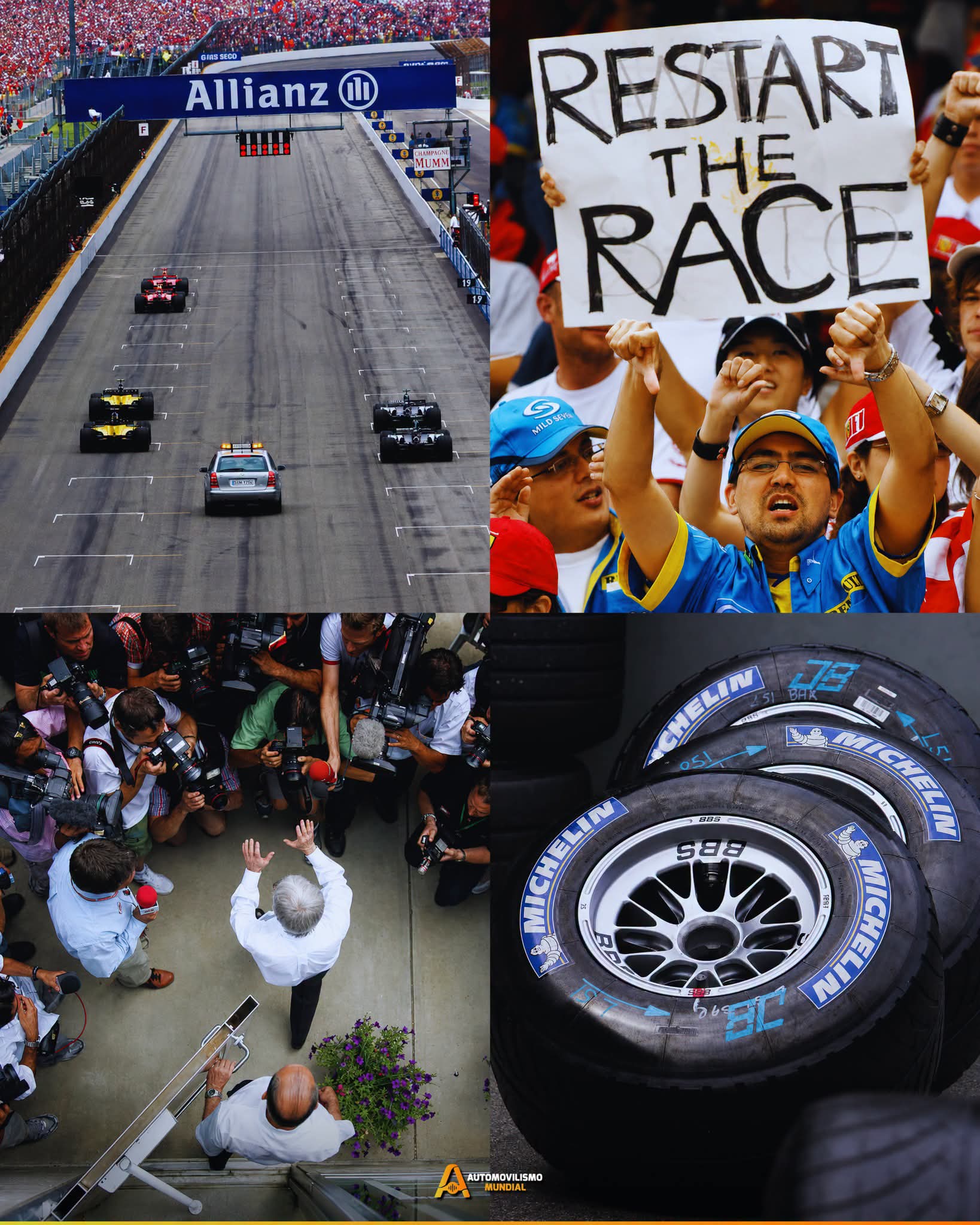
Formula 1 has experienced controversial moments throughout its long and prestigious history, but few events have damaged the sport’s reputation as severely as the 2005 United States Grand Prix at Indianapolis. More than two decades later, the race remains a painful reminder of what can happen when safety concerns, political battles, and regulatory rigidity collide on the biggest stage in motorsport.
What should have been a showcase event for Formula 1 in one of the world’s most important sporting markets instead became one of the most embarrassing spectacles the championship has ever produced. Fans arrived expecting to witness a battle between the sport’s elite drivers and teams. Instead, they watched 14 cars disappear into the pit lane before the race had truly begun.
For many longtime followers, Indianapolis 2005 remains the ultimate example of Formula 1 getting everything wrong at the worst possible moment.
HOW A TIRE CRISIS CREATED A PERFECT STORM
The controversy began during practice sessions when serious concerns emerged over Michelin’s tires.
The unique Indianapolis circuit featured a high-speed banked section of the famous oval integrated into the road course layout. Turn 13 placed enormous stress on the tires, and the situation became alarming after Ralf Schumacher suffered a heavy accident while driving for Williams.
Following investigations, Michelin discovered that its tires could not reliably withstand the loads generated through that corner over race distance. The manufacturer warned its partner teams that continuing under race conditions could pose a significant safety risk.
The timing could not have been worse.
At the time, Formula 1 regulations required drivers to complete the entire race using the same set of tires. Teams could not simply replace worn or damaged rubber during pit stops. Any weakness in tire durability instantly became a major safety issue.
Suddenly, seven teams faced a nightmare scenario with no obvious solution.
THE FAILED ATTEMPTS TO SAVE THE RACE
As panic spread through the paddock, several proposals were discussed.
Michelin-backed teams requested temporary changes to the circuit, including the installation of a chicane before the problematic banking section. Such a modification would have significantly reduced speeds and lowered the stress placed on the tires.
However, the FIA rejected the proposal.
The governing body argued that altering the circuit shortly before the race would compromise sporting integrity and create unfair advantages. Ferrari, which used Bridgestone tires and did not suffer from the same problem, also opposed modifying the track.
With neither side willing to compromise, tensions escalated rapidly.
What followed would become one of the most notorious moments in Formula 1 history.
THE MOMENT THAT SHOCKED THE SPORT
When the formation lap ended, fans expected the full 20-car field to line up on the grid.
Instead, every Michelin-equipped car peeled into the pit lane and retired before the race officially began.
Teams representing Renault, McLaren, Williams, Toyota, Red Bull, BAR Honda, and Sauber withdrew their entries due to safety concerns. Only the six Bridgestone-powered cars from Ferrari, Jordan, and Minardi remained.
The result was a race that barely resembled a Formula 1 Grand Prix.
With only six cars competing, the competitive element disappeared almost entirely. The crowd inside Indianapolis Motor Speedway watched in disbelief as one of the world’s most prestigious sporting events turned into a glorified exhibition.
A VICTORY OVERSHADOWED BY CHAOS
The race itself produced a Ferrari one-two finish, with Michael Schumacher leading teammate Rubens Barrichello across the line.
For Schumacher, it was another victory in an extraordinary career. Yet unlike most of his triumphs, this one carried little celebration.
The circumstances surrounding the race made it impossible for the result to be viewed as a genuine sporting achievement.
One bright spot emerged when Tiago Monteiro secured third place for Jordan, earning the only Formula 1 podium of his career. Under normal circumstances, it would have been a historic and joyful moment. Instead, it unfolded against a backdrop of frustration and anger.
The podium ceremony felt strangely disconnected from the mood in the grandstands.
THE FANS WERE THE REAL LOSERS
Perhaps the most damaging aspect of the entire episode was its impact on the fans.
Thousands of spectators had spent significant money traveling to Indianapolis. Many had purchased tickets months in advance specifically to watch stars such as Michael Schumacher, Kimi Räikkönen, Fernando Alonso, Jenson Button, and Juan Pablo Montoya battle for victory.
Instead, they witnessed a race stripped of genuine competition.
The reaction was immediate and hostile. Boos echoed around the circuit. Objects were reportedly thrown onto the track. Fans demanded refunds and publicly questioned Formula 1’s commitment to its supporters.
The anger was understandable.
The sport’s biggest stakeholders had become so consumed by politics and regulations that they had forgotten the most important people in attendance: the paying audience.
WHY INDIANAPOLIS 2005 CHANGED FORMULA 1
The consequences extended far beyond a single race weekend.
Formula 1 had spent years trying to strengthen its position in the United States, one of the world’s most valuable sporting markets. The Indianapolis disaster severely damaged that effort.
Trust in the championship collapsed almost overnight.
Many American fans who witnessed the fiasco never returned. The event became synonymous with Formula 1’s inability to manage crises effectively, and the sport struggled for years to rebuild its reputation across the Atlantic.
Eventually, Indianapolis disappeared from the Formula 1 calendar altogether.
Michelin later offered compensation to affected spectators, but the reputational damage had already been done.
LESSONS THAT STILL MATTER TODAY
The 2005 United States Grand Prix remains relevant because it exposed several weaknesses that continue to challenge Formula 1.
The incident demonstrated the dangers of inflexible regulations during extraordinary circumstances. It highlighted how political rivalries can interfere with practical solutions. Most importantly, it reinforced the principle that safety must always come first.
Modern Formula 1 has become significantly better at managing crises, but the lessons of Indianapolis continue to influence decision-making within the FIA and the paddock.
Whenever debates arise regarding safety, sporting fairness, or emergency rule changes, the memory of 2005 often serves as a cautionary example.
THE LEGACY OF FORMULA 1’S MOST EMBARRASSING DAY
While Formula 1 has enjoyed countless iconic races, championship battles, and technological breakthroughs, Indianapolis 2005 occupies a very different place in history.
It was not remembered for extraordinary overtakes or legendary performances. It became infamous because it revealed the sport at its most vulnerable.
A combination of tire failures, regulatory disputes, political stubbornness, and poor leadership transformed a major Grand Prix into a global embarrassment.
More than twenty years later, the image remains unforgettable: 14 cars heading into the pits, six cars left on track, and thousands of stunned fans wondering how Formula 1 had allowed such a disaster to happen.
For many observers, Indianapolis 2005 was not simply a bad race weekend.
It was the day Formula 1’s credibility cracked in full view of the world.