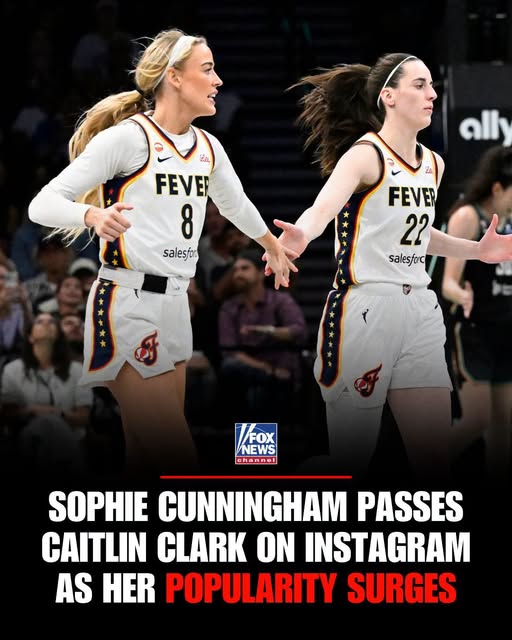
Sophie Cunningham’s rise has taken another unexpected turn, and this time it has nothing to do with what she does on the basketball court.
The Indiana Fever forward has reportedly surpassed Caitlin Clark in social-media followers, crossing the 4 million mark and moving into second place among WNBA players behind Angel Reese. That is a remarkable development for a player who entered the league without anything close to Clark or Reese’s enormous pre-existing national profile.
CUNNINGHAM’S POPULARITY HAS BECOME A STORY OF ITS OWN
Cunningham has always been one of the more recognizable personalities in the WNBA, but her profile has exploded since joining Indiana.
Her unapologetic personality, willingness to engage with controversial moments and growing role alongside Clark have made her a constant presence in conversations surrounding the Fever. Even when the attention has been negative, Cunningham has demonstrated an ability to remain relevant.
That matters in a league where a player’s commercial value increasingly extends beyond statistics.
A player who generates conversation, attracts followers and creates viral moments can become an important asset to a franchise and its sponsors. Cunningham appears to be developing precisely that kind of profile.
PASSING CAITLIN CLARK IS MORE SIGNIFICANT THAN IT LOOKS
Surpassing Clark on social media does not mean Cunningham is more popular overall, more valuable as a basketball player or more influential than the biggest star in women’s basketball.
Those are completely different measurements.
Clark’s influence extends far beyond follower counts, with her television audience, merchandise impact, attendance draw and broader cultural relevance making her arguably the WNBA’s biggest commercial star.
But the social-media development is still noteworthy.
Clark has spent the past two years as the league’s undisputed digital phenomenon. For another Fever player to move ahead of her in a major follower metric demonstrates just how quickly Cunningham’s personal brand has accelerated.
And there is another important factor: controversy creates attention.
THE FEVER’S MOST POLARIZING PLAYER MAY ALSO BE ONE OF ITS BIGGEST ASSETS
Cunningham has rarely been afraid to embrace her personality.
That has made her polarizing, but polarization can be extremely powerful in the modern sports-media environment. People who love a player follow them. People who dislike them often follow them too. Both groups comment, share clips and contribute to the conversation.
That creates something every social platform rewards: engagement.
Cunningham’s situation also demonstrates why the Fever have become such a fascinating ecosystem. Clark is the superstar. Aliyah Boston is a former No. 1 pick and All-Star-level talent. Kelsey Mitchell brings veteran scoring. And Cunningham has developed into one of the team’s most recognizable personalities.
The result is a roster capable of generating attention even when the basketball itself isn’t the only story.
ANGEL REESE STILL HAS THE SOCIAL MEDIA CROWN
According to the figures cited in the original report, Angel Reese remains ahead of both Cunningham and Clark with more than 5 million followers.
That creates an intriguing hierarchy.
Reese remains No. 1 in follower count, Cunningham has moved into second, and Clark is reportedly behind her.
But follower counts fluctuate constantly, and social-media rankings should never be treated as definitive measurements of a player’s overall popularity or influence. Different platforms also produce very different audiences.
Still, the numbers reveal something important about the WNBA’s evolving star system.
The league is no longer dependent on one or two personalities to drive attention. Reese, Clark, Cunningham and several other players are building distinct audiences that extend well beyond traditional basketball coverage.
CUNNINGHAM’S BIGGEST OPPORTUNITY MAY BE OFF THE COURT
The most fascinating part of Cunningham’s rise could ultimately have little to do with basketball.
Crossing the four-million-follower threshold gives her a potentially enormous platform for sponsorships, fashion, lifestyle content, media appearances and other commercial opportunities.
That is especially important because Cunningham doesn’t have to compete with Clark for the same audience. Their brands are different.
Clark’s appeal is heavily connected to elite basketball performance, competitiveness and her status as a generational basketball talent. Cunningham’s appeal is more personality-driven and deliberately provocative.
That distinction could actually make both players more valuable to the Fever and the WNBA.
THE BIGGER STORY IS WHAT THIS SAYS ABOUT THE FEVER
Indiana has accidentally—or perhaps deliberately—built one of the most marketable collections of personalities in women’s basketball.
Clark drives enormous attention. Cunningham generates conversation. Boston provides star power and credibility. And the team’s success gives all of them a bigger stage.
That is why Cunningham’s social-media surge shouldn’t simply be dismissed as a follower-count story.
It is another indication that the Indiana Fever have become one of the WNBA’s most powerful sports-media brands.
And if Cunningham continues producing viral moments while contributing on the court, her social-media rise could be only the beginning.
One thing is becoming increasingly difficult to dispute: Sophie Cunningham is no longer simply Caitlin Clark’s teammate. She has built a brand of her own.