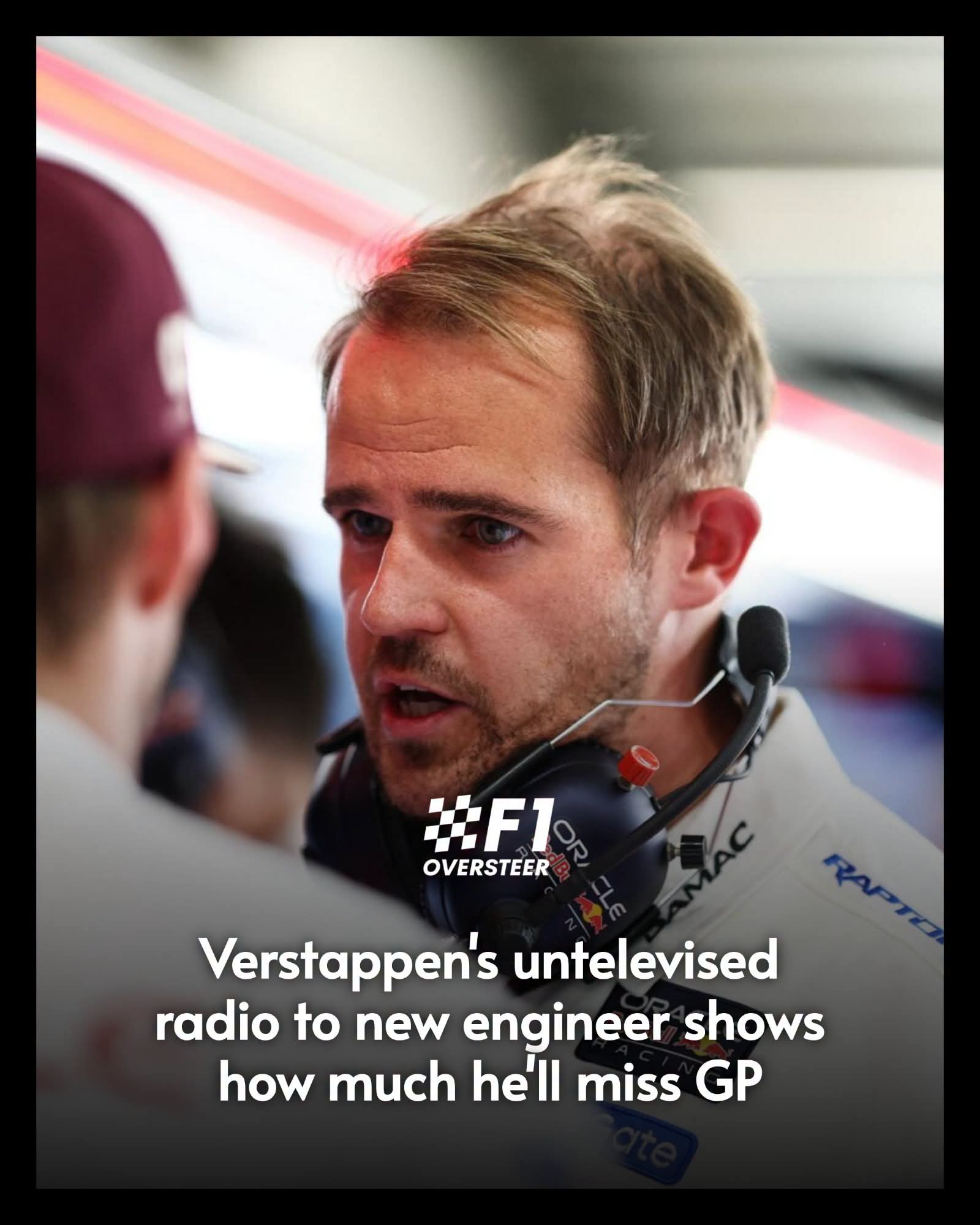
Max Verstappen’s difficult United States Grand Prix offered a revealing glimpse into the challenge awaiting Red Bull as the four-time world champion gradually adjusts to working with a new race engineer. An exchange with Tom Hart during Sunday’s race highlighted the communication difficulties that can emerge when a driver and engineer are still developing the understanding built through years of working together.
Verstappen has enjoyed a remarkably close partnership with Gianpiero Lambiase since joining Red Bull in 2016. Their relationship has become one of Formula 1’s most recognisable driver-engineer partnerships, shaped by championship victories, intense radio exchanges and the ability to communicate effectively under pressure.
However, Lambiase is preparing for a move to McLaren, with his departure date yet to be finalised. Hart has begun taking on greater responsibility and worked with Verstappen in Austin, with further appearances planned for the Brazilian Grand Prix and Las Vegas.
The transition comes at a challenging time for Red Bull. Verstappen finished third in Austin after struggling with the car, and the race exposed how important clear, immediate communication can be when a driver is fighting multiple rivals.
VERSTAPPEN’S RADIO EXCHANGE WITH TOM HART RAISES QUESTIONS
Verstappen’s frustration was evident throughout the United States Grand Prix as he tried to manage his car and defend against the charging Ferraris.
One particularly telling exchange occurred when he requested information about the gap behind Lando Norris.
Verstappen asked for the gap behind Norris, and Hart initially responded with a figure of 1.2 seconds. The engineer then explained that Charles Leclerc was the car behind Norris, prompting Verstappen to clarify that he wanted the gap behind Norris’s car rather than the identity of the driver.
The exchange was brief, but it illustrated the importance of understanding exactly what a driver needs in the middle of a race.
At Formula 1 speeds, drivers have little time to process information. They depend on their engineers to provide precise answers that help them decide when to defend, attack or manage their tyres.
For Verstappen, who is accustomed to a highly synchronised relationship with Lambiase, even a small misunderstanding can add to the frustration of an already difficult afternoon.
It would be unfair to judge Hart’s ability from a single exchange. He is already part of Red Bull’s engineering structure, and the transition gives both sides an opportunity to establish their preferred communication patterns. Nevertheless, the incident demonstrated that technical knowledge alone is not enough to recreate a partnership built over a decade.
ENGINEERING PROBLEMS MADE THE RACE EVEN MORE DIFFICULT
The communication exchange took place against the backdrop of a frustrating race for Verstappen.
Red Bull had entered the weekend hoping to challenge for another victory after the Dutchman won the previous two races. Instead, the team struggled to match the pace of Kimi Antonelli’s Mercedes, while Ferrari proved increasingly competitive as the race progressed.
Verstappen also reported an engine-braking issue that affected his confidence in the car. At one point, he described the machine as undriveable over team radio, underlining how far the race had moved away from his expectations.
His two-stop strategy did not deliver the desired result against Antonelli’s one-stop approach. Although Verstappen briefly recovered the lead during the pit-stop cycle, he ultimately lost ground and finished behind Antonelli and Charles Leclerc.
Communication became another source of frustration when Verstappen wanted Red Bull to provide information more quickly as he defended against Leclerc.
He also expressed dissatisfaction when teammate Isack Hadjar did not immediately move aside after being instructed to let him through. Hadjar eventually yielded at Turn 12, with Verstappen completing the pass a few corners later.
These moments illustrate the pressure placed on a race engineer. The role involves more than relaying lap times and tyre information; it requires understanding a driver’s priorities and delivering the right message at exactly the right moment.
WHY GIANPIERO LAMBIASSE’S DEPARTURE MATTERS
Lambiase’s importance to Verstappen extends beyond the conventional relationship between a driver and an engineer.
Since 2016, the pair have worked together through Verstappen’s development from a young Red Bull prospect into a multiple world champion. Their shared experience has allowed them to communicate during intense moments with a level of familiarity that can be difficult for outsiders to appreciate.
Their radio conversations have often been direct and occasionally confrontational, but that has not prevented them from developing an effective working relationship.
The pair have also demonstrated their ability to adapt when communication systems malfunction. During the Singapore Grand Prix, they managed to communicate effectively despite a radio problem that limited communication to one direction.
Such moments help explain why replacing an established race engineer is not simply a matter of assigning another experienced professional to the same position. The replacement must learn the driver’s preferences, understand how they respond under pressure and anticipate what information they need without lengthy explanations.
For Verstappen, the challenge is particularly significant because he has spent so many seasons working with Lambiase. Their understanding has developed through thousands of laps, countless strategic decisions and multiple championship campaigns.
Hart will need time to build that same familiarity, even if he already understands Red Bull’s systems and procedures.
VERSTAPPEN’S SITUATION RECALLS HAMILTON’S MOVE TO FERRARI
The transition has also invited comparisons with Lewis Hamilton’s move from Mercedes to Ferrari at the end of 2024.
Hamilton had worked with Peter Bonnington, widely known as Bono, throughout his long Mercedes career. Their partnership became central to his championship successes, with Bonnington often providing calm, precise guidance during high-pressure races.
After Hamilton joined Ferrari, he began working with Riccardo Adami. The adjustment attracted attention as the pair navigated communication difficulties and differing expectations during their first season together.
The comparison offers a useful lesson, although the circumstances are not identical. Hamilton changed teams and had to adapt to a new organisation, car and engineering structure. Verstappen, by contrast, remains at Red Bull, where Hart is already familiar with the team and its operations.
That existing familiarity could make Verstappen’s transition smoother. However, it does not eliminate the need for the pair to establish trust and develop a shared rhythm.
A successful driver-engineer partnership depends on more than technical competence. It requires clarity, timing and the ability to understand what the other person means, even when emotions are running high.
CAN TOM HART BUILD THE SAME UNDERSTANDING WITH VERSTAPPEN?
Hart’s immediate challenge is to establish himself as a reliable voice in Verstappen’s ear while helping Red Bull address the performance problems exposed in Austin.
The team will need to analyse why its pace fell short, investigate the engine-braking issue and understand why its strategy failed to produce a stronger result. At the same time, Verstappen and Hart must work towards smoother communication so that questions and instructions are understood quickly during critical moments.
The Brazilian Grand Prix and Las Vegas will provide further opportunities for the pair to develop their working relationship.
It is important not to overstate the significance of one radio exchange. Even established driver-engineer partnerships experience misunderstandings, particularly during races involving technical problems, changing strategies and intense battles.
Nevertheless, the incident highlighted a genuine challenge for Red Bull. Verstappen is accustomed to working with someone who has known his driving style and thought processes for years. Reproducing that level of understanding will take time.
For Hart, the objective is not to imitate Lambiase’s personality but to develop a communication style that works effectively with Verstappen. If the pair can achieve that, the transition may eventually become seamless.
Until then, every difficult race will test their ability to work together under pressure. Austin provided an early reminder that replacing a familiar voice is about much more than changing the name on the radio.