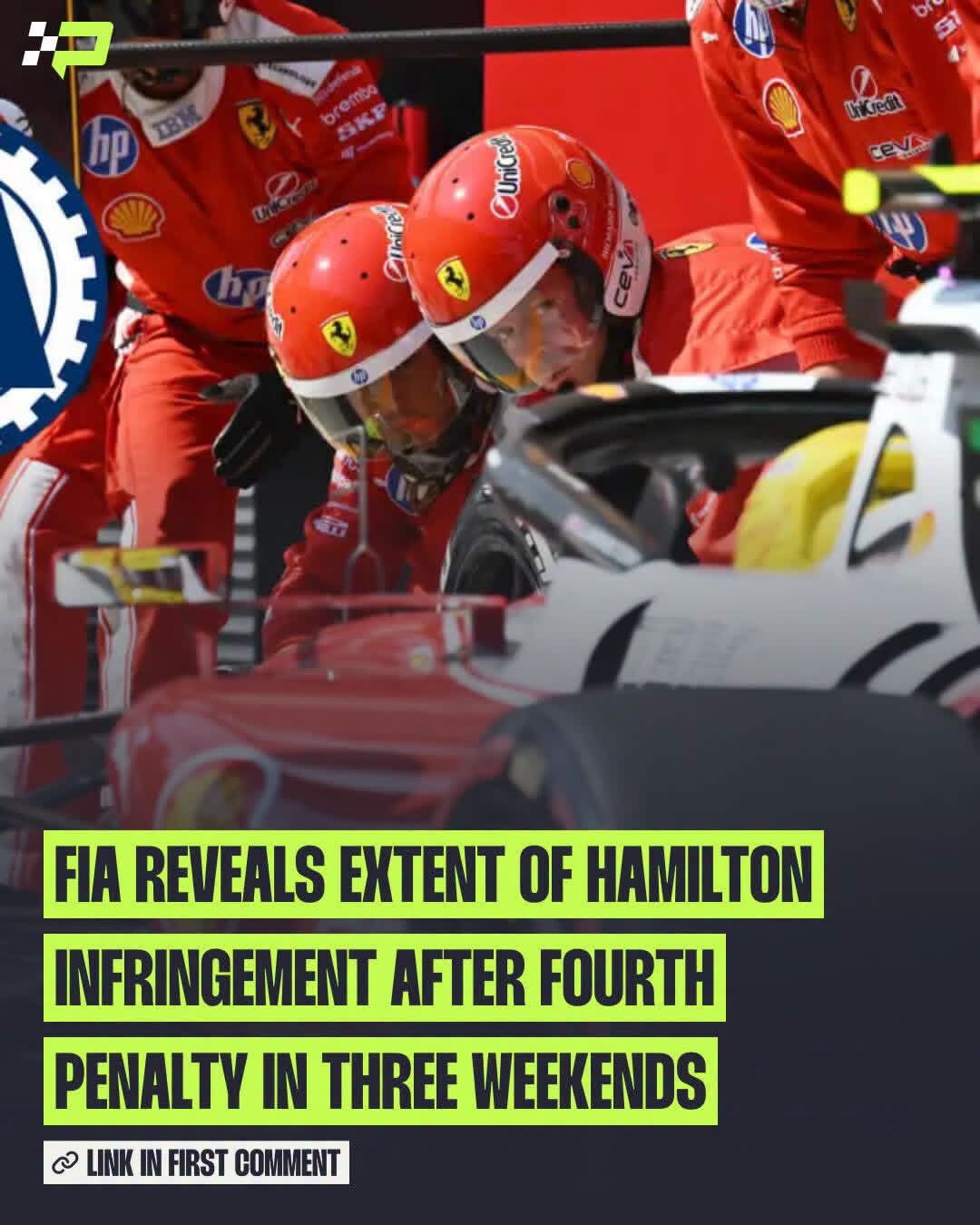
Lewis Hamilton’s frustrating run with Formula 1 stewards continued at the Hungarian Grand Prix after the FIA confirmed the Ferrari driver was penalized for exceeding the pit lane speed limit by an astonishingly small margin of just 0.1 km/h. The five-second time penalty marked Hamilton’s fourth sanction in only three race weekends, dealing another blow to his 2026 Drivers’ Championship ambitions.
The seven-time world champion had been fighting Mercedes sensation Andrea Kimi Antonelli for a podium finish before the penalty ultimately dropped him behind teammate Charles Leclerc in the final classification. While the speed violation appeared almost insignificant, Formula 1’s regulations leave little room for interpretation, making Hamilton the latest victim of the sport’s uncompromising rulebook.
ANOTHER PENALTY ADDS TO HAMILTON’S DIFFICULT MONTH
Hamilton entered the Hungarian Grand Prix already under pressure after a series of costly incidents in recent races. The British driver had previously received a five-second penalty for a false start at Silverstone, another five-second sanction following a collision at Spa-Francorchamps, and a three-place grid penalty in Hungary after being judged to have impeded Oscar Piastri during qualifying.
Sunday’s penalty continued that unfortunate streak.
During a Virtual Safety Car period, Ferrari called Hamilton into the pits while he was locked in a fierce battle with Antonelli for a potential podium. As he entered pit lane, FIA timing systems recorded his speed at 80.1 km/h, exceeding the event’s 80 km/h limit by the smallest measurable margin.
Despite the minimal difference, the stewards imposed a standard five-second penalty.
THE FIA EXPLAINS THE DECISION
Following the race, the FIA released its official explanation, leaving little doubt about the reason behind the punishment.
According to the stewards’ report:
“Car 44 exceeded the pit lane speed limit, which is set at 80 km/h for this event, by 0.1 km/h.”
The wording underscores Formula 1’s zero-tolerance approach to pit lane speed violations. Unlike some racing situations where stewards exercise discretion, pit lane speed limits are enforced through automated timing systems designed to prioritize safety over subjective judgment.
From the FIA’s perspective, the size of the infringement is irrelevant—the rule was broken, and the prescribed penalty followed.
HAMILTON’S FRUSTRATION SPILLED OVER THE TEAM RADIO
Hamilton made no attempt to hide his disappointment after Ferrari informed him about the sanction.
Race engineer Carlo Santi delivered the news during the race, telling his driver that he had received a five-second penalty for speeding in the pit lane.
Hamilton’s immediate reaction reflected his growing frustration.
Later, after the checkered flag, he voiced his dissatisfaction again, arguing that the stewards seemed eager to punish every mistake he made.
His comments came only a day after expressing that he “can’t catch a break” following recent officiating decisions, highlighting the emotional toll that repeated penalties can have even on one of Formula 1’s most experienced competitors.
THE CHAMPIONSHIP IMPLICATIONS ARE BECOMING SERIOUS
While five seconds may seem minor over a 70-lap Grand Prix, the consequences were significant.
Hamilton lost valuable championship points as Andrea Kimi Antonelli extended his lead in the Drivers’ Championship. Ferrari also surrendered crucial points in the Constructors’ battle against Mercedes, where every finish could prove decisive later in the season.
Just weeks ago, Hamilton had reduced the championship deficit to within striking distance after a strong run of performances. However, a combination of penalties and missed opportunities has allowed Antonelli to rebuild a comfortable advantage heading into the second half of the campaign.
If Ferrari hopes to mount a genuine title challenge, eliminating operational errors will become just as important as improving outright pace.
WHY PIT LANE SPEEDING IS TREATED SO SERIOUSLY
Pit lane speed limits exist for one overriding reason: safety.
Unlike the racing circuit itself, the pit lane is crowded with mechanics, engineers, FIA officials, photographers, and media personnel. Even a slight increase in vehicle speed can increase the risk of accidents in such a confined working environment.
For that reason, Formula 1 applies strict liability to pit lane speeding offences. Whether a driver exceeds the limit by 0.1 km/h or 5 km/h, the principle remains identical—crossing the threshold constitutes a breach of the Sporting Regulations.
Although some fans have questioned whether such tiny infringements deserve harsh penalties, consistent enforcement ensures every team operates under identical standards.
CAN HAMILTON TURN HIS SEASON AROUND?
Despite the growing list of penalties, Hamilton remains firmly in the championship conversation. Ferrari has demonstrated race-winning pace throughout 2026, and several circuits later in the calendar could suit both the SF26 and Hamilton’s driving style.
However, the margin for error is rapidly disappearing.
Mercedes continues to execute races with remarkable consistency, while Antonelli has combined speed, composure, and reliability beyond his years. Ferrari must now ensure Hamilton can capitalize on every opportunity without avoidable mistakes undermining strong performances.
The Hungarian Grand Prix will likely be remembered not for Hamilton’s pace, but for how a 0.1 km/h miscalculation proved costly. In a Formula 1 title fight where every point matters, even the smallest infractions can have championship-defining consequences.