OSCAR PIASTRI REVEALS MCLAREN’S BAKU ‘CABLE TIE’ FIX AFTER SHOCK PODIUM QUALIFYING
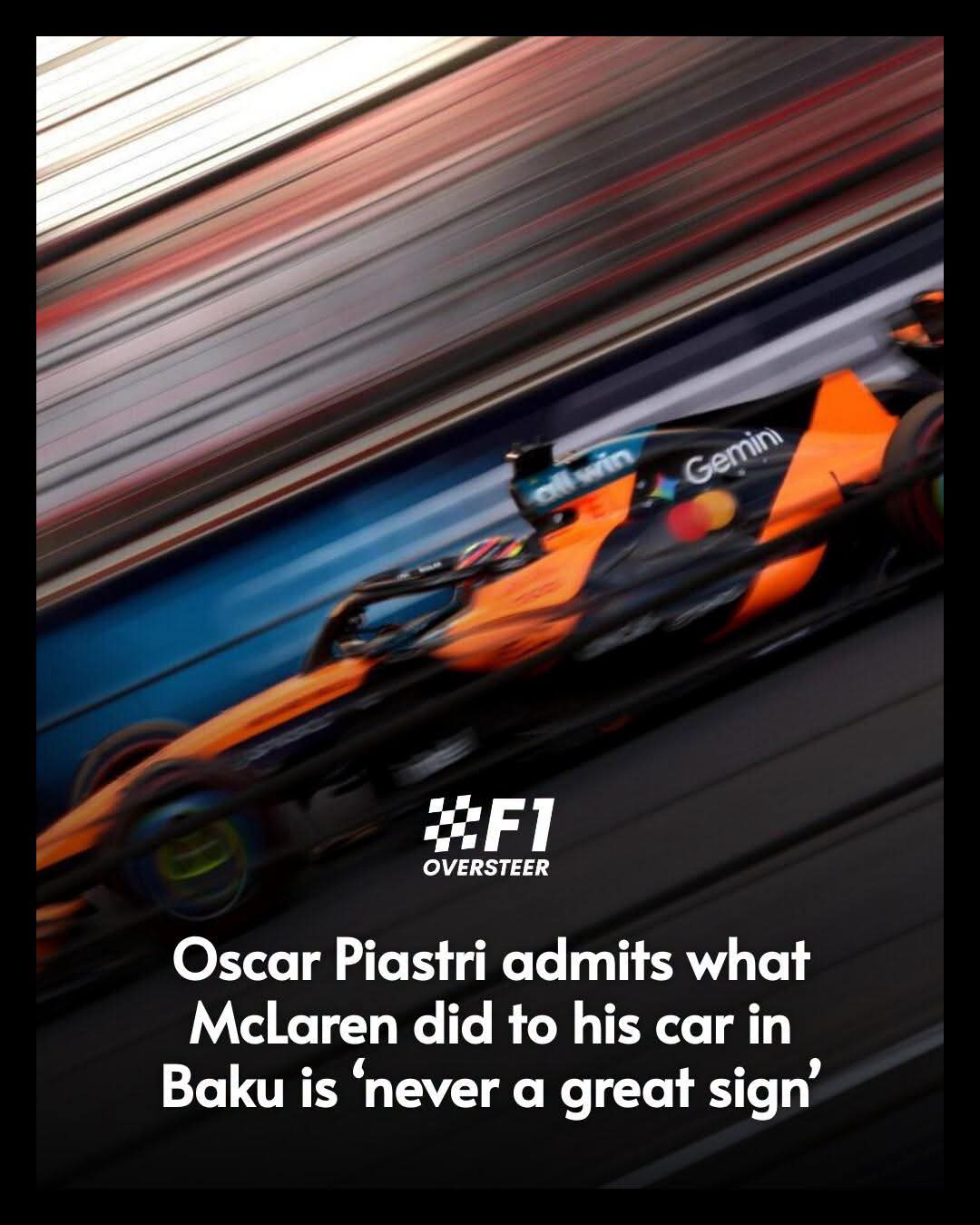
Oscar Piastri has revealed that McLaren resorted to using cable ties on his MCL40 during the Azerbaijan Grand Prix weekend after problems emerged with the team’s heavily revised bodywork.
Under normal circumstances, that would hardly sound like the preparation of a car capable of qualifying third. Yet that is exactly what happened in Baku.
After a difficult practice programme, McLaren transformed its pace when qualifying arrived, with Piastri producing a 1:43.364 to secure third place—just 0.001 seconds behind Charles Leclerc and 0.837 seconds behind pole-sitter George Russell.
The result turned a messy weekend into a potentially significant step forward for McLaren, but Piastri’s comments reveal just how challenging the process was.
MCLAREN’S BAKU WEEKEND STARTED WITH PROBLEMS
McLaren arrived in Azerbaijan with a substantial package of upgrades designed to improve the MCL40’s performance, particularly its efficiency and top speed around Baku’s unusually demanding layout.
The changes included revisions around the sidepods, radiator inlets, engine cover, diffuser, floor, rear suspension and rear wing. However, the new package immediately presented the team with problems during practice.
Both Piastri and Lando Norris spent significant time in the garage while McLaren worked on the cars, with weaknesses identified around the bargeboard area.
Temporary repairs included the use of cable ties to keep parts of the aerodynamic package secure. The team subsequently worked on a more permanent solution.
That explains why Piastri described the situation as “never a great sign.”
PIASTRI’S HONEST ASSESSMENT OF THE CABLE-TIE REPAIRS
Piastri did not attempt to hide the difficulties McLaren experienced.
The Australian explained that the team had been running cable ties on the car during Friday’s running, while also acknowledging that McLaren had struggled for outright pace during practice.
His comments provide an unusual glimpse into the practical side of Formula 1 development.
Modern F1 cars contain extraordinarily complex aerodynamic surfaces. A tiny component can influence airflow over multiple downstream areas of the car, meaning even a relatively small structural problem can force engineers to modify or temporarily reinforce a section before allowing the driver to push at maximum speed.
The fact that McLaren could make the necessary repairs and then produce a third-place qualifying performance makes the turnaround even more notable.
THE UPGRADE FINALLY ‘CAME TO LIFE’ IN QUALIFYING
For much of the weekend, there was little indication that McLaren would challenge for the front two rows.
Piastri had finished sixth in FP1, eighth in FP2 and seventh in FP3. He then began qualifying with an eighth-place Q1 result.
But something changed once the fuel load came down and the drivers were able to attack the circuit more aggressively.
Piastri moved to fourth in Q2 before producing his 1:43.364 in Q3.
Formula 1 reported that Piastri and Norris initially put McLaren at the front of the field in Q3, demonstrating just how dramatically the team’s performance had improved compared with practice.
Piastri has now achieved his best qualifying result of the season three times in 2026, with P3 also coming in Japan and Italy.
WHY MCLAREN’S PRACTICE PACE WAS MISLEADING
The difference between McLaren’s practice and qualifying performance is one of the most interesting aspects of this weekend.
Piastri explained that the team has experienced a similar pattern earlier in the season: the car can appear relatively ordinary during practice before becoming significantly more competitive once qualifying conditions arrive.
Several factors can contribute to this.
Teams use different fuel loads, engine modes and tyre programmes during practice. A driver may also be concentrating on long-run data rather than chasing a single headline lap.
McLaren’s engineers therefore had to distinguish between a genuine performance deficit and a car that simply had not yet been optimised for qualifying conditions.
In Baku, they appear to have unlocked considerably more performance when it mattered.
RUSSELL WAS STILL IN ANOTHER CATEGORY
Piastri’s P3 was impressive, but the size of Russell’s advantage prevented McLaren from seriously challenging for pole.
Russell’s Mercedes produced a 1:42.526, putting him 0.837 seconds ahead of Leclerc and 0.838 seconds ahead of Piastri.
That is an enormous margin in modern qualifying.
Piastri himself acknowledged that McLaren had no realistic answer for Russell’s final lap.
The situation is particularly interesting because Russell’s Mercedes was not simply marginally faster. The gap suggests that Mercedes found a combination of aerodynamic efficiency, tyre preparation and driver execution that McLaren could not match over one lap.
PIASTRI BEAT LECLERC BY JUST ONE THOUSANDTH
While Russell dominated the top of the classification, the battle behind him was incredibly tight.
Leclerc qualified second with a 1:43.363.
Piastri’s time was 1:43.364.
That means the difference between second and third was just 0.001 seconds.
In practical terms, Piastri was only a thousandth of a second away from starting on the front row.
It also demonstrates how much the MCL40 had improved between practice and qualifying.
THE CABLE-TIE STORY MAKES PIASTRI’S RESULT MORE IMPRESSIVE
There is an important distinction between a car being fundamentally unreliable and a new aerodynamic package requiring temporary repairs.
Nothing currently confirms that McLaren’s upgraded MCL40 has a fundamental reliability defect.
Instead, the evidence indicates that the team encountered problems with newly introduced aerodynamic components and worked through them during the weekend.
That makes Piastri’s comments less about a catastrophic mechanical failure and more about the challenges involved in introducing a large development package at a demanding street circuit.
Baku is particularly unforgiving because drivers have to push close to walls while carrying high speeds through several sections.
A loose aerodynamic component can therefore have consequences for both performance and driver confidence.
WHY THE UPGRADE MATTERS BEYOND BAKU
McLaren’s new package is important because the team is continuing to develop its 2026 car rather than simply accepting its current performance level.
The Baku circuit places unusual emphasis on straight-line efficiency, making it a useful environment for testing whether the revised aerodynamic concept delivers the expected benefits.
McLaren technical chief Rob Marshall said the team was still working to unlock the package’s full potential and adapt the chassis and power unit to Baku’s unique demands.
That suggests the Baku specification may not yet represent the final performance of the new concept.
If McLaren can solve the reliability and setup issues while retaining the qualifying gains, the development could become more valuable at future circuits.
PIASTRI’S RESULT ALSO MATTERS FOR MCLAREN’S INTERNAL BATTLE
Piastri’s third-place qualifying result carries another layer of significance.
Lando Norris qualified fifth, meaning Piastri out-qualified his team-mate in Baku.
Norris also suffered a lock-up on his final Q3 attempt, which prevented him from extracting the maximum from his final lap.
Nevertheless, Piastri’s performance is an important confidence boost after a difficult period.
Rather than simply benefiting from a fast McLaren, Piastri had to extract the performance from a car that had been difficult to understand throughout the weekend.
That is precisely the kind of situation in which a driver’s adaptability becomes important.
BAKU IS A PARTICULARLY IMPORTANT TEST FOR PIASTRI
The Azerbaijan Grand Prix has a complicated history for Piastri.
He won in Baku in 2024 after a lengthy battle with Leclerc, but his 2025 weekend ended in disappointment after incidents in both qualifying and the race significantly damaged his championship campaign. Formula 1’s official preview also highlights that contrasting history at the circuit.
Starting third this time gives Piastri a chance to write a very different chapter.
The challenge will be avoiding the mistakes that can quickly turn a strong Baku starting position into a lost opportunity.
THE BIGGEST QUESTION IS RACE PACE
Qualifying has solved one problem for McLaren, but Saturday’s race will answer another.
Leclerc has already indicated that straight-line speed is not Ferrari’s biggest strength, while Piastri’s starting position puts him directly into the fight near the front.
The 6.003-kilometre Baku circuit features long straights and narrow sections through the old city, creating unusual strategic and overtaking opportunities. Historically, pole position has not guaranteed victory here.
That means Piastri’s target of fighting for a podium is realistic as a competitive objective, but the result will depend on tyre management, race pace, safety-car timing and how effectively McLaren’s upgraded package behaves over a full race distance.
CAN THE CABLE-TIE MCLAREN HOLD TOGETHER?
That is perhaps the most entertaining question heading into the race.
The cable ties themselves are not necessarily a sign that Piastri’s car is about to fail. They were part of temporary repair work on aerodynamic components while McLaren developed a more permanent solution.
But the fact that Piastri openly mentioned them highlights just how difficult the team’s weekend has been.
The pressure will now be on McLaren to ensure the revised components can withstand sustained race conditions.
A qualifying lap lasts only a short period.
A Grand Prix requires the car to survive dozens of laps of high-speed running, kerb strikes, aerodynamic loads and changing temperatures.
WHAT PIASTRI HAS ALREADY PROVED IN BAKU
Whatever happens in the race, Piastri’s qualifying performance has already provided McLaren with valuable information.
The team entered the weekend looking significantly behind Mercedes in practice.
It emerged with Piastri only one thousandth away from the front row.
That does not mean McLaren has suddenly become the fastest car in Baku—the 0.837-second gap to Russell demonstrates otherwise.
But it does suggest the team’s new package has performance that can be accessed under the right conditions.
The next challenge is making that performance more consistent.
THE BIGGER MCLAREN STORY
Piastri’s cable-tie revelation is almost symbolic of McLaren’s entire Baku weekend.
The team arrived with ambitious upgrades, encountered problems, spent significant time repairing its cars and still managed to produce a competitive qualifying result.
That is a useful reminder that Formula 1 development is rarely a straight line.
A new component can create unexpected problems before engineers understand how to optimise it. A car that looks disappointing on Thursday can suddenly become competitive on Friday. And a temporary fix can sometimes keep a major upgrade alive long enough for the team to learn what works.
For McLaren, the real value of Baku may therefore extend beyond Piastri’s starting position.
If the team can turn the lessons from this difficult weekend into a more stable and reliable package, the upgraded MCL40 could become considerably more competitive at future races.
For now, Piastri has earned a front-running grid position after one of McLaren’s messier weekends of the season. The cable ties may not look glamorous, but the P3 result suggests there is genuine performance hidden inside McLaren’s latest development package.