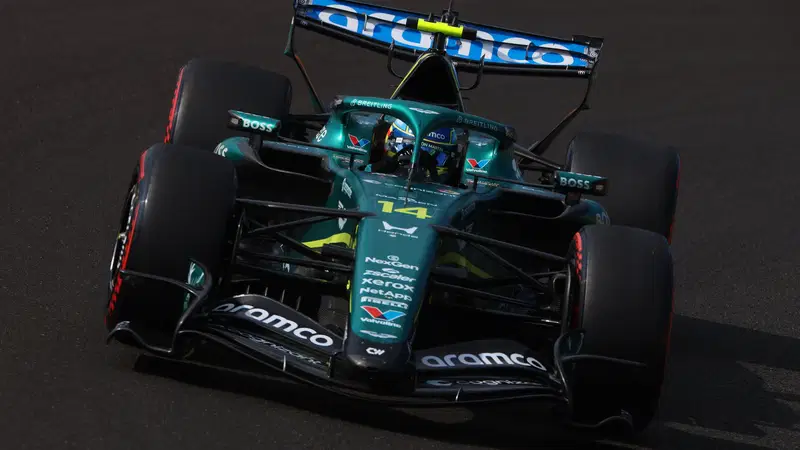
Honda is preparing to take an important step in its Formula 1 partnership with Aston Martin, with the Japanese manufacturer set to run its upgraded power unit for the first time during a filming day in Hungary next Wednesday.
The test will provide the first opportunity to see how Honda’s new-specification engine performs when installed in the AMR26 before its official competitive debut at the Dutch Grand Prix after Formula 1’s summer shutdown.
For Aston Martin, the timing could hardly be more important. After a deeply disappointing start to the 2026 campaign, the team has recently shown signs of progress with the introduction of its heavily revised B-specification car. The next question is whether Honda can deliver a power unit capable of matching those chassis gains.
HONDA PREPARES FOR A CRUCIAL ENGINE TEST
Honda’s upgraded power unit is scheduled to make its first competitive appearance at Zandvoort, but the manufacturer will get an early opportunity to evaluate the engine during a filming day next week.
Honda trackside general manager and chief engineer Shintaro Orihara confirmed that the engine will be installed in Aston Martin’s AMR26 for the first time during Wednesday’s running.
The filming day is limited to 200 kilometres, meaning the session will not replicate the demands of a full Grand Prix weekend. However, it should still provide Aston Martin and Honda with valuable information about engine installation, reliability, cooling, energy deployment and the interaction between the new power unit and the revised chassis.
Orihara described the test as an important opportunity to understand how the new engine behaves inside the car before Honda commits to racing it at the Dutch Grand Prix.
That makes the session more than a promotional exercise. For a team fighting to recover from a difficult season, every kilometre of reliable running can help reduce uncertainty.
ASTON MARTIN’S B-SPEC CAR OFFERS A GLIMMER OF HOPE
Aston Martin’s decision to introduce its B-specification AMR26 at the Hungarian Grand Prix represented one of the team’s biggest attempts to change the direction of its season.
The Silverstone-based outfit has endured a frustrating campaign, with its performance often leaving Fernando Alonso and Lance Stroll fighting near the back of the field.
Hungary did not suddenly transform Aston Martin into a front-running team, but there were encouraging signs.
Alonso and Stroll finished 14th and 13th respectively, beating one Alpine, both Haas cars and both Williams drivers. On paper, those results remain modest, but the more important story was the potential shown by the revised car.
The upgrade appears to have given Aston Martin a better platform to build upon. That is particularly significant because Honda’s new engine is arriving at precisely the moment when the team believes its chassis development is beginning to produce results.
The combination could be far more important than either upgrade individually.
A faster chassis can expose the limitations of a power unit, while a stronger engine can be undermined by an inefficient aerodynamic package. Aston Martin now needs both sides of its technical operation to move forward together.
HONDA ADMITS PRESSURE IS BUILDING
The upcoming engine upgrade comes with significant expectations.
Aston Martin has already invested heavily in its technical project, including the arrival of renowned designer Adrian Newey, while Honda has returned as the team’s works power unit partner under the new 2026 regulations.
With the chassis now showing signs of improvement, the spotlight naturally shifts toward the engine department.
Orihara acknowledged that Honda feels pressure to deliver after Aston Martin’s recent progress.
His comments underline the importance of the Dutch Grand Prix. If the upgraded power unit provides a noticeable performance gain, Aston Martin could finally begin to see the benefits of combining its new technical direction with Honda’s works engine support.
However, the upgrade must do more than simply produce additional horsepower.
Modern Formula 1 performance is determined by a complex combination of combustion efficiency, electrical energy deployment, battery management, cooling requirements and aerodynamic efficiency. A power unit that produces more performance but forces the car to carry additional cooling or compromises aerodynamic packaging may not deliver the expected lap-time improvement.
That is why Wednesday’s running will be so valuable.
WHY THE DUTCH GRAND PRIX COULD BE A TURNING POINT
The Dutch Grand Prix at Zandvoort is not necessarily the easiest circuit for evaluating raw engine performance. Its narrow layout and high-speed corners place significant emphasis on aerodynamic efficiency and mechanical balance.
That could actually make the weekend particularly revealing for Aston Martin.
If the B-spec car has genuinely improved the team’s underlying performance, Honda’s upgraded power unit should allow the team to determine how much of its deficit comes from the chassis and how much comes from power delivery.
A clear step forward would give Aston Martin momentum heading into the second half of the season.
A disappointing result, however, could raise difficult questions.
The team currently sits 10th in the constructors’ championship, just one point ahead of Cadillac. Aston Martin’s position has been helped by Fernando Alonso’s solitary point from Monaco, meaning the battle at the bottom of the standings remains extremely tight.
That makes every upgrade potentially decisive.
ASTON MARTIN’S BATTLE WITH CADILLAC COULD BECOME A MAJOR STORY
One of the most intriguing consequences of Aston Martin’s difficult season is its battle with Cadillac.
As a new team, Cadillac entered Formula 1 with the challenge of establishing itself in the championship. Aston Martin, meanwhile, is an established operation with major investment, an experienced driver lineup and an ambitious technical project.
Yet the two teams are separated by only one point heading into the summer break.
That statistic illustrates just how far Aston Martin has fallen below expectations.
It also means the Honda upgrade could have an immediate championship impact. Even a small performance gain could be enough to move Aston Martin away from the bottom of the standings if the team can consistently qualify ahead of its closest rivals.
The opposite is also true. If the new engine fails to deliver the expected improvement, Cadillac could see an opportunity to close the gap and potentially overtake Aston Martin.
FERNANDO ALONSO COULD BE THE BIGGEST BENEFICIARY
Fernando Alonso’s presence makes Aston Martin’s progress particularly interesting.
The two-time world champion remains one of the most experienced drivers on the grid, and his ability to extract performance from difficult machinery has been evident throughout his career.
But experience can only compensate for a lack of performance to a certain degree.
If the B-spec Aston Martin is genuinely more competitive and Honda delivers the expected improvement, Alonso could become a major factor in the team’s fight for championship positions.
The Spaniard’s feedback will also be crucial in evaluating the new package. His ability to identify weaknesses in the car and communicate them to engineers could help Aston Martin understand whether the engine upgrade is producing genuine performance or simply changing the balance of the AMR26.
For Alonso, the second half of 2026 could therefore become an important test of Aston Martin’s long-term project.
THE BIGGEST QUESTION IS HOW MUCH LAP TIME HONDA CAN FIND
Honda has suggested that its new power unit should bring a lap-time gain, but the size of that improvement will ultimately determine whether Aston Martin’s fortunes change significantly.
A small gain may help the team fight more closely with the midfield, while a larger step could completely alter its competitive position.
The key will be qualifying.
Aston Martin has often struggled to escape the lower reaches of the grid this season. If the upgraded Honda engine allows Alonso and Stroll to gain several positions in qualifying, the team could immediately find itself in a stronger position to score points.
Race performance will then depend on reliability, tyre management and strategy.
This is where the upgrade could have a compounding effect. Starting higher up the grid reduces the risk of getting trapped in traffic, gives the team more strategic options and increases the likelihood of scoring points when faster cars encounter problems.
In other words, even a relatively modest power-unit improvement could generate a larger overall championship benefit.
THE 200KM FILMING DAY WILL NOT TELL THE WHOLE STORY
It is important not to overreact to whatever happens during Wednesday’s test.
A filming day is heavily restricted compared with a Grand Prix weekend. The running distance is capped at 200 kilometres, and teams do not use such sessions in the same way they would a full race weekend or official testing programme.
The real evaluation will come at Zandvoort.
Honda and Aston Martin will need to examine whether the engine delivers consistent performance across different modes, whether reliability is strong and whether the power unit integrates effectively with the revised AMR26.
There will also be questions surrounding energy deployment and straight-line performance.
The most encouraging sign for Aston Martin would be a power unit that provides additional performance without creating new reliability or packaging problems.
WHAT THIS MEANS FOR ASTON MARTIN’S 2026 SEASON
The Hungarian Grand Prix may ultimately be remembered as the weekend when Aston Martin began to change direction, rather than as a race defined by its finishing positions.
The B-spec car has given the team a new foundation. Honda’s upgraded engine now represents the next piece of the puzzle.
If both developments work as hoped, Aston Martin could turn the second half of 2026 into a recovery campaign.
That does not necessarily mean the team will suddenly challenge for podiums. The gap to the leading teams is likely too significant for such a transformation to happen overnight.
Instead, the realistic target should be to become a consistent midfield contender, regularly fighting for points and gradually moving away from the bottom of the constructors’ championship.
The first major test of that ambition will arrive at Zandvoort.
OUR VERDICT AND PREDICTION
The Honda engine upgrade arrives at an intriguing moment for Aston Martin.
For much of 2026, the team has looked like a project struggling to turn its considerable resources into results. Now, however, the B-spec AMR26 appears to offer a more promising platform, while Honda is preparing to introduce a new power unit designed to unlock additional performance.
Our prediction is that Aston Martin will make progress after the summer break, but the improvement is likely to be measured rather than revolutionary.
The most important outcome at Zandvoort may not be a sudden jump into the top 10. Instead, it will be whether Aston Martin can demonstrate that its new technical direction is working.
If Alonso and Stroll begin qualifying closer to the midfield and regularly fighting for points, the team will have reason to believe its long-term project is finally moving in the right direction.
If the Honda upgrade fails to produce a meaningful gain, however, pressure will increase on Aston Martin’s entire 2026 strategy.
Either way, Wednesday’s first engine run will mark an important milestone.
The new Honda power unit is about to meet the new Aston Martin chassis, and the results could shape the team’s battle with Cadillac—and its entire second half of the 2026 Formula 1 season.