LANDO NORRIS CALLS FOR F1 RACE BAN AFTER FRANCO COLAPINTO’S BAKU CRASH
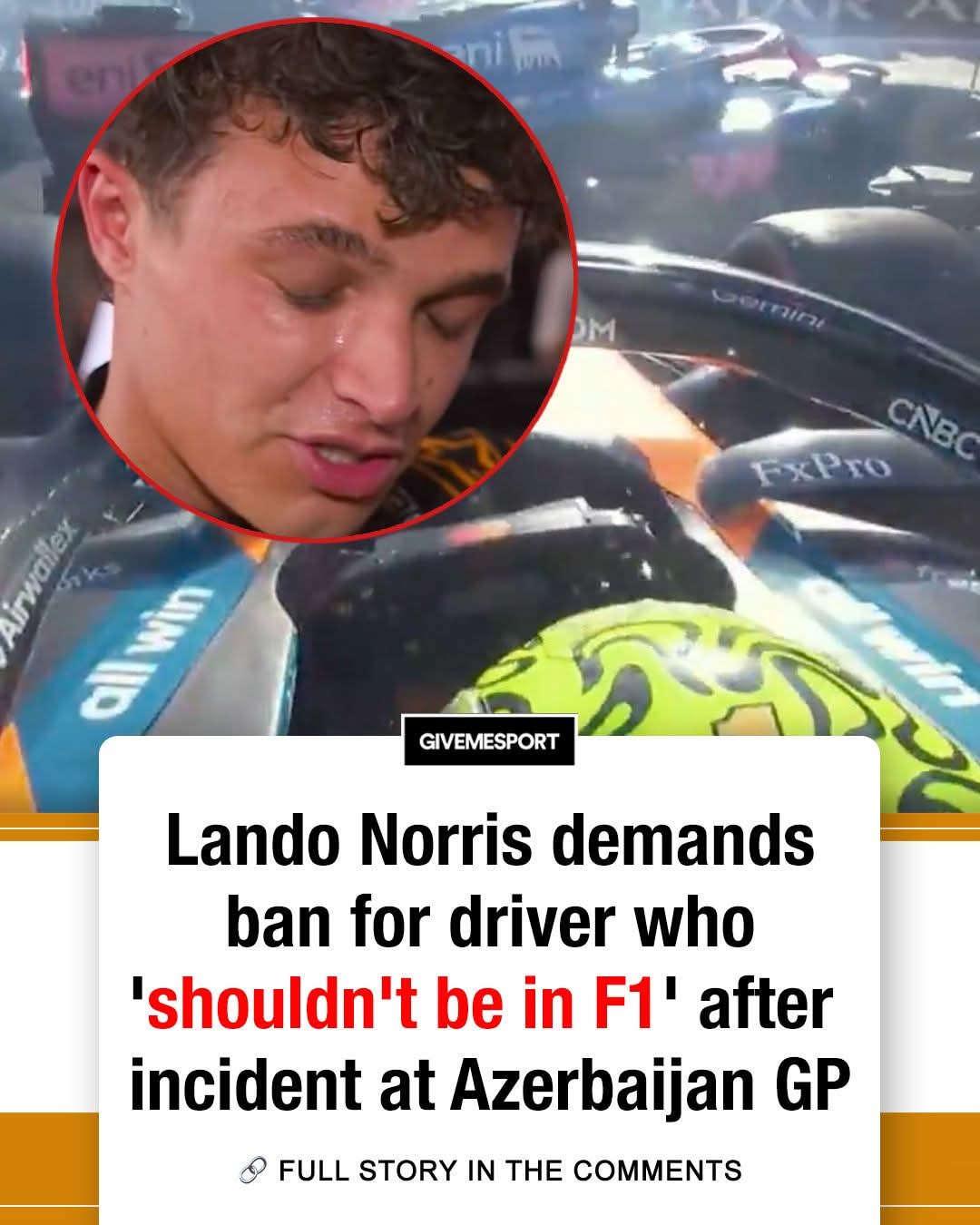
Lando Norris has called for tougher punishment after a dramatic collision at the Azerbaijan Grand Prix ended his race and that of Alpine drivers Franco Colapinto and Pierre Gasly.
The incident happened during a Safety Car restart at Baku’s Turn 1. Colapinto locked up heavily while approaching the corner and lost control of his Alpine, triggering a chain reaction that collected his team-mate Gasly and McLaren’s Norris. All three drivers were forced to retire.
For Norris, the crash was particularly painful because he had been fighting to score valuable championship points before the incident.
The reigning world champion subsequently argued that the FIA should consider race bans for incidents of this nature, saying some drivers were making mistakes that, in his view, should have more serious consequences.
NORRIS WANTS A STRONGER FIA RESPONSE
Norris did not hide his frustration after the race.
Speaking after his retirement, he suggested that the FIA should become stricter and consider handing out race bans for what he described as careless driving.
He also admitted that he had not yet watched a replay of the collision before giving his initial reaction. That is an important detail when assessing his comments, because his view was formed immediately after being eliminated from the race.
Norris ultimately said that he had been taken out and criticised what he regarded as an unacceptable level of driving in Formula 1.
His comments immediately became one of the biggest talking points from the Azerbaijan Grand Prix.
HOW COLAPINTO’S MISTAKE TRIGGERED THE CRASH
The collision occurred immediately after a Safety Car restart.
Colapinto was running inside the top ten and approaching Turn 1 behind the cars ahead. As the field compressed under the restart conditions, he locked the front tyres while braking.
The Alpine failed to slow sufficiently and continued towards the corner.
Colapinto then collided with Gasly, his own team-mate, before the incident also collected Norris’s McLaren.
The consequences were severe.
Gasly and Norris were both forced out of the race, while Colapinto was also unable to continue.
It was especially costly for Alpine because both of its cars had been in position to score points.
COLAPINTO ACCEPTS RESPONSIBILITY
Colapinto did not attempt to shift the blame after the accident.
The Alpine driver immediately acknowledged that he had lost control of the situation and apologised to Gasly, Norris and his team.
His response was significant because there was little ambiguity about his responsibility for the incident.
Colapinto effectively accepted that the mistake came from his own braking error and said he expected the stewards to investigate and penalise him.
That admission came before the FIA stewards delivered their verdict.
FIA HANDS COLAPINTO A FIVE-PLACE GRID PENALTY
The FIA subsequently investigated the collision and handed Colapinto a penalty for the next Formula 1 race.
The initial 10-second penalty was converted into a five-place grid drop for the following Grand Prix because Colapinto had retired from the Azerbaijan race and therefore could not serve the time penalty during the event.
That means the incident will continue to affect Colapinto at the next round.
However, the punishment falls short of the one-race suspension Norris had called for.
This creates an interesting discussion about how Formula 1 should punish major mistakes that eliminate multiple competitors.
WHY NORRIS WAS PARTICULARLY FRUSTRATED
Norris’s frustration was understandable in the context of his own race.
The McLaren driver started fifth on the Azerbaijan grid and was in the leading group early in the event. The official grid placed him behind Russell, Charles Leclerc, Oscar Piastri and Isack Hadjar.
That meant Norris had entered the race with a realistic opportunity to collect a strong points haul.
Instead, his afternoon ended in the Turn 1 crash.
For a driver involved in a championship battle, losing an entire race because of another competitor’s mistake can have consequences well beyond a single afternoon.
THE CHAMPIONSHIP CONSEQUENCES
The incident could prove important in the wider 2026 championship picture.
Norris was the reigning world champion entering the Azerbaijan weekend, making every retirement potentially significant.
Unlike a normal on-track mistake by Norris himself, this retirement came through contact initiated by another driver.
That distinction matters when looking at the sporting consequences.
Norris cannot recover the lost points from Baku, while the championship moves on to the next round regardless of how the incident occurred.
The incident therefore adds another layer of frustration to what was already a difficult race for McLaren.
A DIFFICULT DAY FOR ALPINE TOO
While Norris understandably received much of the attention after the crash, Alpine suffered an equally painful setback.
Gasly had been running in a points-scoring position before being eliminated by his own team-mate.
That meant Alpine effectively lost the opportunity to bring both cars home with points.
For a midfield team, such opportunities can be particularly valuable.
Instead, the team left Baku dealing with the consequences of a restart collision involving both of its drivers.
SHOULD F1 USE RACE BANS MORE OFTEN?
Norris’s comments have reopened a broader debate about penalties in Formula 1.
The sport already has a range of punishments available to stewards, including time penalties, grid penalties, penalty points and, in more serious circumstances, race bans.
The question is where the threshold should be.
A driver making a genuine mistake under difficult race conditions is not necessarily the same as a driver deliberately making dangerous contact.
That distinction is one reason why stewards consider factors such as the circumstances of an incident, the driver’s actions, the consequences and whether the driver could reasonably have avoided the collision.
In Colapinto’s case, the FIA chose a five-place grid penalty rather than a suspension.
WHAT HAPPENS TO COLAPINTO NEXT?
The immediate consequence is clear: Colapinto carries a five-place grid penalty into the next Grand Prix.
That will make his qualifying position even more important.
If he qualifies near the front, the penalty could push him several places down the starting order. If he qualifies further back, the practical effect could be smaller because he would already be starting outside the points-scoring positions.
More importantly, Colapinto will need to respond on track.
His public apology and acceptance of responsibility have already addressed the immediate aftermath, but his next race will provide the opportunity to put the Baku incident behind him.
NORRIS’S MESSAGE GOES BEYOND ONE INCIDENT
Although Norris’s comments were made in the heat of a frustrating retirement, they highlight a larger issue within modern Formula 1.
Drivers are increasingly competing in extremely tight spaces at high speeds, particularly during Safety Car restarts when the entire field is compressed.
A small braking error can therefore have consequences for several cars at once.
Baku demonstrated exactly how quickly such an incident can develop.
One driver lost control into Turn 1, his team-mate was collected, and Norris’s McLaren was caught in the aftermath.
Three drivers went from fighting for points to watching the remainder of the Grand Prix from the garage.
THE BIGGER PICTURE
George Russell ultimately won the Azerbaijan Grand Prix after holding off Max Verstappen, while Isack Hadjar completed the podium.
But behind the fight for victory, the Colapinto-Gasly-Norris collision became one of the defining moments of the race.
For Norris, it was a missed opportunity.
For Gasly and Alpine, it was a costly team-mate collision.
For Colapinto, it became a major reminder of how quickly one braking mistake can affect an entire race—and how seriously the FIA treats incidents that cause multiple retirements.
The FIA has chosen a five-place grid penalty rather than the race ban Norris requested.
Whether that punishment is sufficient will remain a matter of debate among drivers, teams and fans.
What is certain is that Norris’s comments have put the question of stronger penalties firmly back into the Formula 1 conversation.