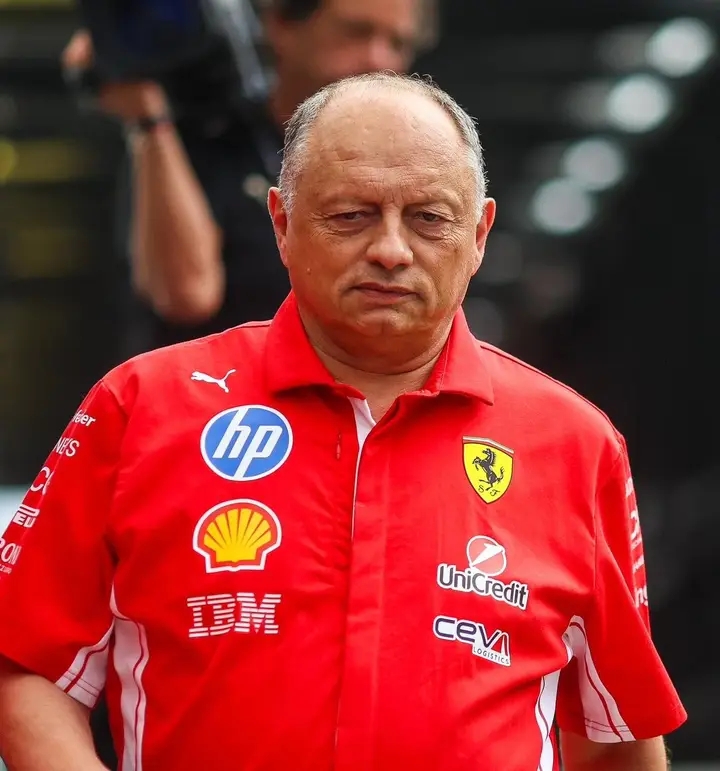
Formula 1 qualifying sessions often end with as much drama in the stewards’ office as they do on track, and the 2026 Austrian Grand Prix was no exception. However, Ferrari team principal Fred Vasseur has made it clear that the Scuderia will accept the FIA’s verdict after George Russell escaped punishment following a late qualifying investigation.
Speaking after the session, Vasseur admitted Ferrari could do little but respect the governing body’s decision.
“The FIA decided no further action. We don’t have access to the data.”
His brief but telling response highlights a reality that Formula 1 teams face every race weekend: while competitors can question decisions, only the FIA has access to all telemetry, video angles, marshalling information, and evidence used by the stewards before reaching a verdict.
WHY RUSSELL WAS INVESTIGATED
George Russell came under scrutiny after qualifying on pole position for the Austrian Grand Prix. Questions were raised over whether he had respected yellow flag procedures during his decisive lap.
Yellow flags are among the strictest regulations in Formula 1. Drivers are expected to demonstrate that they have significantly reduced speed and are prepared to change direction if necessary. Failure to comply usually results in lap deletions or grid penalties.
After reviewing the available evidence, FIA stewards concluded Russell had slowed sufficiently through the affected sector, meaning there was no sporting infringement worthy of further punishment. His pole position therefore remained intact.
FERRARI CHOOSES NOT TO ESCALATE THE SITUATION
Vasseur’s comments suggest Ferrari sees little value in challenging a decision without access to the complete dataset reviewed by officials.
In modern Formula 1, teams receive extensive telemetry from their own cars but not the full collection of information available to race control. The FIA can combine onboard footage, GPS traces, sector timing, marshalling reports and additional telemetry before making a ruling.
By acknowledging this limitation, Vasseur avoided fuelling further controversy while accepting that the governing body had more information than rival teams.
WHAT THIS MEANS FOR THE AUSTRIAN GRAND PRIX
Keeping Russell on pole dramatically changes Sunday’s competitive picture.
Mercedes gains a major opportunity to convert qualifying pace into a race victory, while Ferrari’s Charles Leclerc starts alongside him hoping to capitalize if tyre degradation or race strategy swings in Ferrari’s favour.
Lewis Hamilton also remains firmly in contention after another encouraging qualifying performance, giving Ferrari two cars capable of challenging for a podium if race pace matches expectations.
Meanwhile, Red Bull faces additional pressure after a difficult qualifying session at its home circuit, making the opening laps even more critical.
WHY THE FIA’S DECISION MATTERS
Incidents involving yellow flags always attract enormous attention because consistency is one of the most debated topics in Formula 1.
Drivers, teams and fans expect identical standards regardless of the championship standings or the driver involved. Every investigation becomes another benchmark against which future decisions will be judged.
By deciding there was “no further action,” the FIA effectively stated that Russell met the required safety standard despite the concerns raised after qualifying.
CHAMPIONSHIP IMPLICATIONS
Pole position at the Red Bull Ring is especially valuable because overtaking opportunities, while possible, remain heavily influenced by track position and race strategy.
If Russell converts pole into victory, Mercedes could strengthen its momentum heading into the next phase of the season. Ferrari, meanwhile, needs a strong points haul to stay firmly in the championship battle, making strategy execution and tyre management absolutely vital.
Even if the controversy has ended before the race begins, its outcome could have significant consequences for both the Drivers’ and Constructors’ Championships.
FINAL THOUGHTS
Fred Vasseur’s measured response reflects the pragmatic approach often required in modern Formula 1. Rather than speculate about evidence Ferrari cannot access, he accepted the FIA’s conclusion and shifted focus toward the race itself.
With Russell retaining pole, Ferrari now knows exactly what it must do on Sunday: beat Mercedes on track rather than in the stewards’ room.
The Austrian Grand Prix is now perfectly set up for a fascinating battle, with championship points, momentum and pride all on the line.