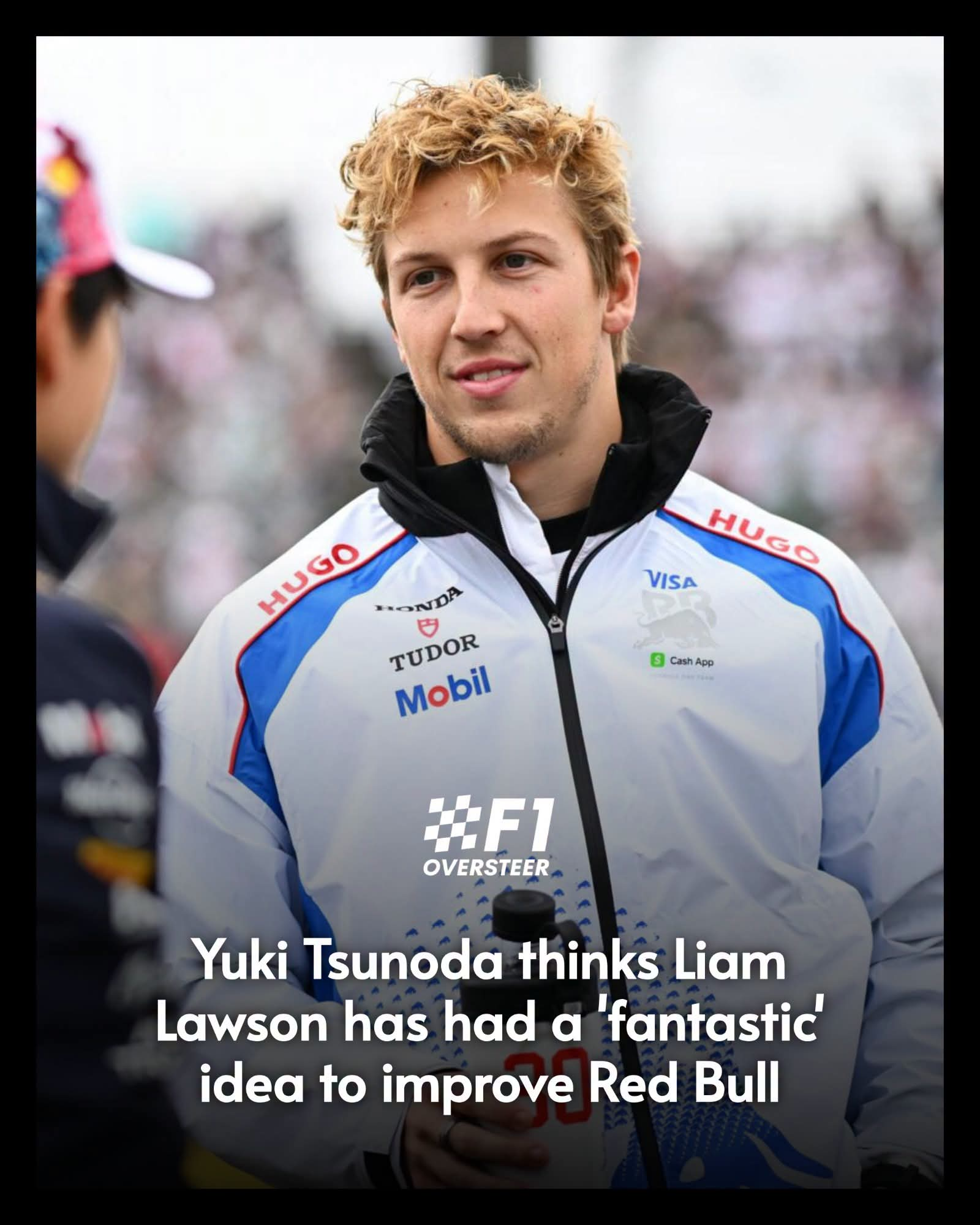
Red Bull could have an important technical lesson to learn from its sister team Racing Bulls after Liam Lawson proposed an approach that Yuki Tsunoda believes could produce a much stronger Formula 1 car.
The discussion centres on a problem that has troubled Red Bull for several seasons: building a car that combines exceptional aerodynamic performance with predictable handling. While Red Bull has often produced machinery capable of winning races, several of Max Verstappen’s teammates have struggled to extract consistent performance from it.
Lawson experienced those difficulties firsthand after moving to Red Bull early in the season. His return to Racing Bulls highlighted the contrast between the two cars, reinforcing the argument that outright speed means little if a driver cannot confidently push the machinery to its limits.
TSUNODA BELIEVES RED BULL COULD BENEFIT FROM LAWSON’S IDEA
Lawson believes both cars have strengths that could be combined to create a more competitive package. Speaking in Singapore, he explained that each concept had advantages and weaknesses, suggesting that bringing their best characteristics together could produce a very fast racing car.
Tsunoda, who has experience driving for both teams, agreed with the basic principle. Speaking to Fuji Television, he described the proposed combination as an attractive possibility, particularly if Red Bull could retain its aerodynamic efficiency while improving the car’s overall balance.
The idea is straightforward: Racing Bulls’ more manageable handling characteristics could complement Red Bull’s ability to generate performance efficiently. If engineers could achieve that balance, the resulting car might allow drivers to attack corners more confidently without sacrificing too much speed on the straights.
However, combining those qualities is far easier to describe than to achieve. Aerodynamic performance, mechanical grip, tyre behaviour and driver confidence are interconnected, meaning improvements in one area can sometimes create compromises elsewhere.
WHY RED BULL’S SECOND CAR HAS BEEN A MAJOR CHALLENGE
Red Bull’s difficulty has not necessarily been a lack of performance from its leading car. The bigger concern has been how consistently its second driver can extract that performance.
Drivers including Sergio Perez, Lawson and Tsunoda encountered difficulties adapting to the car during the ground-effect era. Verstappen, meanwhile, was often able to operate closer to its limits, making the difference between the two sides of the garage particularly noticeable.
The contrast with Racing Bulls has been significant. The sister team has generally placed greater emphasis on making its machinery predictable and easier to drive, even if that approach can involve compromises in outright performance.
Isack Hadjar’s results have provided encouragement for Red Bull’s wider driver programme. According to the figures cited in the original report, Hadjar had scored 105 points despite missing three races, while Red Bull’s second car collected only 30 points during the 2025 season.
Those numbers underline the importance of giving drivers a car in which they can perform consistently. A theoretically faster machine is not necessarily more effective across a championship if its handling characteristics make it difficult for the driver to approach its limits.
RED BULL CANNOT SIMPLY COPY RACING BULLS’ AERODYNAMIC IDEAS
Despite their close relationship, Red Bull Racing and Racing Bulls are required to operate as separate competitors under Formula 1 regulations. They cannot simply exchange aerodynamic designs or transfer technical concepts without restrictions.
That makes Lawson’s suggestion more complicated than combining two sets of car parts. Engineers would need to understand which characteristics deliver the strongest results and develop their own solutions within the rules.
Nevertheless, the relationship between the teams could still offer organisational advantages. The original report notes that Red Bull signed Andrea Landi, Racing Bulls’ deputy technical director, earlier in the year. Landi’s experience could be valuable as Red Bull continues to examine how its technical approach might evolve.
His appointment does not guarantee that Racing Bulls’ handling philosophy will be replicated at Red Bull. However, experience gained across the two organisations could help engineers better understand why one car feels more predictable than the other.
MAX VERSTAPPEN COULD BENEFIT IF RED BULL FINDS THE RIGHT BALANCE
For Verstappen, a more balanced car could offer an opportunity to remain competitive while making the package less difficult for his teammate to drive. Better consistency could also help Red Bull collect more points across both cars, strengthening its position in the constructors’ championship.
The challenge is finding a solution that improves drivability without sacrificing the aerodynamic efficiency that has made Red Bull competitive. Too much emphasis on one characteristic could undermine another, particularly when the car must perform across circuits with very different cornering and straight-line demands.
Tsunoda’s support for Lawson’s idea is therefore less a claim that a simple fix exists and more an acknowledgement of the technical challenge facing both teams. Racing Bulls’ experience suggests that predictable handling has real value, while Red Bull’s approach demonstrates the importance of aerodynamic efficiency.
If Red Bull can bring those qualities together, it could create a more versatile car and reduce the performance gap between its drivers. For now, however, the proposal remains a technical direction worth exploring rather than a confirmed development plan.
The central question is whether Red Bull can deliver a car that is both fast and forgiving enough for its drivers to exploit consistently. Lawson has highlighted the possibility, and Tsunoda believes the concept makes sense. Turning that idea into measurable performance will be the real test.