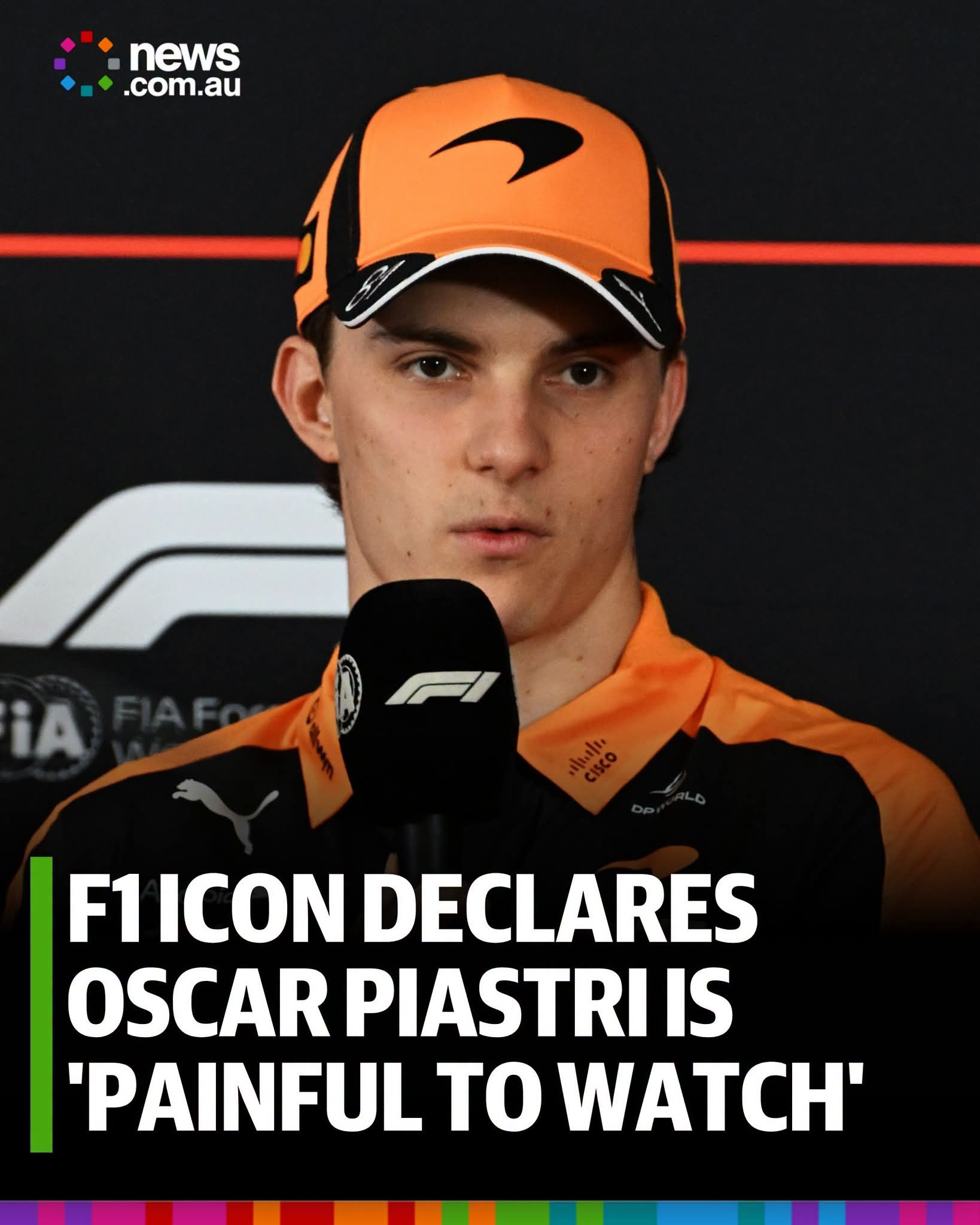
Oscar Piastri’s difficult 2026 Formula 1 campaign has taken another painful turn, with respected F1 commentator Martin Brundle admitting that watching the Australian struggle has become “painful to watch.” After expecting Piastri to recover from his early-season difficulties, Brundle’s latest assessment suggests the McLaren driver still faces a major challenge adapting to Formula 1’s new-generation cars.
Piastri’s latest disappointment came at the United States Grand Prix at the Circuit of the Americas, where he started seventh and finished in the same position. While teammate Lando Norris remained competitive, Piastri struggled to match his pace and ended the race more than 50 seconds behind winner Kimi Antonelli. The result extended his run without a podium finish to 15 races, a worrying statistic for a driver who was a leading championship contender last season.
MARTIN BRUNDLE QUESTIONS PIASTRI’S STRUGGLES
Writing in his Sky Sports F1 column, Brundle highlighted the contrast between Piastri’s previous performances and his current difficulties. He pointed to the Australian’s lack of front-running pace and the significant gap to the race winner as evidence of how far he has fallen behind the leading drivers.
“Oscar simply can’t seem to gel with the 2026 cars,” Brundle wrote, describing the situation as painful to witness after Piastri’s impressive run in 2025.
The comments carry weight because Brundle had previously expressed optimism that Piastri could turn his season around. His latest assessment suggests that the problem has persisted longer than expected, with no clear breakthrough yet appearing on race weekends.
However, the criticism does not necessarily mean Piastri has lost his ability. Formula 1’s new technical regulations have changed how drivers extract performance from their cars, and adapting to those changes can affect competitors in different ways. The challenge for Piastri is to find a reliable approach that allows him to compete consistently with Norris and the other frontrunners.
MCLAREN TEAM ORDERS ADD TO THE PRESSURE
Piastri’s United States Grand Prix also featured an uncomfortable moment when McLaren instructed him to let Norris pass.
Norris had complained over team radio that he was being held up behind his teammate while attempting to close the gap to the car ahead. The team subsequently told Piastri that Norris was running a different strategy, and the Australian moved aside.
Although team orders can be a normal part of Formula 1 strategy, the incident was another difficult moment for Piastri during a season in which he has struggled to demonstrate his usual pace. Allowing Norris through also highlighted the performance difference between the two McLaren drivers on that particular afternoon.
Piastri eventually finished more than 20 seconds behind Norris, according to the report. For a driver who was previously competing closely with his teammate, the growing gap is becoming one of the most concerning aspects of his campaign.
The situation also creates a strategic dilemma for McLaren. The team must balance its constructors’ championship ambitions with the need to help Piastri recover his confidence and form. If Norris continues to deliver stronger results, McLaren may increasingly need to prioritise immediate race opportunities while working to understand why Piastri is struggling.
WHY THE 2026 CARS ARE CAUSING PIASTRI PROBLEMS
Piastri’s struggles appear to be connected to the characteristics of the 2026 cars and how they respond to his preferred driving style. The Australian has traditionally performed well when he can rely on smooth inputs and predictable behaviour, but those strengths have not consistently translated into results under the new regulations.
The reduction in aerodynamic downforce, estimated in the report at around 30 per cent, has changed the demands placed on drivers. With less downforce available, managing grip, braking and corner entry becomes even more important, and techniques that previously worked well may no longer deliver the same results.
Piastri has acknowledged that adapting has been difficult. He explained that some of the driving habits that helped him succeed last season have become weaknesses in certain situations this year.
“We’ve been trying some things,” he said, adding that adapting himself to the car had required considerable work. He also admitted that moving away from techniques he had trusted for a long time presented a mental challenge.
Despite the difficulties, Piastri believes progress is being made. He said the car was beginning to feel more comfortable, although he acknowledged that there was still significant room for improvement.
That admission offers some encouragement, but McLaren will need to turn those incremental gains into stronger qualifying performances and race results if Piastri is to stop the decline.
THE CHAMPIONSHIP GAP IS BECOMING A MAJOR CONCERN
The scale of Piastri’s downturn becomes clearer when comparing his current position with last season. According to the report, he now trails Norris by 67 points in the drivers’ standings, having finished last year just 13 points behind his teammate.
That reversal highlights how dramatically the competitive picture has changed. Rather than fighting Norris for championship honours, Piastri is now attempting to rediscover the consistency that previously made him one of McLaren’s strongest performers.
Meanwhile, Mercedes driver Kimi Antonelli has emerged as a major force in the championship, with his United States Grand Prix victory further strengthening his position. As rival teams continue to collect important points, every difficult weekend makes Piastri’s recovery more urgent.
The upcoming Mexican Grand Prix will provide another opportunity for the Australian to demonstrate progress. However, the high-altitude conditions at the Autódromo Hermanos Rodríguez create their own technical challenges, meaning McLaren must ensure its setup works effectively for both drivers.
CAN PIASTRI SILENCE HIS CRITICS BEFORE THE SEASON ENDS?
Piastri’s immediate priority is not to respond to every criticism but to understand why his performance has dropped and find a solution with McLaren’s engineers. The team has the data, technical resources and experience needed to investigate the problem, but identifying the right changes may take time.
Brundle’s comments underline the growing frustration surrounding Piastri’s season. The Australian entered 2026 with expectations shaped by his previous performances, yet his prolonged podium drought has made it increasingly difficult to defend his current form.
Still, writing him off completely would be premature. His struggles have come amid a major regulatory change, and his own comments suggest that he is continuing to work on both his driving approach and his relationship with the car.
The crucial test will be whether that work produces measurable improvements over the remaining races. A stronger qualifying result, improved race pace and a closer finish to Norris would help rebuild confidence and challenge the growing perception that Piastri cannot adapt to the new machinery.
For McLaren, the situation is equally important. Helping Piastri recover could strengthen the team’s overall performance, while leaving the problem unresolved risks allowing a talented driver’s difficult season to become an even bigger story.
Brundle has made his frustration clear. Now Piastri must find a response on the track. With the Mexican Grand Prix approaching, the pressure is mounting for the Australian to show that his 2026 campaign can still be rescued.