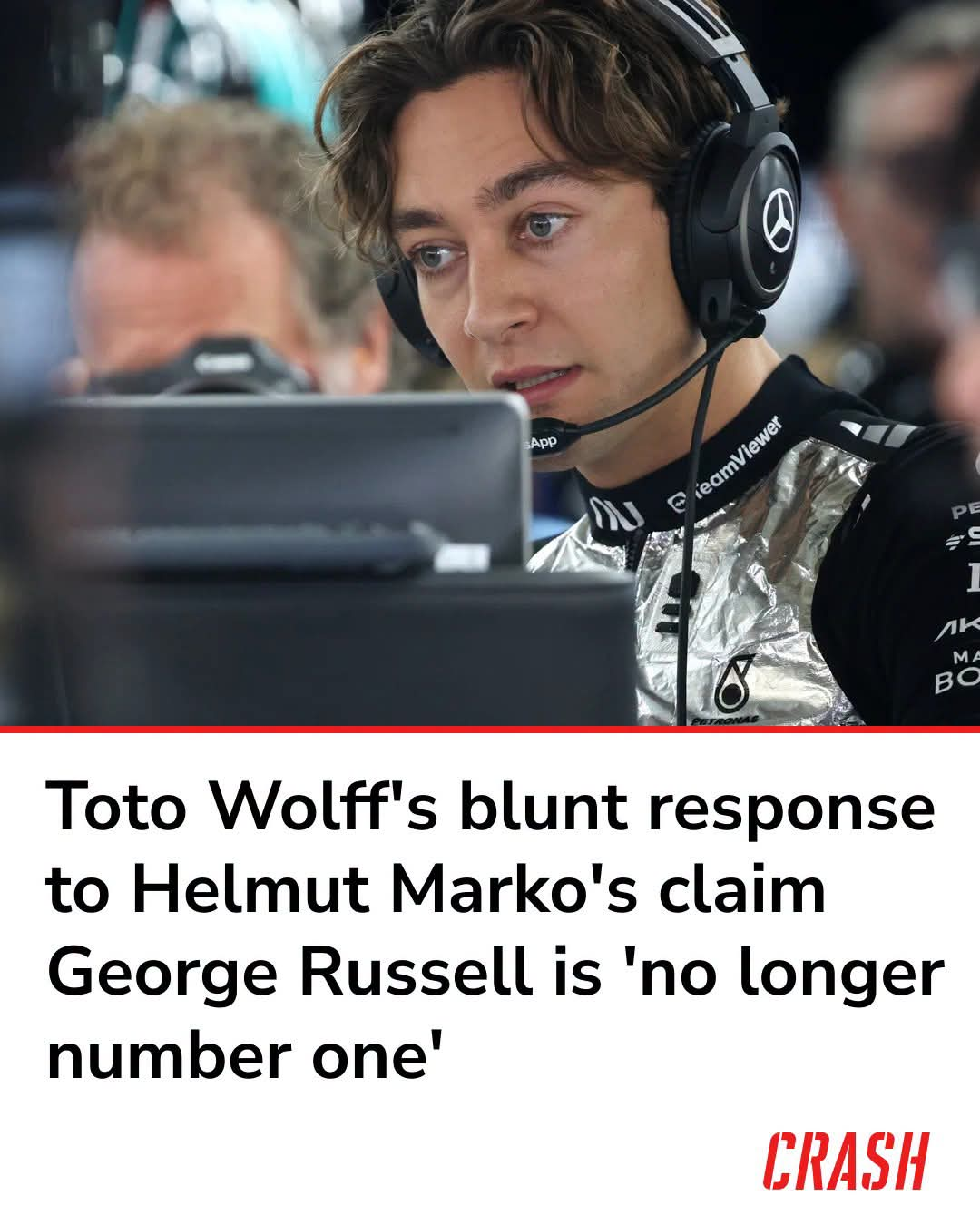
Mercedes team principal Toto Wolff has firmly rejected former Red Bull advisor Helmut Marko’s suggestion that George Russell’s Formula 1 title hopes are effectively finished. The comments came in the aftermath of the 2026 United States Grand Prix in Austin, where young teammate Kimi Antonelli claimed another victory while Russell struggled to eighth.
Marko, speaking to Sky Germany ahead of the race, delivered a stark assessment. He argued that Russell is no longer Mercedes’ number-one driver after being comprehensively outperformed by the 20-year-old Italian this season. Antonelli has taken nine wins to Russell’s three, turning what many expected to be Russell’s breakthrough championship year into a one-sided affair. Marko went further, expressing doubt that Russell would ever again receive a genuine shot at the world title or clear number-one status at any team.
Wolff’s response was measured but decisive. “He’s my Austrian not so buddy, but I respect his opinion. But I think he’s wrong on George,” the Mercedes boss told reporters. “George has all the ability. I think the car doesn’t suit him.”
WHY THE CAR, NOT THE DRIVER, IS THE REAL ISSUE ACCORDING TO WOLFF
Wolff pointed to a specific mismatch between Russell’s driving style and the characteristics of the current Mercedes package under the new 2026 regulations. He noted the psychological challenge Russell faced early in the season. Having entered the year as the clear favourite after outperforming Antonelli in 2025, Russell then watched a “wunderkind” steadily erode his advantage from the other side of the garage.
That mental load, combined with a car that appears to favour Antonelli’s approach, has produced inconsistent results for the Briton. Yet Wolff insisted the underlying talent remains intact. He highlighted Russell’s dominant junior career — consecutive titles in Formula 3 and Formula 2 as a rookie, plus back-to-back European karting championships — as proof that the core ability has not vanished.
“In a new season, if we provide him with a quick car, it’s absolutely possible. He has what it takes to win a championship,” Wolff said. “It’s a bit too easy to say let’s forget all those years… That’s still there.”
THE BIGGER PICTURE FOR MERCEDES AND THE 2026 TITLE FIGHT
Antonelli now sits on the brink of the championship. He needs just two points from the final five races to seal the title, making the mathematical possibility for Russell largely academic. The Italian’s rise has been one of the defining stories of the season, transforming Mercedes’ internal dynamics in a single campaign.
This situation carries significant implications. For Russell, a driver long viewed as a future champion after years of near-misses and strong performances alongside Lewis Hamilton, the narrative has shifted from expected successor to teammate under pressure. For Mercedes, the challenge is clear: extract the best from both drivers while developing a car that does not so heavily favour one style over the other.
Wolff’s public backing matters. In Formula 1, team principals’ words shape driver confidence, market value, and future negotiations. By refusing to write Russell off and framing the problem as largely car-related, Wolff protects his driver’s standing and signals that the Briton remains central to the team’s plans beyond 2026.
WHAT THIS MEANS FOR THE WIDER GRID AND FUTURE SEASONS
Marko’s comments reflect a broader paddock conversation about how quickly hierarchies can change under new regulations. The 2026 rules have reshaped the competitive order, and drivers who adapted fastest — or whose styles matched the new cars most naturally — have pulled ahead. Antonelli’s success raises questions about experience versus raw adaptability in the current era.
Russell’s situation also highlights the mental demands of modern Formula 1. Starting a season as favourite only to watch a younger teammate take control is a rare and intense test. Wolff’s recognition of that difficulty humanises the challenge without excusing the results.
Looking ahead, the next regulation cycle or even a refined 2027 package could reset the balance. History shows that drivers written off too early often return stronger once the machinery aligns with their strengths. Wolff is clearly betting on that possibility for Russell.
The Austrian pair’s exchange also adds another layer to the long-running, sometimes prickly relationship between Wolff and Marko. Calling him a “not so buddy” while still respecting the opinion is classic Wolff — diplomatic on the surface, firm underneath.
RUSSELL’S PATH FORWARD AND THE STAKES FOR EVERYONE INVOLVED
For Russell, the remaining races offer a chance to rebuild momentum and demonstrate the qualities that once made him the bookmakers’ pick. Strong performances in the final rounds could quiet some of the external noise and reinforce Wolff’s public confidence.
For Mercedes, the dual challenge is maximising the constructors’ position while managing two highly talented drivers whose results have diverged sharply. For the championship picture, Antonelli’s near-certainty of the title marks a remarkable achievement for a driver still early in his F1 career.
Wolff’s rejection of Marko’s verdict is more than defensive spin. It is a statement of belief in Russell’s long-term potential and a reminder that one difficult season under new regulations does not define a driver’s ceiling. In a sport that moves as quickly as Formula 1, that kind of institutional support can prove decisive when the next opportunity arrives.
The coming months will test whether Mercedes can deliver a car that unlocks Russell’s full ability again. If they do, Marko’s doubts may prove premature. If not, the conversation about Russell’s future will only intensify. For now, Wolff has drawn a clear line: the talent is still there, and the story is far from over.